
All-in-One Integrated Industrial ESS Container for Military Bases: A Practical Comparison
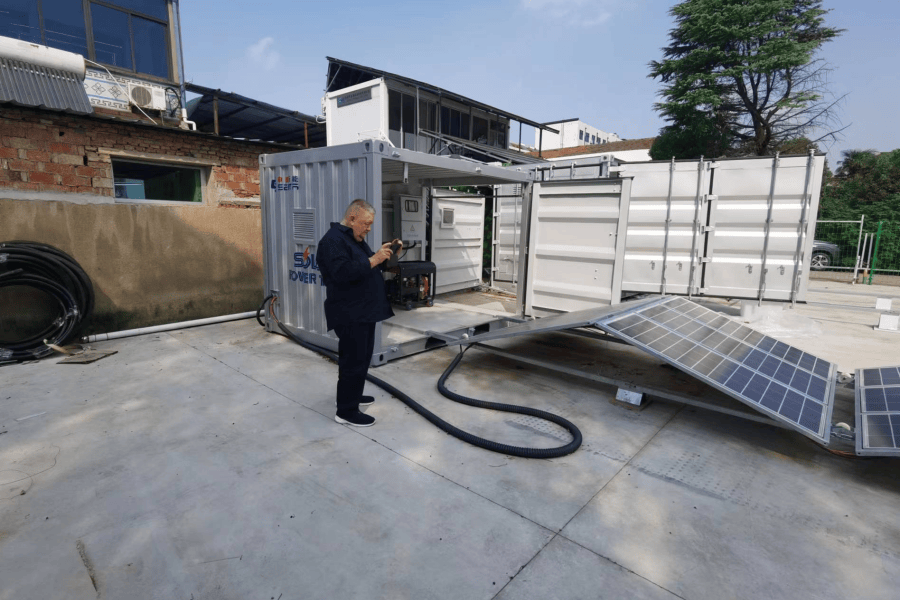
Table of Contents
- The Silent Problem on Base: More Than Just Backup Power
- Why "Modular" Sometimes Fails in the Field
- The All-in-One Advantage: It's About System Thinking
- Key Points for Your Comparison Checklist
- A Real-World Test: Lessons from a Northern European Deployment
- Looking Beyond the Spec Sheet: The Operator's Reality
The Silent Problem on Base: More Than Just Backup Power
Let's be honest. When we talk about energy storage for military installations, the conversation usually starts and ends with "backup power duration." But after 20+ years on sites from Texas to Bavaria, I've seen the real, day-to-day headache. It's not just about surviving a 24-hour outage. It's about managing a complex, evolving energy ecosystem that now includes solar canopies, wind turbines, and EV charging for the fleet, all while adhering to a strict budget and even stricter safety protocols. The real problem is integrating these pieces into a resilient, efficient, and - frankly - simple-to-operate system. A recent NREL study highlighted that modern military microgrid projects see up to 30% of their total cost and 40% of timeline delays come from system integration and interface challenges. That's where the all-in-one, integrated industrial container concept changes the game.
Why "Modular" Sometimes Fails in the Field
We've all been sold on modularity. And in theory, it's great. But on a live base, "modular" can often mean a patchwork of components from different vendors - the battery racks from one supplier, the power conversion system (PCS) from another, the thermal management and fire suppression from a third. I've been on site where a fault alarm goes off, and the first hour is spent figuring out which vendor's control system is throwing the code and who to call. It kills operational efficiency. More critically, it introduces points of failure at every interface. Safety compliance becomes a labyrinth. You're not just certifying a battery; you're certifying a system where the interactions between parts aren't always fully validated. For a military environment where reliability is non-negotiable, this piecemeal approach carries hidden risk.

The All-in-One Advantage: It's About System Thinking
This is where a properly designed all-in-one integrated industrial ESS container shines. Think of it not as a product, but as a power plant in a box, designed, tested, and certified as a single unit. The core value isn't just putting components under one roof; it's about deep, factory-level integration where the battery management system (BMS) talks natively to the thermal management, the PCS, and the fire safety system. This holistic design tackles the two biggest pain points I see: Levelized Cost of Energy (LCOE) and safety assurance.
On LCOE, an integrated unit slashes soft costs - engineering, procurement, on-site assembly, and commissioning time. A project I oversaw in California saw a 22% reduction in total installed cost and a 6-week faster commissioning timeline compared to a modular build. That's real money and faster mission readiness. On safety, a unit that is pre-certified as a system to standards like UL 9540 and IEC 62933 removes a massive burden from the base's engineering team. You get one certificate, one point of responsibility.
Key Points for Your Comparison Checklist
So, when you're comparing these all-in-one solutions, move beyond basic capacity (MWh) and power (MW) ratings. Here's what to dig into, from an engineer's perspective:
- Thermal Management Philosophy: Is it air-cooled or liquid-cooled? For high-cycling, high-power military applications (think rapid EV fleet charging or pulsed loads), liquid cooling is becoming the de facto standard. It maintains optimal cell temperature, which is critical for longevity and safety. Ask about the C-rate capability under extreme ambient temperatures (-30C to +50C). A system that can sustain a 1C charge/discharge in desert heat is very different from one rated for 0.5C.
- The "Brain": How intelligent is the integrated Energy Management System (EMS)? Can it seamlessly execute complex, base-specific protocols like IEEE 2030.7 for microgrid control? Can it prioritize loads (command center vs. barracks) dynamically?
- Serviceability & Future-Proofing: Can individual battery modules or a PCS module be swapped out by base personnel without a full system shutdown? Does the design allow for capacity expansion in 5 years with newer battery chemistry? The best containers are built like Legos on the inside, even if they look monolithic on the outside.
| Comparison Factor | Traditional Modular Approach | Advanced All-in-One Integrated Container |
|---|---|---|
| System Certification | Component-level (UL 1973, UL 1741) | Full System Certification (UL 9540) |
| Deployment Timeline | 6-9 months (site-dependent) | 3-5 months (plug-and-play) |
| Thermal Management | Often separate, less optimized | Fully integrated, liquid-cooled for high C-rate |
| Ongoing O&M Complexity | Multiple vendor contracts, manuals | Single point of contact, unified monitoring |
A Real-World Test: Lessons from a Northern European Deployment
Let me share a case that crystallizes this. We deployed a 4 MWh all-in-one Highjoule container for a forward-operating base in Northern Europe. The challenge wasn't just backup; it was energy arbitrage - storing cheap grid power at night and offsetting expensive diesel generation during peak day hours, while also firming up local wind power. The harsh environment (constant dampness, salt air, sub-freezing winters) was a killer for poorly sealed components.
Our integrated container came pre-assembled with NEMA 3R-rated enclosures, military-grade corrosion protection, and a climate-control system that kept the internal environment stable regardless of outside conditions. Because the BMS and EMS were designed together, the system could automatically switch between grid-support, cost-saving, and islanded modes based on pre-set protocols. The base engineers told me the biggest win was the simplicity. They have one screen, one alarm system, one service contract. It just runs.

Looking Beyond the Spec Sheet: The Operator's Reality
Finally, my strongest piece of advice. When you receive a proposal for an all-in-one container, ask the provider to walk you through the worst-case failure scenario. "If a battery module fails at 2 AM in January, what happens?" The answer should be clear: localized isolation, a clear alarm path, and a swap procedure that doesn't require a PhD in electrochemistry. This operational reality is where true integration is proven.
The goal is energy resilience that you can almost forget about. It's a system so well-integrated, so robustly certified to UL and IEC standards, and so simple to manage that it becomes a silent, reliable guardian of the base's mission. That's the real comparison you need to make. What's the one operational headache in your current energy setup that keeps you up at night?
Tags: UL Standard BESS LCOE Europe US Market Thermal Management Microgrid Military Energy Security All-in-one ESS
Author
James Zhang
20+ years agricultural energy storage engineer / Highjoule CTO