
Rapid Deployment BESS Containers: The New Standard for Data Center Backup
Beyond the Generator: Why Rapid Deployment BESS Containers Are Redefining Data Center Resilience
Honestly, if I had a dollar for every time I've stood on a data center site, listening to the hum of diesel generators during a test, and thought, "There has to be a better way," I'd be writing this from my private island. For decades, the default for backup power has been diesel gensets. They're loud, they're polluting, and their fuel supply chain is a constant operational headache. But the real shift I'm seeing firsthand, from Silicon Valley to Frankfurt, isn't just about replacing diesel. It's about rethinking the entire rapid deployment energy storage container for data center backup power paradigm. It's not just backup; it's a strategic, revenue-generating asset. Let's talk about why the comparison is no longer close.
Quick Navigation
- The Real Problem: More Than Just a Power Blip
- Why "Rapid Deployment" Isn't Just a Marketing Term
- The Critical Comparison: Containerized BESS vs. Traditional Build
- A Case in Point: The Frankfurt FinTech Fix
- Expert Insight: Decoding the Specs That Matter
- The Future is Modular and Connected
The Real Problem: More Than Just a Power Blip
The pain point for data center operators has evolved. It's no longer just about surviving a 30-second outage until the gensets kick in. The challenges are now multi-layered:
- Space & Scalability: Urban data centers are land-constrained. Building a traditional battery room (BESS) requires significant upfront civil work, permits, and space you often don't have. How do you scale power capacity when a new client comes onboard?
- Speed to Market: In this industry, time is literally money. A 12-18 month lead time for a custom-built battery system is unacceptable when you need to commission a new hall in six months.
- Total Cost of Ownership (TCO): It's not just the capex. It's the ongoing maintenance, the lost opportunity cost of unused space, and the sheer operational complexity of managing a disparate system. The National Renewable Energy Lab (NREL) consistently highlights that system integration and soft costs are major hurdles.
- Grid Services & Sustainability Goals: A backup system that sits idle 99.9% of the time is a stranded asset. Meanwhile, executives are under immense pressure to meet aggressive ESG targets. That diesel genset isn't helping the corporate sustainability report.
Why "Rapid Deployment" Isn't Just a Marketing Term
When we at Highjoule talk about "rapid deployment," we're talking about a fundamental shift in project execution. I've managed both types: the traditional pour-concrete-and-wire-everything-on-site method, and the containerized approach. The difference is night and day.
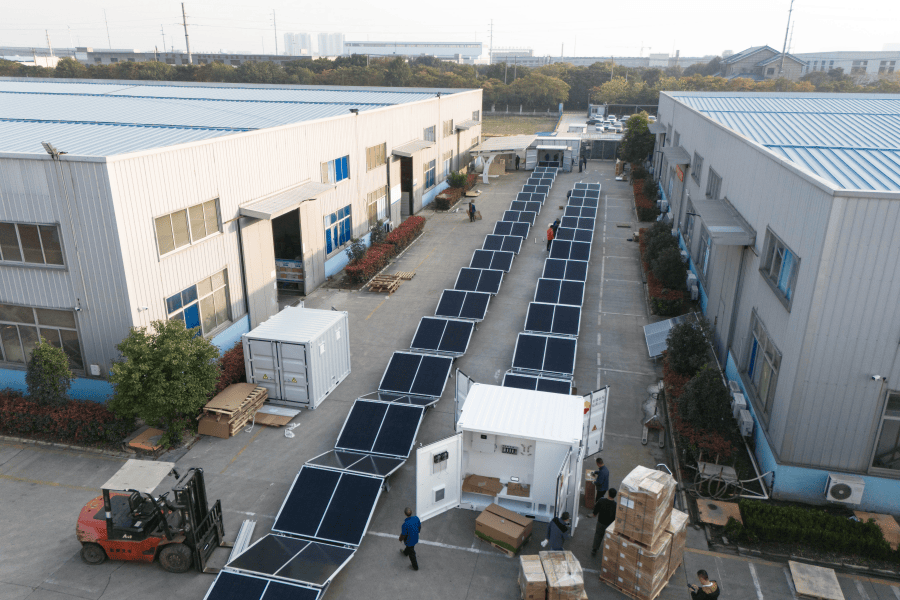
A true rapid deployment containerized BESS is engineered, assembled, and tested in a controlled factory environment. Think of it like a hyperscale data center module. By the time it arrives on your site, it's a plug-and-play asset. We're talking about commissioning timelines slashed from over a year to under 90 days. This speed directly translates to faster revenue generation for your data center and unparalleled agility in responding to load growth or new service offerings.
The Critical Comparison: Containerized BESS vs. Traditional Build
Let's break down the comparison of rapid deployment energy storage container for data center backup power against the old way. It's not just about the box itself; it's about what's inside and how it integrates.
| Consideration | Traditional Built-In-Site BESS | Rapid Deployment Containerized BESS |
|---|---|---|
| Deployment Time | 12-18+ months | 3-6 months (Site work to commissioning) |
| Scalability | Difficult, requires new construction | Modular. Add another container as needed. |
| Safety & Compliance | System certified on-site; variable quality. | Unit pre-certified to UL 9540, IEC 62933 in factory. Consistent, auditable. |
| Thermal Management | Custom-designed for each room, complex integration. | Self-contained, liquid-cooled or advanced air-cooled system, optimized and tested as one unit. |
| Site Footprint | Large, fixed room footprint. | Compact, can be placed on slab or rooftop. |
| Financial Flexibility | High upfront Capex. | Often lower Capex, clear TCO. Can be leased or financed as a distinct asset. |
The key isn't just that one is faster. It's that the containerized approach de-risks the project. Factory testing means we catch and solve problems in a controlled environment, not on your critical path schedule. Having a single vendor responsible for the entire, integrated power block - battery racks, BMS, PCS, thermal management, fire suppression - simplifies everything from procurement to warranty support.
A Case in Point: The Frankfurt FinTech Fix
Let me give you a real example. We worked with a financial technology data center in Frankfurt. Their challenge was classic: they needed to add 2 MW / 4 MWh of backup capacity to support a new high-frequency trading client, but their existing infrastructure space was maxed out. The local grid authority also had new regulations on permissible generator runtimes.
A traditional build was quoted at 14 months. They didn't have 14 months. Our solution was two 1 MW/2 MWh Highjoule PowerBlock containers. These units are pre-certified to VDE-AR-E 2510-50 (the critical German standard for stationary storage) and UL 9540.

The site prep was minimal: two reinforced concrete pads. The containers were shipped, connected to the medium-voltage switchgear, and commissioned in 11 weeks. But here's the strategic win: they didn't just get backup. The system is configured for peak shaving, reducing their demand charges daily. During grid stress events, they can participate in Germany's balancing market, creating a new revenue stream. That's the modern rapid deployment energy storage container for data center backup power - a multi-tool, not a one-trick pony.
Expert Insight: Decoding the Specs That Matter
When you're comparing containers, don't just look at the MW and MWh numbers. As an engineer who has to ensure these systems run for 15+ years, here's what I drill into:
- C-rate and Discharge Duration: This tells you the battery's "athleticism." A 1C rate means the battery can discharge its full energy capacity in 1 hour. For backup, you often need high power (a high C-rate) to support the massive inrush current of all your servers spinning up simultaneously. But for energy arbitrage, you want a slower, deeper discharge. The best containers offer flexible C-rate configurations.
- Thermal Management (The Silent Hero): This is the number one factor for longevity and safety. I've seen systems fail because of poor thermal design. Liquid cooling is becoming the gold standard for high-density containers because it maintains optimal cell temperature uniformly, dramatically extending life and preventing thermal runaway propagation. Ask your vendor about their cooling strategy and temperature delta across the rack.
- Levelized Cost of Storage (LCOS): This is your true north metric. It factors in capex, opex, efficiency losses, cycle life, and degradation. A slightly cheaper container with poor thermal management will have a much higher LCOS because it degrades faster. According to analysis by the International Renewable Energy Agency (IRENA), system design and cycling patterns are pivotal in minimizing LCOS.
At Highjoule, our design philosophy is to optimize the entire system for the lowest possible LCOS, not just the lowest sticker price. That means investing in superior thermal management and using a battery chemistry (like LFP) that we know from two decades of field data offers the best balance of safety, life, and cost for this application.
The Future is Modular and Connected
The conversation is moving beyond simple backup. The winning data centers are those building resilient microgrids. A rapid deployment energy storage container is the perfect building block for this. It can integrate seamlessly with on-site solar, accept grid signals for demand response, and form the heartbeat of a self-healing electrical infrastructure.
The comparison is clear. The question for data center operators and executives isn't really "Should we consider a containerized BESS?" anymore. It's "How quickly can we deploy one, and how many value streams can we unlock?" Your backup power system is ready to graduate from an insurance cost to a grid partner and a profit center. What's the first application you'd tackle?
Tags: Energy Storage Container UL Standard BESS Rapid Deployment US Market Europe Market Data Center Backup Microgrid
Author
James Zhang
20+ years agricultural energy storage engineer / Highjoule CTO