
Scalable Modular 5MWh BESS for Military Base Energy Security & Cost Savings
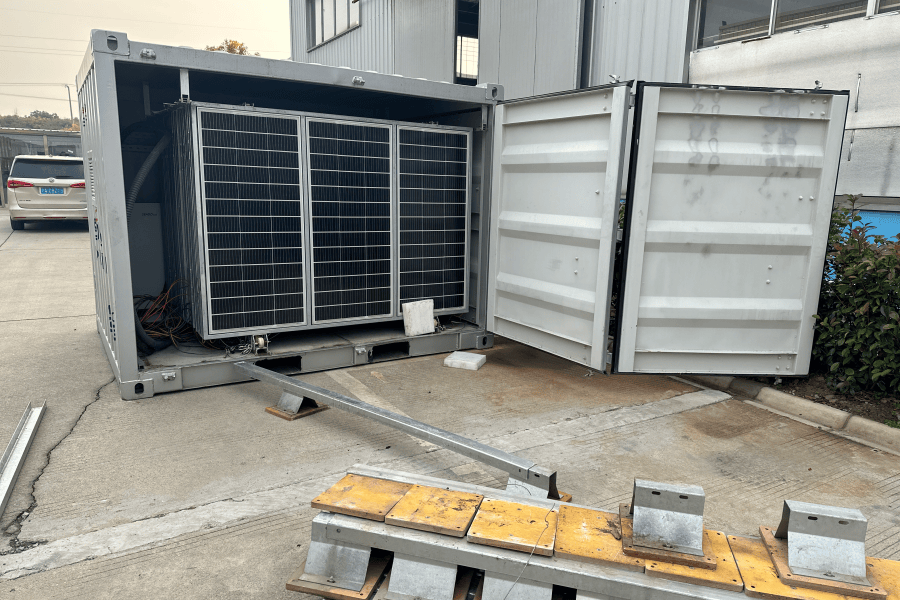
Table of Contents
- The Quiet Problem on Base: Inflexible Power & Spiking Costs
- Why "Scalable Modular" Isn't Just a Buzzword for Military Sites
- Safety: The Non-Negotiable in Every 5MWh BESS Comparison
- Beyond Capex: The Real Cost Metric for Your 20-Year Project
- A Case in Point: From Blueprint to Resilient Microgrid
- Your Next Steps: Questions to Ask Your BESS Vendor
The Quiet Problem on Base: Inflexible Power & Spiking Costs
Let's be honest. When we talk about energy on military installations, the conversation usually starts with one word: resilience. It's the top-line requirement, and rightfully so. But after two decades on sites from California to Bavaria, I've seen the real, day-to-day struggle that often gets buried in the RFP. It's the tension between that critical need for "always-on" power and the brutal reality of budget cycles, aging infrastructure, and frankly, energy bills that can be as unpredictable as the weather.
You're dealing with a load profile that's anything but typical. One minute it's steady-state operations; the next, you're ramping up for a high-intensity training exercise or a mission-critical computing load. The traditional grid connection - and even some older, monolithic storage systems - struggle with that kind of swing. They're either overbuilt (and sitting idle, costing you capital) or underbuilt (and risking brownouts). The financial pain is real. According to a National Renewable Energy Laboratory (NREL) analysis, commercial and institutional customers, including government facilities, often face demand charges that can make up 30-70% of their total electricity bill. A sudden spike in power demand during a peak grid period isn't just an operational headache; it's a direct hit to your budget.
Why "Scalable Modular" Isn't Just a Buzzword for Military Sites
This is where the core idea behind a Scalable Modular 5MWh Utility-scale BESS shifts from a nice-to-have to a strategic tool. When I compare systems for bases, I'm not just looking at a big box with a number on it. I'm looking at a building block.
Think of it like this: a monolithic 20MWh system is a massive, one-time bet. A modular system built from standardized 5MWh blocks is a phased, adaptable strategy. You start with a 5MWh unit to handle critical load shaving and backup for your communications center. Next fiscal year, you add another block to support a new EV charging depot for the motor pool. The scalability is in the design - from the DC bus architecture to the thermal management system. It's designed to grow with your needs, not force you to predict them 15 years out.
Honestly, I've seen this firsthand on site. A base in the Southwest U.S. started with a primary goal of demand charge management. Six months after their first 5MWh block was commissioned, new funding came through for a solar carport project. Because they chose a truly modular system, integrating the new PV and adding a second storage block was a straightforward, plug-and-play process. Their "comparison" wasn't just about the first cost; it was about preserving future options.

Understanding C-rate in Plain English
You'll hear engineers like me talk about "C-rate." Don't let it confuse you. It simply tells you how fast a battery can charge or discharge relative to its total capacity. A 5MWh battery with a 1C rate can deliver 5MW of power for one hour. A 0.5C rate means it delivers 2.5MW for two hours. For military applications, you need to match the C-rate to the mission. Is the priority bridging to generators during a grid outage (high power, shorter duration)? Or is it shifting cheap solar energy from midday to evening (lower power, longer duration)? A good modular system lets you optimize this balance per block or even within blocks.
Safety: The Non-Negotiable in Every 5MWh BESS Comparison
Safety is the bedrock. There is zero room for compromise. In our industry, safety isn't just about a component; it's about a system-wide culture, validated by the toughest standards. For any deployment in the U.S. or Europe, UL 9540 (the standard for ESS safety) and IEC 62443 (for cybersecurity) aren't optional certifications; they're the baseline proof of due diligence.
When evaluating a modular BESS, you must look beyond the cell datasheet. How is thermal management handled? I prefer systems with liquid cooling for a 5MWh block size - it provides more uniform temperature control than air, especially in dusty environments or extreme climates, which directly extends battery life and maintains safety margins. Ask about the fire suppression system: is it a generic room-flooding system or a targeted, cell-level solution that can isolate a thermal event within a single module? At Highjoule, for instance, our modular design incorporates this cell-level detection and suppression, along with passive fire barriers between modules. This "defense-in-depth" approach is what you should be looking for.
Beyond Capex: The Real Cost Metric for Your 20-Year Project
Procurement looks at the initial capital expenditure (CapEx). But as an operator, you live with the operational expenditure (OpEx). The metric that ties them together is the Levelized Cost of Storage (LCOS) - think of it as the "true cost per kWh" over the system's entire life.
A cheaper system with poor thermal management will degrade faster, losing capacity. That means your effective 5MWh block might only be 4MWh in five years, killing your ROI. A system that's hard to service will have higher maintenance labor costs. The modular approach wins on LCOS in two key ways: 1) Serviceability: If a module has an issue, you can isolate and service it without taking the entire 5MWh block offline. 2) Technology Agnosticism: The best modular architectures are somewhat cell-agnostic. This means that in 8-10 years, when battery chemistry has inevitably improved, you might be able to retrofit new, higher-density modules into your existing rack, dramatically extending the asset's useful life and beating the original LCOS projections.
A Case in Point: From Blueprint to Resilient Microgrid
Let me give you a concrete example from a project in Northern Europe. The challenge was a remote base with a weak grid connection, a mandate to integrate local wind power, and a requirement for 48 hours of backup power for critical loads. They needed more than just a battery; they needed a grid-forming microgrid core.
The solution was built around multiple 5MWh modular BESS blocks. Each block was pre-integrated with grid-forming inverters and controls in a containerized, plug-and-play format. This modularity allowed for staged deployment that matched construction phases. The key technical insight here was the system's ability to "black start" - to boot up the microgrid from a total blackout without any external grid support. We spent significant time on-site testing this, islanding and reconnecting sections of the base's network. The scalable design meant they could later add more blocks as the wind farm expanded, without a complete system redesign.

Your Next Steps: Questions to Ask Your BESS Vendor
So, when you're comparing Scalable Modular 5MWh systems, move beyond the spec sheet. Have a coffee with their engineering team and ask:
- "Walk me through how a single 5MWh module is cooled, and show me the data on cell temperature variance under full load."
- "Can I add a module with a different, future battery chemistry to the same rack in 5 years? Show me the interface design that allows that."
- "During a maintenance event on one power conversion module, what percentage of the total storage capacity remains online and operable?"
- "Provide the specific third-party test report for UL 9540 and IEC 62443 for this exact system configuration."
The right system isn't just a product; it's a long-term partner in your base's energy resilience. It should feel less like buying a piece of hardware and more like acquiring a strategic capability that evolves with your mission. What's the one energy security challenge you're facing that a truly flexible storage asset could solve?
Tags: LCOE Optimization UL 9540 Utility-Scale BESS Military Energy Security Scalable Modular Design
Author
James Zhang
20+ years agricultural energy storage engineer / Highjoule CTO