
Environmental Impact of 20ft High Cube Industrial ESS Container for Construction Site Power
Quick Navigation
- The Silent Problem on Every Site
- The Numbers: Looking Beyond Diesel Generators
- A Real-World Case: Austin, Texas
- Why a 20ft High Cube Container Makes a Difference
- The Heart of the Matter: Thermal Management & Safety
- Making the Switch: What to Look For
The Silent Problem on Every Site
Honestly, when you're managing a construction project, the last thing you want to think about is your temporary power source. You rent a diesel generator, fuel it up, and it hums (or roars) in the background. It's a line item. But after 20+ years on sites from California to North Rhine-Westphalia, I've seen the real cost of that "line item" firsthand. It's not just the fuel bill. It's the constant low rumble that neighbors complain about, the faint smell of diesel that permeates the site office, and the nagging knowledge that you're pumping out emissions right where people are supposed to be building a future. The environmental impact of traditional construction site power is a silent, accepted problem. But what if your temporary power didn't have to be a trade-off between getting the job done and being a good neighbor?
The Numbers: Looking Beyond Diesel Generators
Let's talk data for a second, because this is where the story gets compelling. According to the International Energy Agency (IEA), diesel generators are a significant source of local air pollution, including nitrogen oxides (NOx) and particulate matter. On a typical mid-sized site, a single generator can emit over 20 tons of CO2 in a year. That's for temporary power. Now, layer on the noise C often hitting 75-85 dB(A) at 7 meters, which is well above most local ordinances for daytime noise in residential-adjacent areas.
The real shift, though, is in total cost of ownership. Everyone looks at the rental rate per day. But the Levelized Cost of Energy (LCOE) C which factors in fuel, maintenance, downtime, and environmental compliance costs C for diesel is skyrocketing. I've seen projects where the "cheap" generator ended up costing 40% more than budgeted due to fuel price volatility and unplanned maintenance. That's the agitation point: the assumed cheap option is becoming a financial and reputational liability.

A Real-World Case: Austin, Texas
Let me give you a concrete example. We worked with a developer on a multi-use residential/commercial project in Austin. The challenge was stringent: tight noise limits due to nearby occupied homes, a sustainability mandate from the city, and a need for ultra-reliable power for precision tools and crane operations.
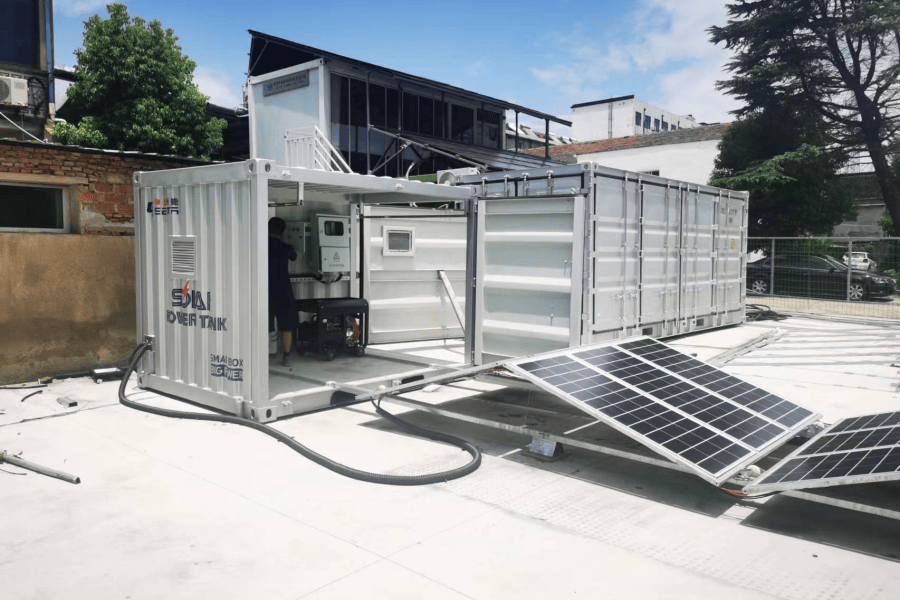
The solution was a 20ft High Cube Industrial ESS Container from Highjoule, paired with a temporary solar canopy. This wasn't just a battery box. It was a self-contained power plant. We configured it for a moderate C-rate (that's the speed at which a battery charges or discharges C think of it like a steady, reliable flow from a large tank versus a frantic, high-pressure hose) to maximize lifespan and safety. The result?
- Zero onsite emissions during operation.
- Noise levels below 60 dB(A) C quieter than a normal conversation.
- Fuel cost savings of over 70% for the duration of the project.
- The solar+storage setup actually fed excess power back to the grid during weekends, creating a small revenue stream.
The container's footprint was identical to the diesel gen-set it replaced, but its environmental and operational footprint was night-and-day different.
Why a 20ft High Cube Container Makes a Difference
You might ask, why a standardized container? The environmental impact of a 20ft High Cube Industrial ESS Container for construction site power starts with its form factor. The High Cube design gives us the extra vertical space (about a foot more than a standard container) that is absolutely critical. It allows for optimal, passive airflow design and safer, more accessible installation of the battery racks, power conversion systems (PCS), and the most important part: the thermal management system.
This isn't just about slapping air conditioners on a box. Proper thermal management in a BESS is like the circulatory system in a human body. It keeps every cell (or battery) within its ideal temperature range. An overheated battery degrades faster and is a safety risk; an underutilized one is a wasted capital asset. The space in a High Cube container lets us implement a staged cooling approach that's incredibly energy-efficient, reducing the system's own parasitic load. This directly lowers the LCOE and extends the system's usable life across multiple projects C a huge win for lifecycle environmental impact.
The Heart of the Matter: Thermal Management & Safety
This brings me to my core engineering insight. When evaluating any ESS for a harsh environment like a construction site, don't just look at the battery chemistry spec sheet. Look at the thermal management design and the safety certifications. At Highjoule, our 20ft containers are built to UL 9540 and IEC 62933 standards from the ground up. This means every component, from the cell-level fusing to the container-level fire suppression, has been tested as a unified system.
On site, I've seen containers that are basically ovens because the cooling can't handle a Texas summer. Ours are designed for ambient extremes from -30C to +50C. The system intelligently manages the C-rate based on temperature to prevent stress. This robust design means less degradation, fewer replacements, and a system that can be redeployed on 5, 6, or 7 projects over its life. That reuse factor is a massive, often overlooked, environmental benefit. You're not consuming materials for a single-use power source.

Making the Switch: What to Look For
So, if you're considering the move to containerized ESS power for your next project, here's my advice from the field:
- Demand Full Certification: Ask for the UL 9540 or IEC 62933 test reports for the entire container system, not just components.
- Ask About Parasitic Load: How much energy does the container's own cooling and systems use? A efficient system keeps more energy for your tools.
- Plan for Logistics: A 20ft container is easy to ship and position. Work with a provider like us who handles the grid connection, commissioning, and decommissioning. Our local teams in both the EU and US make this turnkey.
- Think Beyond the Project: Discuss the residual value. A well-built, certified container has a long second life in microgrids or as grid support. That's the ultimate sustainable choice.
The bottom line? The conversation around site power is changing. It's no longer just about availability. It's about responsibility, total cost, and future-proofing your operations. The right 20ft High Cube ESS container isn't an expense; it's a strategic asset that works quietly, cleanly, and reliably in the background. What's the one site constraint that's pushing you to rethink your power strategy?
Tags: Construction Site Power UL Standard BESS LCOE Europe US Market Renewable Energy ESS Container
Author
James Zhang
20+ years agricultural energy storage engineer / Highjoule CTO