
Environmental Impact of All-in-one Integrated Hybrid Solar-Diesel System for Military Bases
Table of Contents
- The Silent Cost of "Business as Usual" Power
- Beyond the Fuel Truck: The Real Environmental Footprint
- The Integrated Approach: More Than Just Panels and Gensets
- A Case in Point: Lessons from a European Forward Operating Site
- The Tech That Makes It Work (And Why It Matters for Your Bottom Line)
- The Path Forward: Building a Resilient, Responsible Base
The Silent Cost of "Business as Usual" Power
Honestly, for years, the conversation around power for remote or mission-critical sites like military bases was dominated by two words: reliability and cost. Environmental impact, while acknowledged, often took a backseat. The default solution? Scale up the diesel gensets, ensure the fuel logistics chain is robust, and maintain a 24/7 watch on those engines. I've been on sites where the hum of diesel generators is the constant background noise, and the monthly fuel bill reads like a national budget.
The problem isn't just the carbon emissions, though those are significant. It's a trifecta of pain points: the staggering operational expenditure (OpEx) of continuous fuel consumption, the supply chain vulnerability it creates, and the increasingly stringent environmental regulations that installations must now comply with, both in the U.S. and across NATO territories. It's a model built for a different era.
Beyond the Fuel Truck: The Real Environmental Footprint
Let's agitate that pain point a bit. When we talk about Environmental Impact of All-in-one Integrated Hybrid Solar-Diesel System for Military Bases, we're looking beyond just tailpipe CO2. A traditional diesel-reliant system has a sprawling footprint:
- Noise & Thermal Pollution: Constant generator noise isn't just an annoyance; it can compromise operational security and personnel well-being. The waste heat is, well, wasted energy.
- Spill Risk & Soil Contamination: Every fuel transfer and storage event is a potential environmental incident. I've seen the extraordinary (and costly) measures needed to mitigate this risk firsthand.
- Lifecycle Emissions: The International Energy Agency (IEA) has highlighted that decentralised diesel generation is one of the most carbon-intensive ways to produce power. When you factor in the emissions from fuel extraction, refining, and transportation - the "well-to-wire" impact - the footprint balloons.
The real kicker? This comes at a massive financial cost. The Levelized Cost of Energy (LCOE) for pure diesel generation in remote areas is exceptionally high, and it's subject to the wild volatility of global fuel markets.
The Integrated Approach: More Than Just Panels and Gensets
So, what's the solution? It's not simply bolting some solar panels onto the side of a generator shed. That creates more problems than it solves - voltage fluctuations, generator cycling that increases wear and tear, and unreliable output.
The true solution is an all-in-one, integrated hybrid system. Think of it as a sophisticated energy orchestra, where a advanced battery energy storage system (BESS) acts as the conductor. Solar PV generates clean power. The BESS stores excess solar, smoothes its delivery, and provides instantaneous power. The diesel gensets are relegated to a premium, on-demand role - only kicking in when absolutely necessary, and then running at their optimal, fuel-efficient load.
This integration is where the magic happens for environmental impact. We're talking about fuel consumption reductions of 60-80% in many of the projects we've assessed. That's fewer fuel convoys, lower spill risk, and a dramatic cut in direct emissions and noise. The gensets last longer because they aren't constantly cycling on and off. This isn't theory; it's the operational reality of modern, smart hybrid systems.
A Case in Point: Lessons from a European Forward Operating Site
Let me share a scenario from a project we supported in Southern Europe. A forward operating base needed resilient power for communications and surveillance infrastructure. Their challenge was classic: reduce fuel logistics, cut their thermal and acoustic signature, and ensure 99.99% uptime.
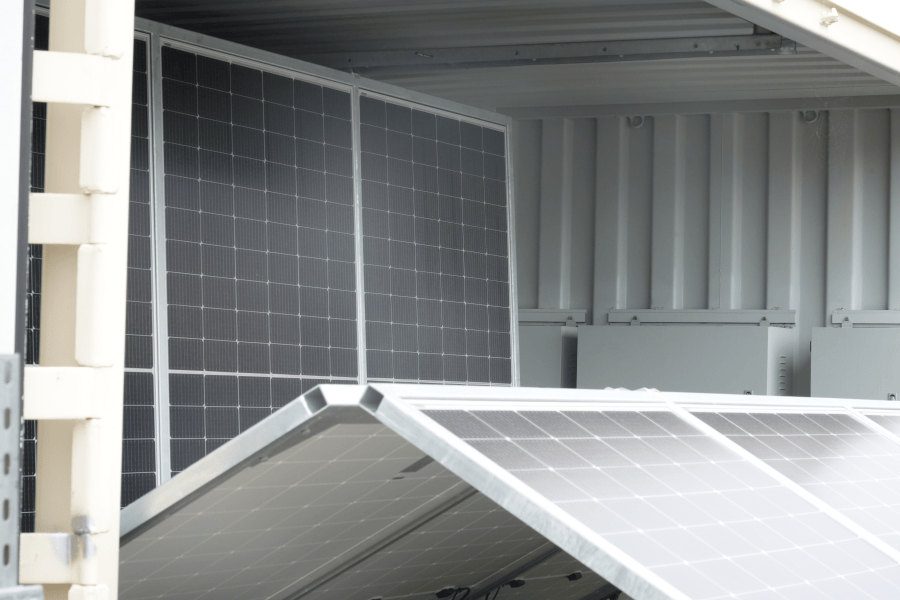
The solution was a containerized, all-in-one system. It housed a UL 9540-certified battery bank, a sophisticated power conversion system (PCS) that managed AC/DC coupling, and all the controls in one secure, weatherproof enclosure. The solar array was deployed on nearby unused land. The intelligence was in the control software - it prioritized solar consumption, used the batteries for overnight load and peak shaving, and treated the diesel genset as the final backup.
The results? The fuel delivery schedule went from weekly to quarterly. The constant generator noise that previously masked ambient sounds was eliminated, enhancing site security. From an environmental standpoint, the annual CO2e emissions were slashed by over 70 tonnes. For the commanding officer, the metrics that mattered were the reduced risk to personnel from fuel convoys and the significant cut in operational energy costs.
The Tech That Makes It Work (And Why It Matters for Your Bottom Line)
You might hear terms like "C-rate" or "thermal management" thrown around. Let me break down why they're critical for environmental and economic performance in simple terms.
C-rate is basically how fast you charge or discharge a battery. For a military base, you need a battery that can handle high power demands (a high discharge C-rate) when a cloud passes over the solar array or a large load kicks in, preventing the diesel from needing to start. Our systems are designed with this in mind, ensuring seamless power quality.
Thermal Management is the unsung hero. A poorly cooled battery degrades faster, wasting the embodied energy used to manufacture it and hurting your long-term return on investment. We insist on liquid-cooled systems for these demanding applications. They maintain optimal temperature, extend battery life to beyond 10 years, and ensure safety - a non-negotiable aligned with UL and IEC standards.
This brings us back to LCOE. By combining high-efficiency solar, a long-life BESS, and minimized diesel use, the levelized cost of energy over the system's 15-20 year life plummets. The higher initial CapEx is quickly offset by the near-zero marginal cost of solar and the slashed fuel OpEx. It's a financially and environmentally sustainable model.
At Highjoule, our design philosophy for these integrated systems is "resilience by design." It means building from the component level up - using cells and modules from tier-one suppliers, assembling in UL-listed enclosures, and writing control algorithms based on two decades of field data. This ensures the system isn't just a collection of parts, but a unified, reliable asset that meets the stringent demands of military specifications and global standards like IEEE 1547 for grid interconnection.
The Path Forward: Building a Resilient, Responsible Base
The shift towards integrated hybrid systems is more than an energy upgrade; it's a force multiplier. It enhances operational resilience by diversifying power sources and reducing logistical tails. It directly supports sustainability mandates from the Department of Defense and other national bodies.
The Environmental Impact of All-in-one Integrated Hybrid Solar-Diesel System for Military Bases ultimately translates to: quieter, cooler, and more stealthy operations; a drastic reduction in fossil fuel dependency and its associated risks; and a clear path to meeting both current and future regulatory requirements.
The technology is proven, the economics make sense, and the environmental imperative is clear. The question is no longer "if," but "how and when" to start the transition. What's the first power-critical load on your base that could be the pilot for this kind of transformation?
Tags: UL Standard BESS LCOE Environmental Impact Military Energy Hybrid Power Systems Solar-Diesel Integration
Author
James Zhang
20+ years agricultural energy storage engineer / Highjoule CTO