
Environmental Impact of Scalable Modular Industrial ESS Containers for Grids
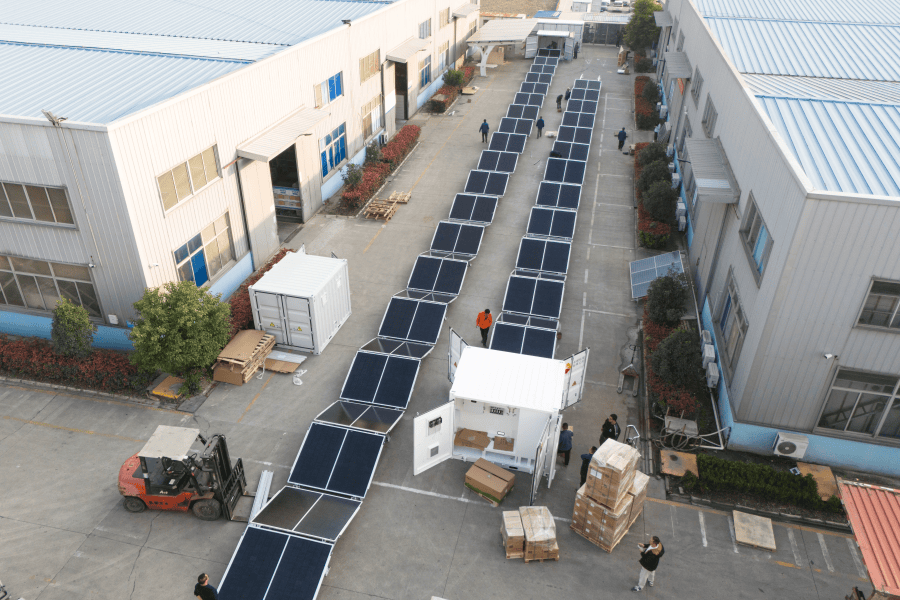
Table of Contents
- The Hidden Environmental Cost of Grid-Scale Storage
- It's Not Just About Carbon: The Full Lifecycle Picture
- The Scalable Modular Container: A Game Changer for Impact
- A Real-World Test: Grid Support in Central Europe
- From Blueprint to Reality: Making Low-Impact ESS Work
The Hidden Environmental Cost of Grid-Scale Storage
Let's be honest. When we talk about Battery Energy Storage Systems (BESS) for public utility grids, the first conversation is always about performance and cost. Can it deliver 100MW for 4 hours? What's the Levelized Cost of Storage (LCOS)? But sitting down with utility planners in places like California or Germany, I've noticed a quiet, persistent question creeping up the agenda: "What's the real environmental footprint of this massive battery bank we're about to install?"
It's a fair question. The International Energy Agency (IEA) notes that global energy storage capacity needs to expand massively to meet net-zero goals. But if we solve the carbon problem by creating a waste, resource, and local impact problem, we haven't really moved forward. I've been on sites where "standard" large-scale BESS deployments felt like building a data center from scratch each time - massive concrete pours, complex custom steelwork, and thermal management systems that seem over-engineered for the local climate. The initial embodied energy - the carbon spent before the system even stores its first kilowatt-hour of clean energy - can be staggering.
It's Not Just About Carbon: The Full Lifecycle Picture
To truly gauge the Environmental Impact of Scalable Modular Industrial ESS Container for Public Utility Grids, we have to look at the entire lifecycle. This isn't just about operational emissions (which, frankly, are near zero). It's about:
- Manufacturing & Materials: The mining, processing, and assembly of cells, modules, and the container itself.
- Deployment & Construction: The site prep, foundation work, and assembly energy. Honestly, I've seen projects where the diesel burned by earth-moving equipment and cranes on site offset the first six months of clean energy arbitrage.
- Operational Efficiency: This is where thermal management is king. An inefficient cooling system can parasitically consume 5-10% of the stored energy. Over a 20-year lifespan, that's a mountain of wasted clean power.
- End-of-Life & Second Life: What happens in 15-20 years? Can components be easily replaced? Is the system designed for disassembly and recycling, or is it a glued-together monolith destined for shredding?
A study by the National Renewable Energy Laboratory (NREL) emphasizes that a systems-level approach, focusing on design for longevity and recyclability, is critical for sustainable storage. This is where the modular philosophy shifts from a convenience feature to an environmental imperative.
The Scalable Modular Container: A Game Changer for Impact
So, how does a scalable, modular industrial container design directly address these impacts? From my two decades on the ground, it boils down to three core principles: Reduce, Optimize, Future-Proof.
First, Reduce. A pre-fabricated, standardized container built in a controlled factory environment is simply more material and energy-efficient than field construction. At Highjoule, we build our UL 9540 and IEC 62933 compliant containers on a single, optimized production line. This means less steel per kWh of capacity, precision-applied insulation, and integrated thermal loops that are tested before they leave the factory. The reduction in on-site construction time and waste is something I've seen firsthand - we're talking weeks, not months, of disruptive activity.
Second, Optimize. Scalability isn't just about adding more boxes. It's about right-sizing the system to the grid's evolving needs, avoiding overbuilding. A utility can start with a 2 MWh modular unit for frequency regulation and add identical units as renewable penetration grows. This phased deployment matches capital expenditure with need and, crucially, defers the environmental cost of manufacturing excess capacity until it's actually required. The thermal management system in a well-designed modular unit is also optimized for its specific form factor, leading to lower parasitic loads and a better overall system C-rate without the energy penalty.

Third, Future-Proof. Technology evolves. A cell chemistry with a lower environmental footprint today might be surpassed in five years. A modular container system with a standardized internal interface allows for graceful refresh. Instead of decommissioning an entire 20-foot container, individual racks or power conversion systems can be swapped out. This extends the asset's core infrastructure life to 30+ years and dramatically reduces lifecycle waste. It turns the BESS from a consumable product into a upgradable platform.
A Real-World Test: Grid Support in Central Europe
Let me give you a concrete example from a project we supported in North Rhine-Westphalia, Germany. The local grid operator needed to mitigate congestion from distributed solar PV, but the proposed site was in a semi-rural area with strict limits on permanent construction and visual impact.
The challenge was deploying 10 MWh of storage with a minimal physical and environmental footprint, and fast. A traditional BESS building was out of the question. Our solution was a cluster of five 2 MWh modular containers. Because they were factory-certified (UL and IEC), site work was limited to a simple gravel pad and grid connection. The total site disruption was under three weeks. The modular design also allowed them to use a natural convection-assisted cooling system for eight months of the year, drastically cutting auxiliary power use compared to a forced-air system. The local authority approved it precisely because it was seen as a temporary, low-impact installation - even though its service life will be 20 years. That's the modular advantage in action.
From Blueprint to Reality: Making Low-Impact ESS Work
Understanding the theory is one thing. Making it work on your grid is another. Based on my site experience, here's what utility decision-makers should focus on:
- Demand Full Lifecycle Data: Ask your vendor for a lifecycle assessment (LCA) that covers from cradle to grave. Look for designs that use recycled steel or aluminum in the container structure.
- Prioritize Operational Efficiency: Don't just look at the round-trip efficiency number. Drill into the thermal management system's parasitic load. A few percentage points saved there compound over decades into massive energy savings.
- Plan for Decommissioning on Day One: Choose a modular design with clear disassembly paths. How are the battery racks bolted in? Can the HVAC unit be detached? This forethought is what separates a sustainable product from a future liability.
At the end of the day, the goal is to make the clean grid even cleaner. The Environmental Impact of Scalable Modular Industrial ESS Container for Public Utility Grids isn't a side note; it's becoming a central criterion for responsible deployment. The technology isn't just ready - it's proven. The real question is, as you plan your next grid storage project, what weight will you give to the footprint you leave behind?
What's the biggest environmental concern your team is grappling with in your upcoming storage procurement? Is it end-of-life liability, embodied carbon, or something else entirely?
Tags: UL Standard LCOE Environmental Impact Utility Grid IEEE Modular ESS BESS Container
Author
James Zhang
20+ years agricultural energy storage engineer / Highjoule CTO