
Modular Mobile Power Containers: A Sustainable Solution for Rural Electrification
Beyond the Grid: The Real Environmental Footprint of Mobile Power
Honestly, after two decades on the ground from Texas to Thailand, I've seen the good, the bad, and the ugly of energy deployment. One conversation I keep having with project developers, especially those looking at rural or off-grid electrification, revolves around a single, crucial question: "How do we power communities sustainably without creating a new set of environmental problems?" It's a tension I feel firsthand. The goal is noble, but the traditional paths - diesel gensets, large-scale fixed infrastructure in sensitive areas - often come with a heavy ecological price tag. Today, let's chat about how the very design of scalable, modular mobile power containers is rewriting that script, using lessons from places like the Philippines to build better projects everywhere.
Quick Navigation
- The Hidden Cost of "Getting the Lights On"
- Beyond Carbon: The Full Environmental Ledger
- The Modular Advantage: Built for Minimal Footprint
- A Blueprint from the Philippines
The Hidden Cost of "Getting the Lights On"
We all celebrate when a remote community gets reliable electricity. But the celebration often overlooks the long-term environmental agitations. I've stood on sites where the solution was a bank of diesel generators. The noise is one thing, but the air quality and constant fuel logistics - spills, emissions, the carbon footprint - it adds up. Even renewable microgrids can stumble. Oversizing a fixed solar-plus-storage system for future growth means disturbing more land upfront, using more materials than needed for years. It's inefficient. According to the International Energy Agency (IEA), achieving universal energy access by 2030 requires smart, scalable solutions that avoid locking in high-emission pathways or unnecessary habitat disruption. The pain point isn't just providing power; it's providing it in a way that's truly sustainable and adaptable from day one.
Beyond Carbon: The Full Environmental Ledger
When we talk environmental impact, carbon emissions are just the headline. On-site, you have to think about the whole project lifecycle. Land use and site preparation: pouring large concrete pads in rural or ecologically sensitive areas is a permanent change. Resource efficiency: a fixed system sized for peak future demand sits underutilized for years, tying up lithium, steel, and copper that have their own extraction impacts. End-of-life mobility: decommissioning a massive, fixed BESS in a remote location is a logistical and potential contamination nightmare. A National Renewable Energy Laboratory (NREL) report highlighted that system mobility and modularity are key design principles for reducing the lifecycle environmental impact of remote energy systems. It's about leaving the lightest possible touch on the land.
The Modular Advantage: Built for Minimal Footprint
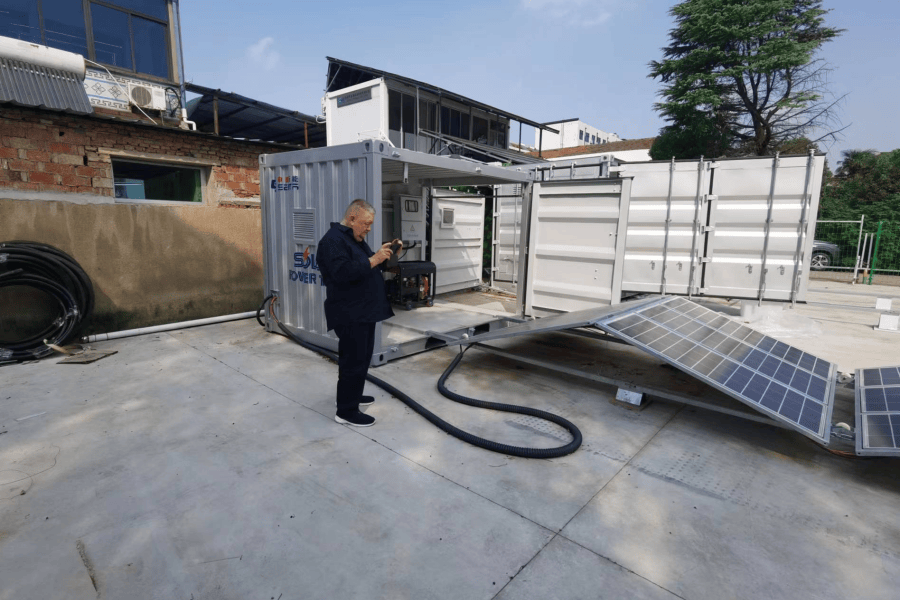
This is where the scalable modular mobile power container concept shifts the paradigm. Think of it as "pay-as-you-grow" energy with a built-in exit strategy. Instead of one large fixed installation, you deploy a standardized, self-contained unit that meets initial demand. Its inherent design tackles those lifecycle issues head-on:
- Minimal Site Disturbance: These containers often need simple, leveled gravel pads or minimal concrete. I've seen them placed on existing industrial land or community outskirts, avoiding core natural areas. When it's time to expand or relocate, you pick up and move, allowing the land to recover.
- Resource & Efficiency Optimization: You scale capacity by adding identical modules only when load increases. This means your system's C-rate - basically, how hard you're pushing the batteries - is optimized for longer battery life and better efficiency from the start, rather than running a huge system at a tiny fraction of its capability.
- Controlled, Factory-Built Environment: The core technology is assembled in a controlled factory setting. This isn't just about quality; it means stricter control over materials, more efficient recycling of production waste, and a unit that arrives on-site fully tested. This slashes on-site construction waste, noise, and local pollution dramatically.
A Blueprint from the Philippines: Scalability in Action
Let me give you a real-world parallel. While not in the EU or US, the challenges and solutions in Philippine island electrification are incredibly instructive. A project I advised on involved powering a growing fishing village and its new ice storage facility. The initial need was 500 kWh. A fixed system for the projected 5-year need would have been 2 MWh, requiring major land clearing.
Instead, the team used a modular mobile container solution. They started with one 500 kWh container. When tourism picked up and a small resort was built 18 months later, they didn't break new ground. They brought in a second, identical container, linked it seamlessly, and doubled the capacity. The thermal management systems in each unit are independent yet coordinated, preventing hotspots and ensuring safety without a complex, site-built cooling infrastructure. The local operator told me the biggest benefit was knowing that if the community's needs changed again, the system could adapt without another major construction project. That's sustainable planning.

Choosing the Right Container: It's Not Just a Box
Here's my expert insight from the field: not all "mobile" containers are created equal. The environmental and safety benefits hinge on core engineering. At Highjoule, when we build our MobilePower Cube series, we obsess over details that matter for sustainable, compliant deployment:
- Safety as Sustainability: A fire or failure is the ultimate environmental incident. Our designs are built to UL 9540 and IEC 62619 standards from the cell up. This isn't just paperwork; it means proven, independent validation of our battery management and thermal runaway containment systems. It gives developers and communities peace of mind.
- Thermal Management for Longevity: I've opened up units that relied on cheap, basic air conditioning. They fail in dusty, hot environments, leading to battery degradation. We use an independent, liquid-cooled system. It maintains optimal temperature, which extends battery life significantly - sometimes by years. This directly lowers the Levelized Cost of Energy (LCOE) and reduces the frequency of battery replacements, a huge win for resource efficiency.
- True Grid-Readiness: For projects that might one day connect to a main grid, these containers can be designed as grid-forming or grid-following assets. This future-proofs the investment, preventing it from becoming stranded or obsolete - another form of waste avoided.
The lesson from global deployments, from Philippine islands to remote North American microgrids, is clear. The most sustainable project is one that is right-sized, minimally invasive, and adaptable. The scalable modular mobile power container is more than a technical solution; it's a philosophy of flexible, respectful energy deployment. So, on your next rural or industrial off-grid project, ask your team: are we building a monument, or are we deploying a tool that can evolve with the community and protect the environment it's meant to serve?
What's the biggest site constraint you're facing in your next project?
Tags: Off-grid Power Rural Electrification UL IEC Standards Environmental Impact Mobile Power Container Modular BESS Sustainable Energy
Author
James Zhang
20+ years agricultural energy storage engineer / Highjoule CTO