
High-Voltage DC Solar Container Cost for Island Microgrids | Expert Insight
Contents
- What You're Really Asking About Cost
- The Hidden Costs That Keep Project Managers Up at Night
- Viewing Cost Through a High-Voltage DC Lens
- A Real-World Snapshot: Lessons from the Atlantic
- The $/kWh Myth and The LCOE Reality
- Your Next Step: Asking the Right Questions
What You're Really Asking About Cost
Honestly, when someone asks me "How much does it cost for a high-voltage DC solar container for remote island microgrids?", I hear a different question. What you're really asking is: "How do I make this complex, mission-critical project financially viable and reliable for the next 20 years?" The upfront price tag of the container itself is just the tip of the iceberg - and if you've managed an island grid, you know the bulk of the challenge lies beneath the surface.
The Hidden Costs That Keep Project Managers Up at Night
I've seen this firsthand on site. You're not just procuring a box of batteries. You're solving for:
- Logistical Headaches: Getting heavy equipment to a remote island often involves specialized barges, limited port infrastructure, and weather windows that blow budgets apart. Every extra shipment adds a massive cost multiplier.
- Balance of System (BOS) Bloat: Traditional low-voltage AC systems need a jungle of heavy AC cabling, massive transformers, and multiple power conversion stages. That's more equipment to buy, ship, install, and maintain. The National Renewable Energy Laboratory (NREL) has shown BOS costs can account for up to 50% of a system's total installed cost in remote areas.
- Efficiency Leaks: Every conversion from DC (solar) to AC and back again loses energy. On an island where every kilowatt-hour of diesel is gold, these losses directly hit your operational budget. They silently increase your Levelized Cost of Energy (LCOE).
- The Safety & Standards Maze: Meeting UL 9540, IEC 62933, and IEEE 1547 isn't optional - it's your license to operate and insure the project. A system not designed from the ground up for these standards leads to costly re-engineering, delays, and compliance risks.
These factors are why a simple $/kWh battery cell quote is almost meaningless for your application. The real cost is in the total system integration and lifetime operation.
Viewing Cost Through a High-Voltage DC Lens
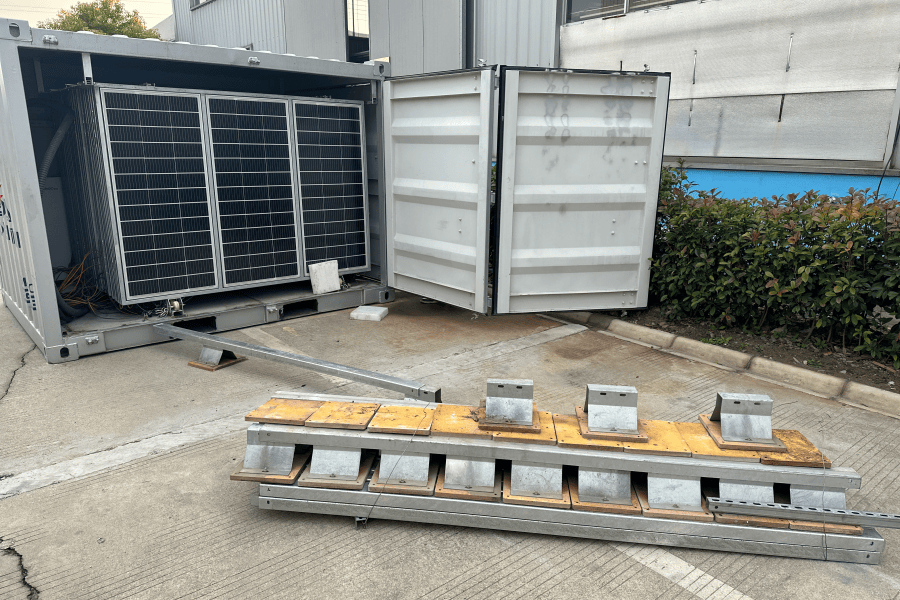
This is where the high-voltage DC solar container concept shifts the paradigm. Think of it as a pre-integrated, plug-and-play power plant on a skid. By keeping the solar array and battery storage on a common high-voltage DC bus, we eliminate multiple conversion steps. Fewer conversions mean higher round-trip efficiency - often 3-5% higher than AC-coupled systems. That's free energy, year after year.
More importantly for cost, it drastically simplifies the Balance of System. You need less cabling (high-voltage DC uses thinner wires for the same power), fewer large transformers, and a more streamlined interconnection. This translates directly into lower shipping weight, faster on-site installation (critical when skilled labor is scarce and expensive on an island), and reduced civil works.

A Real-World Snapshot: Lessons from the Atlantic
Let me share a scenario from a project off the coast of Scotland, supporting a community microgrid. The challenge was classic: high diesel costs, an aging grid connection, and a need for 100% renewable resilience during storms. The initial quotes for a standard AC system were staggering, mostly due to the civil and electrical work needed for the substation upgrade.
Our team at Highjoule proposed a containerized high-voltage DC solution. The key wasn't just the container; it was the system design. We pre-integrated everything - battery racks, PCS, DC combiners, thermal management, and fire suppression - into two UL 9540-certified containers. Because the system was DC-coupled and operated at a higher voltage, we could use the existing switchgear with minimal modification.
The result? The installation time was cut by nearly 40%. The avoided costs on substation upgrades and reduced cabling alone justified the investment. But the real win is the ongoing LCOE. With a higher system efficiency and intelligent cycling that minimizes battery degradation (we pay close attention to C-rate and thermal management to extend life), the community is seeing a faster payback. The system just hums along, managing the microgrid's frequency and providing black-start capability, which is priceless during those North Atlantic gales.
The $/kWh Myth and The LCOE Reality
So, let's talk numbers. You might see containerized solutions advertised from $400 to $800 per kWh of storage capacity. But for a high-voltage DC system designed for harsh, remote duty, you should be thinking in the range of $550 to $950 per kWh, fully integrated and commissioned. The range is wide because it hinges on your specifics:
- Duration & Power (C-rate): A 4-hour system (low C-rate) has a different cost structure than a 2-hour system (higher C-rate) for grid stabilization. The power electronics cost more.
- Thermal Management: A liquid-cooled system, which I often recommend for island environments with high humidity and salt spray, adds upfront cost but dramatically improves battery lifespan and safety - lowering your LCOE.
- Compliance & Software: Does the price include full UL/IEC certification and the advanced grid-forming software needed for a weak island grid? It should.
The true metric is LCOE - the total lifetime cost of ownership divided by the energy produced. A high-quality, high-voltage DC system with superior cycle life and efficiency will often show a lower LCOE than a cheaper, less integrated alternative that bleeds value through losses and maintenance. According to IRENA, innovation in system integration is a key driver for reducing LCOE for island energy systems, sometimes by double-digit percentages.

Your Next Step: Asking the Right Questions
Instead of just asking for a price, frame your next vendor discussion around total cost of ownership. Ask them:
- "How does your design minimize Balance of System costs for my specific site?"
- "Can you show me the calculated round-trip efficiency and projected LCOE for a 20-year horizon?"
- "Is the system pre-certified to UL 9540 and IEEE 1547 for grid-forming operation, and what does the commissioning process look like?"
At Highjoule, this is the conversation we have every day. We don't just sell containers; we deliver a guaranteed performance outcome - be it reduced diesel consumption, grid stability, or LCOE target. Our value is in making sure that when your container arrives on that remote dock, it's not the beginning of your problems, but the end of them. The cost, then, becomes an investment in predictability.
What's the single biggest cost uncertainty you're facing in your island microgrid plan?
Tags: UL Standard BESS LCOE Europe US Market Renewable Energy Remote Island Microgrid IEEE 1547 High-voltage DC Solar Container
Author
James Zhang
20+ years agricultural energy storage engineer / Highjoule CTO