
Smart BESS Container Cost for Military Bases: A Real-World Breakdown
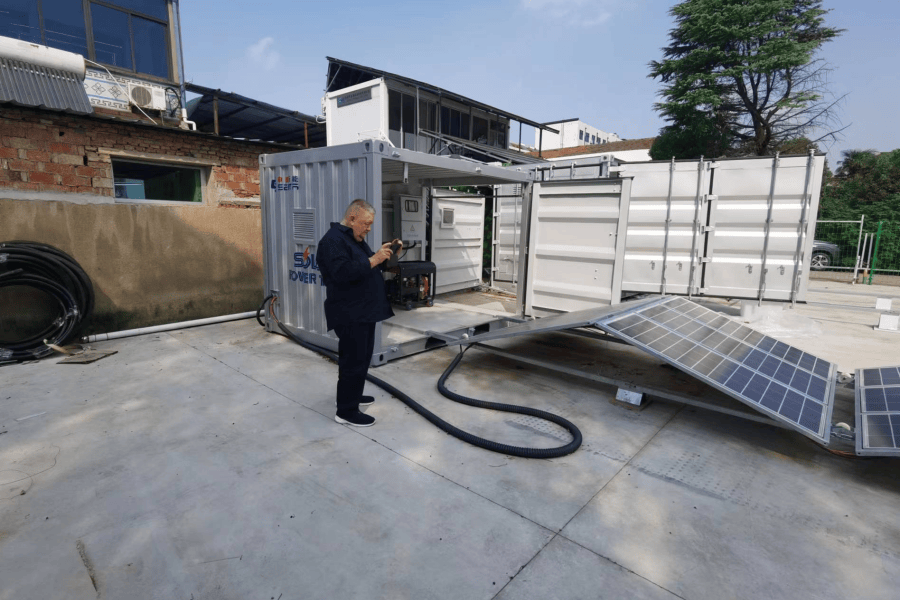
Table of Contents
- It's Never Just a Price Tag
- The Hidden Costs of "Cheaper" Solutions
- What You're Really Paying For: The Core Value Drivers
- A Pragmatic Approach: How We Frame Cost at Highjoule
- So, What Should You Ask Instead?
It's Never Just a Price Tag
Honestly, when a procurement officer or base commander asks me, "How much does a Smart BMS Monitored Industrial ESS Container for our military base cost?" C I get it. You need a number for the budget. But in my 20+ years of deploying these systems from Texas to Bavaria, I've learned that giving a simple dollar-per-kilowatt-hour figure upfront is almost a disservice. It's like asking for the price of a "military-grade armored vehicle" without specifying the terrain, threat level, or mission duration. The real cost isn't in the steel box; it's in the resilience, safety, and intelligence inside it, guaranteed to perform when the grid is down and national security is on the line.
The Hidden Costs of "Cheaper" Solutions
Let's talk about the elephant in the room. The market is flooded with containerized ESS offers. The initial capital expenditure (CapEx) can vary wildly, sometimes by 40% or more. The low end might look attractive on a spreadsheet. But here's the agitation: on a military installation, a failure isn't an inconvenience; it's a mission-critical event. I've seen firsthand on site what happens when thermal management is an afterthought C sudden derating, reduced lifespan, and in worst-case scenarios, thermal runaway. A cheaper BMS might just monitor voltage; a Smart BMS we deploy predicts cell-level anomalies and takes preventive action. The cost of a single safety incident or mission disruption dwarfs any initial savings.
Consider the data from the National Renewable Energy Laboratory (NREL): system performance and longevity are the dominant factors in the Levelized Cost of Storage (LCOS) C that's your true total cost over 15-20 years. A system that degrades faster or requires constant maintenance has a much higher LCOS, even if its sticker price was low.

What You're Really Paying For: The Core Value Drivers
So, when we at Highjoule build a quote for a military base, the cost is built from these non-negotiable pillars:
- Certification & Compliance (The Foundation): This isn't optional. Your system must meet UL 9540 for the overall ESS, UL 1973 for the batteries, and IEEE 1547 for grid interconnection. In Europe, it's the IEC equivalents. This engineering rigor is baked into the cost but is your primary insurance policy.
- The "Smart" in Smart BMS (The Brain): You're paying for predictive analytics, not just monitoring. It's the difference between being told a cell is failing and being alerted that a cell might fail in 90 days, allowing for scheduled, secure maintenance. This capability directly reduces operational risk and long-term OpEx.
- Robust Thermal Management (The Muscle): Military bases face extreme climates. A system's C-rate C basically, how fast you can charge or discharge it C is directly limited by its ability to manage heat. We design for the worst-case scenario, not the lab test. This ensures full power is available when needed, every time.
- Cybersecurity & Integration (The Nerve System): The container must seamlessly integrate with existing base microgrid controls and withstand cyber threats. This isn't a plug-and-play USB drive; it's a hardened node in a secure network. The engineering for MIL-STD or relevant cybersecurity frameworks is a significant value-add.
Take a project we completed for a forward-operating base in Europe. The challenge wasn't just backup; it was providing "grid-forming" capability to black-start critical comms infrastructure. The challenge was seismic stability and rapid deployment. The cost reflected a containerized ESS with ultra-high C-rate cells (for sudden, large loads), integrated black-start logic, and a seismic rating beyond standard. The "cost" was for a guaranteed performance envelope.
A Pragmatic Approach: How We Frame Cost at Highjoule
We don't start with a product catalog. We start with a conversation: What is the critical load (in MW/MWh)? What's the required uptime during an outage (seconds, minutes, hours)? What are the environmental extremes? Then, we model the LCOE/LCOS for different technology configurations. Often, investing more upfront in higher-cycle-life cells or a more advanced cooling system yields a lower total cost of ownership over a 20-year horizon.
Our Smart BMS is the cornerstone. It allows us to safely push the system closer to its design limits when necessary, extracting maximum value. And because we have boots-on-the-ground service partners in key regions, the cost of long-term maintenance is predictable and stable. You're not just buying a container; you're buying 20 years of energy resilience with a clear support roadmap.
So, What Should You Ask Instead?
Instead of "How much per kWh?", consider asking your potential suppliers:
- "Can you show me the UL/IEC certification documents for the entire assembled system?"
- "How does your Smart BMS predict cell failure, and what's your field-proven false-positive rate?"
- "What is the projected LCOS for this design over 20 years, including assumed degradation?"
- "What is your local service response time for a critical fault, and what cybersecurity protocol do you support for remote diagnostics?"
The final number on the quote will make a lot more sense when it's tied to these answers. It transforms the conversation from a commodity purchase to a strategic investment in mission assurance. What's the one operational risk on your base that keeps you up at night, that a truly resilient power source could solve?
Tags: UL Standard BESS IEEE 1547 Smart BMS Energy Resilience Military Energy Security ESS Container Cost
Author
James Zhang
20+ years agricultural energy storage engineer / Highjoule CTO