
How to Optimize Scalable Modular 1MWh Solar Storage for Data Center Backup Power
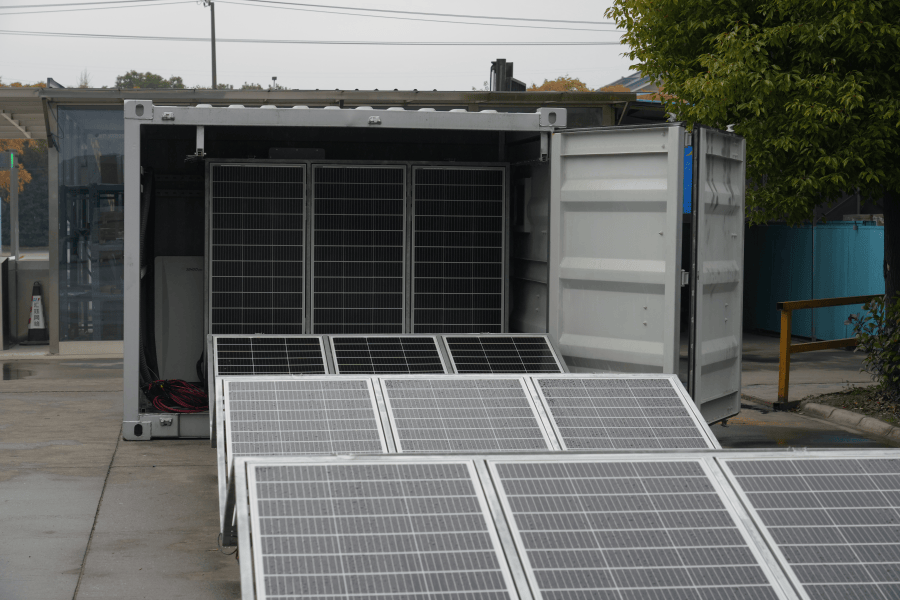
Table of Contents
- The Real Problem: It's Not Just About Capacity
- Why It Hurts: Cost, Complexity, and Unseen Risks
- The Modular Answer: Building Blocks for True Resilience
- Beyond the Spec Sheet: The On-Site Reality of Optimization
- A Case in Point: A 4MW/16MWh Project in Frankfurt
- Your Next Steps: Asking the Right Questions
The Real Problem: It's Not Just About Capacity
Honestly, if you're looking at a 1MWh solar storage system for your data center, you're already thinking ahead. The conversation usually starts with, "We need X hours of backup for our critical load." But here's what I've seen, time and again on sites from Silicon Valley to Stuttgart: the real challenge isn't just getting the storage capacity. It's about making it work efficiently, safely, and economically for the next 15+ years. You're not buying a battery; you're investing in a dynamic, mission-critical power asset that needs to play nice with your solar PV, your gensets, and your grid connection. The pain point? Deploying a rigid, one-size-fits-all monolith that can't adapt to your changing IT load, seasonal generation, or evolving safety standards.
Why It Hurts: Cost, Complexity, and Unseen Risks
Let's agitate that a bit. A non-optimized, non-scalable system hits you in three places. First, cost. The Levelized Cost of Storage (LCOS) C that's your total lifetime cost per MWh C can balloon if the system isn't right-sized and future-proofed. According to the National Renewable Energy Laboratory (NREL), improper system design and integration can increase operational costs by up to 30% over the asset's life. Second, complexity. Integrating a massive storage block requires major upfront civil work, complex power conversion systems, and a control strategy that often feels like a custom science project. Third, and this keeps facility managers up at night: unseen risks. Thermal runaway doesn't care about your uptime SLA. A system that isn't designed with granular monitoring and isolation at a modular level carries higher operational risk. I've walked into sites where the entire BESS had to be taken offline because a fault in one cell string couldn't be isolated C that's a total failure of design for mission-critical backup.
The Modular Answer: Building Blocks for True Resilience
This is where the concept of a scalable, modular 1MWh architecture shifts from a nice-to-have to a non-negotiable. Think of it like server racks. You don't buy one giant server; you deploy standardized, swappable units. The solution is a BESS built from the ground up as independent, pre-integrated 1MWh modules. Each module is its own ecosystem C battery racks, thermal management, fire suppression, and power conversion C all tested and certified as a unit (think UL 9540, IEC 62933). This is the core of optimization: start with a 1MWh block that matches your immediate need and phase-one solar output. Then, as your data hall expands or your sustainability goals tighten, you add more identical blocks. The balance of plant C the switchgear, the grid connection C is designed for the ultimate build-out from day one. This isn't just scaling; it's optimized scaling that controls CapEx, slashes installation time, and future-proofs your investment.

Beyond the Spec Sheet: The On-Site Reality of Optimization
As an engineer who's commissioned these systems, let me break down what "optimization" really means in the field, beyond the marketing gloss.
- Thermal Management is Everything: Lithium-ion cells are sensitive. A 5C temperature gradient across a pack can significantly degrade lifespan. A truly optimized modular system has independent, closed-loop cooling per module. This prevents a hot spot in one unit from compromising its neighbor C a critical fail-safe you don't get in a shared-air monolithic design.
- C-Rate is a Tool, Not a Trophy: Vendors love to tout high charge/discharge rates (C-rate). For data center backup, where you're bridging to gensets, you typically need a high-power discharge for a short duration (like 0.5-2 hours). An optimized system matches the battery chemistry and configuration to this specific duty cycle. Sometimes, a slightly lower C-rate chemistry with better longevity gives you a far lower LCOS. It's about right-sizing the physics to the application.
- The Intelligence Layer: The BMS and EMS are the brains. Optimization means they don't just see a "big battery." They see individual 1MWh modules. They can schedule maintenance on one module while the others carry the backup load. They can perform state-of-health checks sequentially, without taking the whole system offline. This granular control is what companies like Highjoule build into our Platform OS C it turns a static asset into a flexible, manageable one.
A Case in Point: A 4MW/16MWh Project in Frankfurt
Let me give you a real example. We worked with a colocation provider in Frankfurt, Germany. Their challenge: they had space for a 16MWh ultimate system but only budget and immediate need for 4MWh. They also had a hard requirement for VDE-AR-E 2510-50 compliance (the German fire safety standard for stationary storage) and needed to participate in grid frequency regulation for ancillary revenue.
The solution was a build-out in four 1MWh modular phases. We deployed the first phase C four 1MWh UL 9540-certified modules C in under 10 weeks from site delivery to commissioning. The containerized modules included their own Inergen fire suppression and liquid cooling. The key was the common DC bus architecture and the pre-wired EMS that was already programmed for the full 16MWh capacity. When they expanded 18 months later, we simply craned in the new modules, connected the pre-designed busbar links, and the system recognized the new capacity automatically. No major electrical rework, no software overhaul. The optimized, modular approach saved them an estimated 40% on installation costs for the later phases and gave them revenue-generating flexibility from day one.
Where Highjoule Fits In
Our entire product philosophy is built around this scalable modularity. We don't just sell you a 1MWh unit; we provide the master plan for your 10MWh or 50MWh future. Every JouleBlock? module is a self-contained, standards-compliant power node. And because we've done this across different regulatory environments C from California's Rule 21 to the EU's Grid Code requirements C we bake that compliance and interoperability into the design from the start. Our local service teams then ensure that the optimization on paper translates to optimization on the concrete pad in your switching yard.
Your Next Steps: Asking the Right Questions
So, when you're evaluating how to optimize your scalable 1MWh storage system, move beyond the basic kWh and kW talk. Ask your potential1| these questions:
| Question | What a Good Answer Sounds Like |
|---|---|
| "Can I add modules later without replacing the central inverter or redoing the main AC connection?" | "Yes, our design uses a modular, scalable PCS architecture or a DC-coupled approach that allows plug-and-play expansion." |
| "How do you isolate a thermal event or a fault within a single 1MWh module?" | "Each module has independent firewalls, suppression, and electrical isolation. A fault is contained to that single unit." |
| "Show me the LCOS projection for a 15-year horizon, including degradation and replacement of individual modules." | "Here's a transparent model based on real-world cycling data from our fleet, showing staggered module refresh cycles." |
The goal is resilience that adapts. The data center industry mastered this with IT hardware. It's time your backup power did the same. What's the one constraint in your next project C space, phased budget, or regulatory uncertainty C that a truly modular approach could solve?
Tags: UL Standard BESS LCOE Data Center Backup Power Modular Energy Storage Scalable Solar Storage
Author
James Zhang
20+ years agricultural energy storage engineer / Highjoule CTO