
Grid-Forming BESS for Construction Sites: Solving Power Challenges
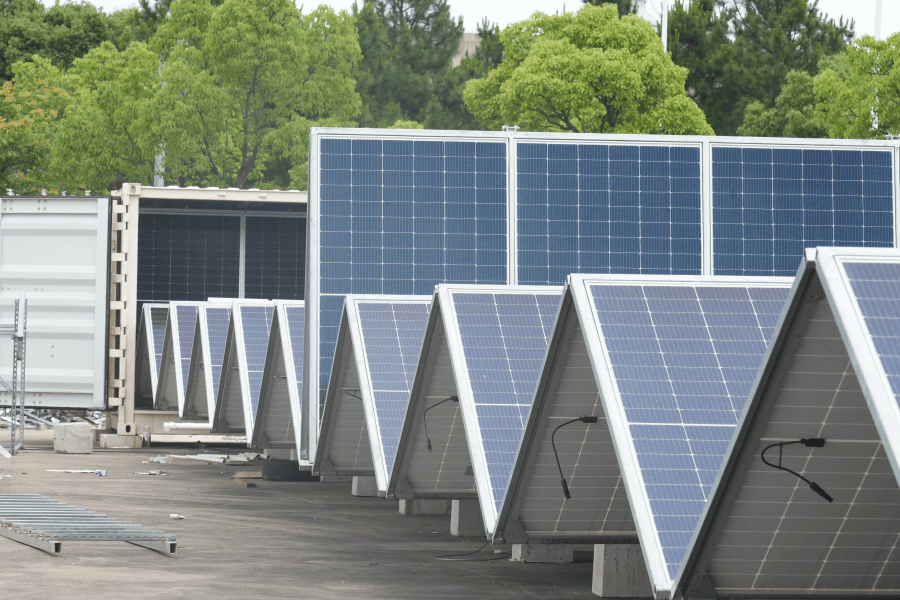
Table of Contents
- The Silent (and Expensive) Construction Site Problem
- Why Diesel Generators Just Don't Cut It Anymore
- The Game Changer: What "Grid-Forming" Really Means On-Site
- A Real-World Case Study: Powering Progress in the American Southwest
- The Tech Talk (Made Simple): C-Rate, Thermal Runaway, and LCOE
- Is Your Next Project Ready for Smarter Power?
The Silent (and Expensive) Construction Site Problem
Let's be honest. If you're managing a construction project in the US or Europe right now, you're probably juggling a dozen major headaches. But one of the most persistent, and frankly, costly ones, is something we rarely talk about: temporary power. You know the drill. You've got your site office trailers, your tool charging stations, your early-phase equipment, and maybe even some critical processes that need clean, reliable electricity long before the utility connection is finalized or is stable enough to trust. The traditional answer? The roar of diesel generators. I've been on sites where the noise and the smell are just part of the background, an accepted "cost of doing business." But it's a cost that's getting harder to swallow.
Why Diesel Generators Just Don't Cut It Anymore
We need to agitate this problem a bit, because the stakes are higher than just fuel bills. First, there's the pure economics. Diesel prices are volatile, as we've all seen. The International Energy Agency (IEA) consistently highlights fuel price volatility as a major risk for off-grid and temporary power operations. You're essentially tying a significant part of your site OPEX to a global commodity market. Then there's the carbon footprint. With more stringent environmental regulations in places like California, the EU, and even on municipal levels, the emissions from a 24/7 diesel gen-set can complicate permitting and clash with corporate sustainability goals. I've seen projects where the local community pushback starts with the constant generator noise.
But here's the real kicker, from a pure engineering standpoint: reliability. A diesel generator provides power, sure, but it's a single point of failure. If it stalls or needs maintenance, everything stops. For modern construction sites using sensitive digital equipment, voltage sags and frequency fluctuations from a generator can also cause damage or data loss. It's a clunky, 20th-century solution for a 21st-century problem.
The Game Changer: What "Grid-Forming" Really Means On-Site
This is where our Real-world Case Study of Grid-forming Photovoltaic Storage System for Construction Site Power comes into play. The solution isn't just slapping some solar panels and a battery on site. That's been done. The breakthrough is in the "grid-forming" capability.
Think of a traditional battery system (grid-following) as a polite guest at a party - it waits for the host (the main grid or a generator) to set the rhythm (voltage and frequency) before it joins in. If the host leaves, the party stops. A grid-forming battery is the host itself. It can create a stable, clean "grid" from scratch, all by itself. This means a solar-plus-storage system can become the primary power source for your islanded construction site, with the diesel generator relegated to a silent, automated backup role - only kicking in if the battery is depleted during a long stretch of bad weather. Honestly, seeing this in action on a remote site for the first time is a revelation. The silence is almost startling.
At Highjoule, when we design these systems, we build this intelligence right into the power conversion system (PCS), ensuring it meets key standards like IEEE 1547-2018 for distributed resources and UL 9540 for energy storage safety. It's not just a product feature; it's a fundamental re-architecture of site power.
A Real-World Case Study: Powering Progress in the American Southwest
Let me walk you through a project we completed last year. A large-scale logistics warehouse was being built in a semi-arid region of Nevada. The site was at the end of a long utility feeder, and the permanent power connection was 9 months out. The developer needed power for site offices, security, material handling, and early electrical work. They were facing a forecasted $180,000 diesel bill and significant emissions.

Our team deployed a turnkey, grid-forming PV storage microgrid. The system consisted of a 500kWh UL 9540-certified battery storage container from Highjoule, coupled with a 250kW solar canopy built over the parking area. The grid-forming inverter was the brains, creating a stable 480V microgrid for the entire site.
The results were stark:
- Diesel Use Reduction: The generator runtime dropped by over 90%. It only ran for a total of 45 hours over 6 months, versus a projected 4,300+ hours.
- Cost Savings: Fuel and maintenance costs were slashed by approximately $155,000.
- Zero Downtime: The seamless transition between solar, battery, and backup generator meant no work stoppages due to power issues.
- Sustainability Win: The project calculated a reduction of nearly 400 metric tons of CO2e during the construction phase, which became a major selling point in their final building marketing.
The system wasn't just temporary, either. After construction, the solar canopy remained for employee parking, and the BESS was relocated to the facility's new substation to provide ongoing demand charge management. That's what we call a future-proof investment.
The Tech Talk (Made Simple): C-Rate, Thermal Runaway, and LCOE
Now, if you're evaluating such a system, you'll hear some technical terms. Let me translate them from my 20 years on site:
C-Rate: Simply put, it's how fast you can charge or discharge the battery. A high C-rate (like 1C) means you can pull the full battery capacity in one hour. For a construction site, you might need a high discharge C-rate to start a large motor, but a moderate C-rate is often more than enough for continuous loads and is kinder on the battery's lifespan. We spec this based on your actual load profile, not just a max theoretical number.
Thermal Management: This is safety and longevity 101. Batteries generate heat. Poorly managed heat leads to degradation and, in worst-case scenarios, thermal runaway - a cascading failure. Every Highjoule container uses a liquid-cooling system that's miles ahead of old air-cooled designs. It maintains an even temperature, extending life and crucially, keeping the system within the strict safety parameters of UL 9540A test standards. I've opened up units after 5 years in the Texas sun, and the cell consistency is remarkable.
LCOE (Levelized Cost of Energy): This is the big one for financial decision-makers. It's the total lifetime cost of your power system divided by the total energy it produces. While diesel has a low upfront capital cost, its LCOE is high and unpredictable due to fuel. A solar+storage system has a higher upfront cost but a very low, predictable LCOE over 10-15 years. For a long-duration site, the math is increasingly a no-brainer. The Nevada case study is a perfect example of LCOE in action.
Is Your Next Project Ready for Smarter Power?
The technology is here, it's proven, and the standards (UL, IEC, IEEE) are in place to ensure its safe deployment. The question isn't really if the construction industry will move away from diesel-dependent temporary power, but when. The early adopters are already reaping the financial and ESG benefits.
So, for your next greenfield project or remote site, what's the first power source you're planning for? Is it the one that makes noise, smells, and burns cash, or the one that quietly harvests the sun and keeps the project on schedule and on budget? The coffee's on me if you'd like to brainstorm what a grid-forming microgrid could look like for your upcoming plans.
Tags: Construction Site Power UL Standard BESS Solar Plus Storage Microgrid IEEE 1547 Grid-forming
Author
James Zhang
20+ years agricultural energy storage engineer / Highjoule CTO