
How Smart BMS & Pre-Integrated PV Containers Solve Construction Site Power Challenges
Contents
- The Power Problem on Your Next Construction Site
- Why the Old Way Hurts Your Budget and Schedule
- A Smarter Way to Power Up: The Integrated Energy Container
- Real-World Case Study: Powering a Mid-Scale Industrial Build in the Southwest
- The Brains of the Operation: What Makes the Smart BMS So Critical
- Why This Matters for Your Business
The Power Problem on Your Next Construction Site
Let's be honest. When you're planning a new construction project - be it a warehouse, a data center, or a commercial complex - temporary power is probably somewhere down on your list. It's a necessary evil, a line item you know you need but wish you could avoid. The default, for decades, has been the diesel generator. You know the drill: the constant rumble, the smell of fumes, the weekly fuel deliveries, and the nagging worry about noise complaints or emissions regulations. It works, but it's messy, expensive, and frankly, a bit old-fashioned.
But here's the phenomenon I'm seeing more and more across the US and Europe: projects are getting stalled not by labor or materials, but by power. Grid connections are delayed. Permits for fossil-fuel generators are getting tighter, especially in urban or environmentally sensitive areas. And the sheer cost of diesel is a volatile budget-killer. According to the National Renewable Energy Laboratory (NREL), integrating solar with storage for temporary power can reduce fuel costs by over 80% in suitable applications. That's not just a minor saving; that's a game-changer for project economics.
Why the Old Way Hurts Your Budget and Schedule
I've been on sites where the generator is the single point of failure. A mechanical issue at 2 AM means all security lighting, tool charging, and critical overnight curing processes just stop. The clock is ticking, and you're waiting on a service truck. The aggravation is real. Beyond the obvious downtime, consider the less visible costs:
- Fuel Logistics & Security: Storing hundreds or thousands of gallons of diesel on-site is a security and environmental liability.
- Carbon Footprint & ESG Goals: More clients and local authorities are mandating emissions reductions. A diesel-only site is a black mark on your sustainability report.
- Operator Labor: Someone has to refuel, check oil, and maintain that generator. That's skilled labor not doing other critical tasks.
The pain isn't just operational; it's financial and reputational. You're building the future, but powering it with the past.
A Smarter Way to Power Up: The Integrated Energy Container
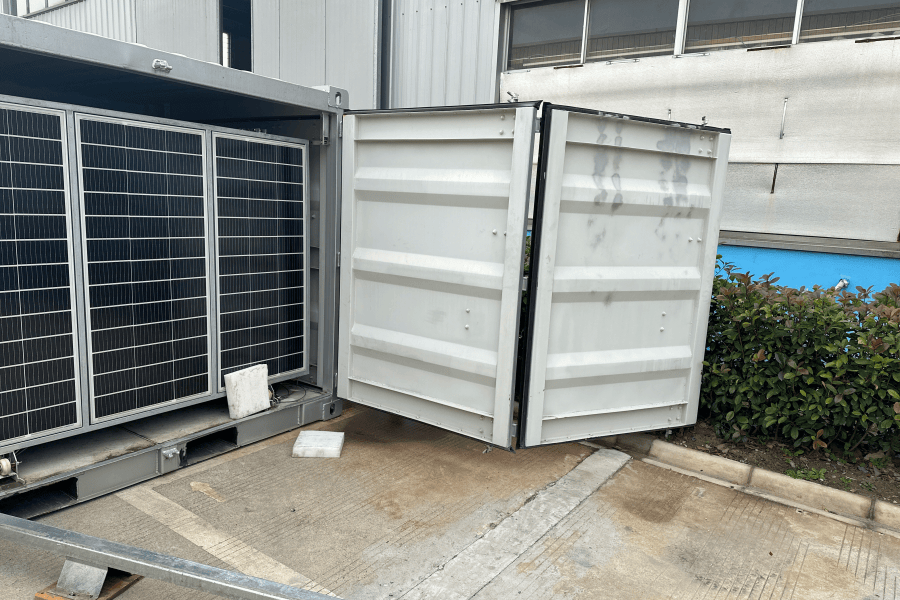
So, what's the solution? It's not just slapping some solar panels on a construction trailer. That's unreliable. The real answer is a pre-integrated, plug-and-play system: a containerized unit that combines solar generation, a significant battery bank, power electronics, and - most importantly - an intelligent Smart Battery Management System (BMS), all built to rough-and-tumble site standards.
Think of it as a silent, self-contained power plant on wheels. It's delivered to your site, you connect your distribution panel, and you have immediate, clean power. The solar panels charge the batteries during the day, and the batteries provide silent, fume-free power through the night and on cloudy days. The diesel generator? It becomes a backup, not the primary. You might only run it a few hours a week, slashing fuel costs and maintenance.
At Highjoule, our SitePower Integrated Container is built around this philosophy. We don't just pack components into a box. We engineer the thermal management from the ground up, ensure every electrical component meets UL 9540 and IEC 62619 standards, and design for easy access and serviceability because I know what a muddy, chaotic site looks like. The goal is to give you a utility-grade asset that just works, without needing a PhD in energy engineering to operate it.

Real-World Case Study: Powering a Mid-Scale Industrial Build in the Southwest
Let me walk you through a project we completed last year. A developer was building a 150,000 sq. ft. manufacturing facility in Arizona. The grid connection was scheduled for month 8 of a 14-month project. The initial plan was three large diesel generators running 24/7.
The Challenge: Beyond fuel costs, they faced strict local noise ordinances and had corporate net-zero commitments for all construction activities. The generator plan was a non-starter.
The Highjoule Solution: We deployed two of our 40-foot SitePower Integrated Containers. Each had a 250 kW/500 kWh battery system and a 120 kW rooftop solar canopy. The key was the Smart BMS that constantly monitored and managed the entire system.
The Outcome: For the first 6 months, the site ran entirely on solar and battery power from 8 AM to 6 PM. The generators only kicked in for peak evening loads (like concrete pours) and overnight, cutting total generator runtime by over 70%. The project manager told me they saved an estimated $12,000 per month on fuel alone. Just as importantly, they passed every environmental compliance check with flying colors and used the silent operation as a selling point for nearby tenants. The containers were demobilized and are now powering another project - that's the beauty of a mobile asset.
The Brains of the Operation: What Makes the Smart BMS So Critical
You might hear "BMS" and think it's just a fancy battery gauge. In a system like this, it's the central nervous system. Honestly, I've seen projects fail because they used a basic BMS that couldn't handle the complex dance between solar input, variable site demand, and battery health.
Our Smart BMS does three things exceptionally well that matter for your site:
- Advanced Thermal Management: Arizona heat or Minnesota cold, the batteries must stay in their happy zone (around 25C/77F). The BMS proactively manages liquid cooling/heating loops, preventing degradation. A poorly managed battery can lose significant capacity in just a few hot months, a cost you'll never see on an invoice but feel in performance.
- State-of-Health (SOH) & C-Rate Optimization: In simple terms, the C-rate is how fast you charge or discharge the battery. Pull too much power too fast (a high C-rate), and you stress the cells, shortening their life. The Smart BMS intelligently limits the draw from tools or equipment to a safe, optimal rate, balancing immediate power needs with long-term battery longevity. It's like having a seasoned equipment operator managing the power flow 24/7.
- Predictive Safety & Diagnostics: It doesn't just react; it predicts. By monitoring voltage and temperature differences between thousands of individual cells, it can flag potential issues weeks before they cause a shutdown. This is where UL and IEC certification isn't just a sticker - it's a rigorous validation of these safety algorithms.
This level of control directly lowers your Levelized Cost of Energy (LCOE) for the project. By maximizing battery life and solar harvest, you get more usable kilowatt-hours out of the same capital investment over the life of the project (and the next one, and the one after that).

Why This Matters for Your Business
This isn't just a "green" alternative. It's a financially and operationally superior one. For a site manager, it means reliability and silence. For the project CFO, it means turning a volatile operating expense (diesel) into a predictable capital expense (a depreciable asset). For the sustainability officer, it's a tangible win.
The technology is here, it's proven, and it's built to the toughest standards. The question isn't really if the industry will move this way - the International Energy Agency (IEA) notes the rapid decline in battery costs driving this shift - but when you'll make the move on your next project.
What's the biggest hurdle you see in making the switch on your sites? Is it the upfront CapEx, the operational familiarity, or something else? I'd love to hear your perspective - these conversations over coffee (or a site walk) are where the best solutions are born.
Tags: Construction Site Power UL Standard BESS Pre-integrated PV Container Smart BMS
Author
James Zhang
20+ years agricultural energy storage engineer / Highjoule CTO