
Step-by-step Installation of All-in-one Integrated Pre-integrated PV Container for Industrial Parks
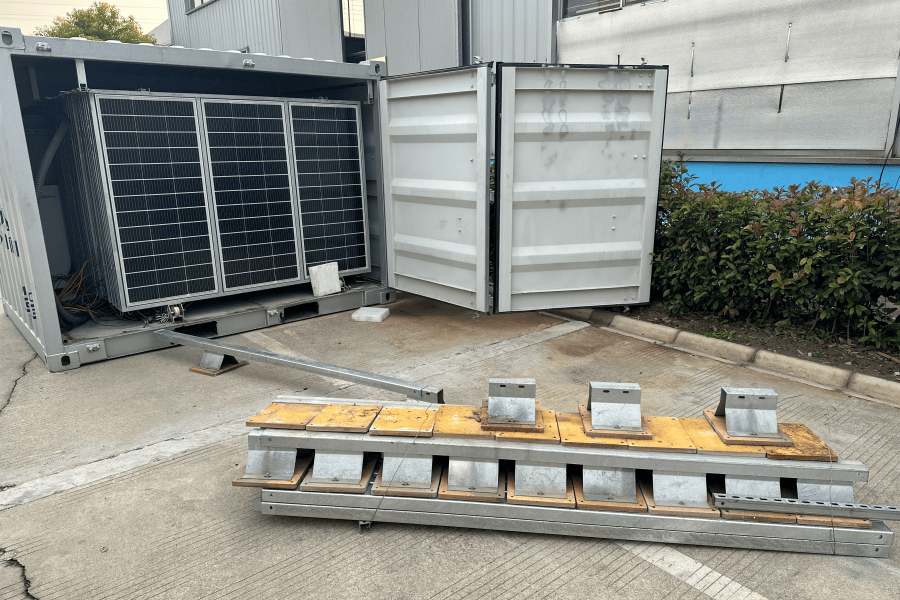
Table of Contents
- The Real Problem: Why On-Site Energy Storage Feels Like a Construction Nightmare
- The Costly Reality: When "Custom" Becomes a Budget-Killer
- A Smarter Path: Unpacking the All-in-One, Pre-Integrated PV Container
- The Installation Playbook: A Step-by-Step Guide from My Experience
- Why This Matters: LCOE, Safety, and Getting Your Project Online Faster
The Real Problem: Why On-Site Energy Storage Feels Like a Construction Nightmare
Honestly, if I had a dollar for every time a plant manager told me their last energy project felt like building a ship in a bottle... while the bottle was on fire... I'd have a nice early retirement fund. We all know the promise: add solar, pair it with storage, slash your energy bills, and gain resilience. The business case on paper is solid. But the path from signing a contract to flipping the "on" switch? That's where the headaches begin, especially for busy industrial parks.
The traditional approach is a symphony of different trades. First, you need a concrete pad designed for immense weight. Then, separate crews arrive for the battery racks, the inverter skids, the HVAC, the fire suppression, the medium-voltage transformer. You're managing a dozen different suppliers, a mountain of interconnection paperwork, and a schedule where one delayed component halts everything. I've seen projects where the batteries sat on-site for months, wrapped in plastic, waiting for a certified electrician to become available. That's capital tied up, doing nothing.
The Costly Reality: When "Custom" Becomes a Budget-Killer
Let's talk numbers, because that's what keeps decision-makers up at night. The National Renewable Energy Laboratory (NREL) has shown that soft costs - engineering, permitting, installation labor, and financing - can make up 40-50% of a commercial BESS project's total cost. That's before a single kilowatt-hour is stored. Every extra day of on-site labor, every unforeseen site condition, every change order eats directly into your ROI.
The aggravation doesn't stop at cost. It's about risk. Each field-wired connection is a potential point of failure. Ensuring every component from different manufacturers talks to each other seamlessly is an integration nightmare. And from a safety perspective, you're essentially building a one-off system. Does it fully comply with UL 9540 for the energy storage system, UL 1741 for the inverters, and the local fire code? Proving that to the Authority Having Jurisdiction (AHJ) can be a long, drawn-out process. I've been in those meetings with fire marshals, trying to explain a unique system design. It's stressful for everyone.
A Smarter Path: Unpacking the All-in-One, Pre-Integrated PV Container
This is where the game has changed. Instead of a "kit of parts," think of a delivered solution. The all-in-one, pre-integrated PV container is exactly what it sounds like: a factory-built, plug-and-play unit that arrives on your site with the solar inverters, battery racks, thermal management, fire safety, and controls already installed, tested, and talking to each other.
At Highjoule, we call this our "PowerBlock" system. The philosophy is simple: move 90% of the complex work to a controlled factory environment. Our engineers pre-assemble everything according to strict UL and IEC standards. We perform full system commissioning - what we call a "hot test" - before the unit even leaves the dock. This means when it arrives, it's not a box of components; it's a functional power plant in a container.

The Installation Playbook: A Step-by-Step Guide from My Experience
So, what does this streamlined installation actually look like? Let me walk you through it, based on a project we completed last year for a food processing plant in Texas. Their challenge was peak shaving and backup power for critical refrigeration.
Step 1: Site Prep & Foundation (Weeks, Not Months)
Because we know the exact dimensions and weight distribution, your civil team isn't designing a custom foundation. They're following our pre-engineered template for a simple, reinforced concrete pad or a pre-fab modular base. This cuts design time and eliminates guesswork.
Step 2: Delivery & Placement (The "Drop and Set")
On installation day, it's a logistics operation, not a construction site. A heavy-duty truck delivers the container. A crane lifts it, and it's placed directly onto the prepared foundation. We use laser levels to ensure perfect alignment for the electrical conduits. This often takes less than a day.
Step 3: The Big Connections (AC, DC, and Data)
Here's the beauty. Instead of hundreds of small wires, we're making a handful of bulk connections. The DC side from your solar array feeds into pre-labeled terminals. The AC side connects to the integrated switchgear that ties into your facility's main distribution panel. Finally, we plug in the fiber-optic data cable to our monitoring gateway. It's clean and straightforward.
Step 4: Commissioning & Go-Live (The Fast Part)
Since the system was fully tested at the factory, on-site commissioning is primarily a verification and safety check. We confirm the voltages, run the integrated HVAC and fire suppression system tests, and ensure the grid interface is stable. With all the UL certifications pre-documented, the AHJ review is vastly simplified. In Texas, we had the system from delivery to energization in under 72 hours.
Why This Matters: LCOE, Safety, and Getting Your Project Online Faster
Beyond just a faster install, this approach hits the core metrics that matter for your business.
Driving Down the Levelized Cost of Energy (LCOE): LCOE is the total lifetime cost of your energy asset. By slashing soft costs and installation time, you immediately improve the numerator. But there's more. A factory-built system has optimized thermal management (crucial for battery life and safety) and higher-quality, consistent wiring. This boosts efficiency and extends the system's operational life, improving the denominator. You get more energy, for less cost, over a longer period.
Safety by Design, Not by Chance: When you build in a factory, you can implement safety protocols that are impossible on a busy job site. Every electrical connection is torqued to spec in a clean environment. The thermal runaway propagation prevention systems are installed as a unified unit. Having a single set of UL 9540 and UL 9540A test reports for the entire assembly gives you, the fire marshal, and your insurer immense confidence.

The Bottom Line for You: It's about predictability. Your project timeline shrinks from a multi-month variable to a predictable schedule. Your budget is protected from costly on-site surprises. Your risk profile is lower. You start saving on your energy bills months sooner.
Look, the energy transition isn't just about buying the right technology; it's about choosing the right deployment method. The all-in-one container model is proving itself daily across Europe and the US because it solves the real-world problems we face in the field. What's the biggest hurdle you're seeing in your next energy project's deployment phase?
Tags: UL Standard BESS LCOE Europe US Market Industrial Energy Storage Renewable Energy Solar PV Container
Author
James Zhang
20+ years agricultural energy storage engineer / Highjoule CTO