
Step-by-step Installation of C5-M Anti-corrosion Energy Storage Container for Construction Site Power
Contents
- The Silent Cost on Your Construction Site
- Why Standard Containers Fail (And It's Not Just the Weather)
- The C5-M Advantage: More Than a Rating
- The Highjoule Field Manual: A Step-by-Step Installation Guide
- Real-World Proof: From Blueprint to Reliable Power
- Beyond the Installation: The Real ROI Talk
The Silent Cost on Your Construction Site
Let's be honest. When you're managing a construction site, power is often the last thing you want to think about - until it fails. The diesel generators roar, the fuel bills pile up, and the noise?- well, let's just say the neighbors aren't fans. But there's a bigger, quieter cost I've seen firsthand on sites from Texas to Bavaria: corrosion. It's the slow killer of electrical equipment. A recent report by NREL highlighted that premature degradation of balance-of-system components is a leading cause of increased Levelized Cost of Storage (LCOS) in non-ideal environments. On a construction site, you're not in a clean, controlled data center. You're in a C5-M environment.
What does that mean? According to the ISO 12944 standard, a C5-M (Marine) environment is classified as having very high corrosivity. Think of constant exposure to salt spray (coastal sites), industrial pollutants, or the abrasive dust and chemical-laden moisture of an active construction zone. Your standard, off-the-shelf battery container might have an IP rating for water and dust, but its steel and electronics are being eaten away from the inside out by these aggressive agents. The result? Unexpected downtime, costly emergency replacements, and safety risks that keep any project manager up at night.
Why Standard Containers Fail (And It's Not Just the Weather)
I've been called to too many sites where a "rugged" storage unit failed within 18 months. The client points to a rusty panel or a fried inverter. The real issue? A systemic mismatch between the product and the environment. Standard containers often use carbon steel with standard industrial paint. In a C5-M setting, that's like wearing a cotton t-shirt in a hailstorm. The corrosion starts at micro-scratches, weld points, and fastener holes - places you can't easily inspect.
This isn't just about aesthetics. Corrosion leads to increased electrical resistance, heat buildup, and ultimately, thermal runaway risk. Your battery management system (BMS) is only as good as the signals it receives from sensors housed in corroding enclosures. When those signals get noisy or fail, your entire system's safety and performance are compromised. You're not just losing power; you're gambling with a critical asset.

The C5-M Advantage: More Than a Rating
This is where a true C5-M Anti-corrosion Energy Storage Container isn't just a product spec - it's your project's insurance policy. At Highjoule, when we build for C5-M, we're thinking about the entire lifecycle. It starts with hot-dip galvanized steel structural frames, not just painted ones. We use aluminum or stainless-steel cladding for the exterior. All fasteners are stainless steel. The paint system isn't just a coat; it's a multi-layer, epoxy-based barrier applied under controlled conditions. Honestly, it's over-engineered for a reason: to survive what your construction site will throw at it for a 15-20 year lifespan.
The protection extends inward. Our environmental control system isn't just an air conditioner. It's a sealed, positive-pressure system with corrosion-inhibiting filters. This keeps the internal environment at an ideal C2 or C3 level (low corrosivity), regardless of the chaos outside. This is crucial for maintaining the precision of the BMS and thermal management systems, which directly impact your battery's C-rate capability and longevity. A stable, cool, dry interior means you can safely draw higher power (a higher C-rate) when you need to run heavy equipment, without stressing the cells.
The Highjoule Field Manual: A Step-by-Step Installation Guide
Alright, let's get practical. How do you actually deploy one of these systems correctly? It's not "plug and play." Here's the condensed field manual from two decades of getting this right.
Phase 1: Pre-Site & Foundation (The Most Critical Week)
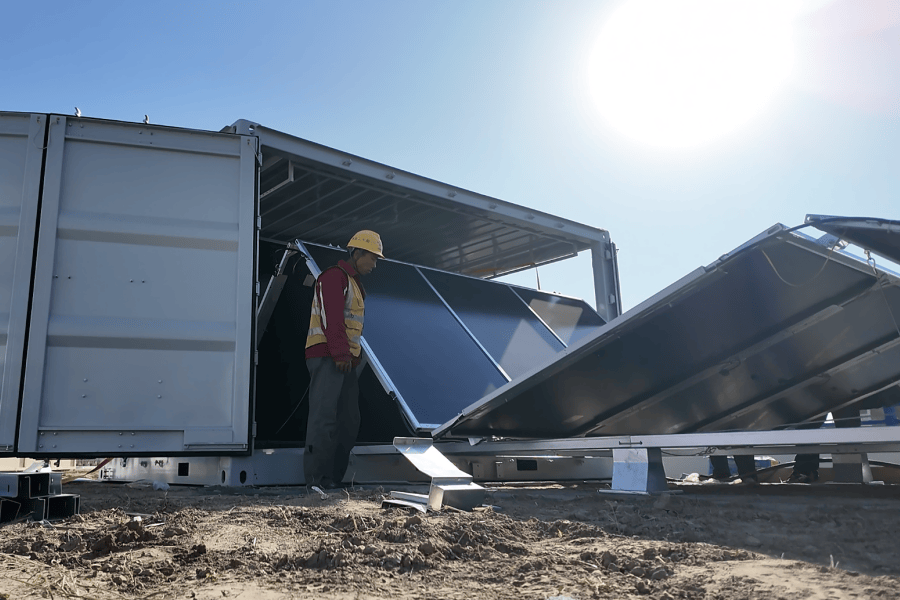
Step 1: Site Verification & Civil Works. Before the container even ships, our team verifies the site plan. The foundation isn't just a concrete pad. It must be level, have proper drainage away from the unit, and include embedded anchor bolts or a mounting frame that matches our container's base. We've seen pads heave or pool water, leading to immediate corrosion and stress on the structure. All electrical conduits and utility trenches must be pre-laid.
Step 2: Delivery & Unloading. Use a crane with soft slings. Never lift from external conduits or HVAC units. The container is heavy, and a twist during landing can break the environmental seal. Position it within 50mm of the planned anchor points.
Phase 2: Mechanical & Electrical Installation
Step 3: Anchoring and Sealing. Bolt down using the provided torque specs. This is non-negotiable for wind load and seismic compliance (think IEEE 693 and local building codes). Immediately after, install the base sealant kit around the perimeter. This foam-rubber gasket is your first line of defense against ground moisture and rodents.

Step 4: Electrical Hookup. Here's a common pitfall: using standard, non-weatherproof connectors for the main AC/DC feeds. All external connections must go through the provided IP66/IP67 rated gland plates. Internal cabling should be neatly routed and secured - vibration from nearby construction can loosen wires over time. The grounding connection is sacred; we often install an independent ground rod bonded to the main site grid.
Step 5: Commissioning & "Bake-Out". Power on the internal environmental system first. Let it run for 24-48 hours. We call this the "bake-out" period. It stabilizes the internal humidity and temperature, ensuring no condensation forms when you bring the high-voltage battery racks online. Only then do we begin the full system commissioning, cycling through BMS alarms and grid interface tests.
Real-World Proof: From Blueprint to Reliable Power
Let me give you a real example. We deployed a 1.2 MWh C5-M system for a major port infrastructure expansion in the Netherlands. The challenge: constant salt spray, heavy vibration from pile driving, and zero tolerance for downtime as the port needed to remain operational.
The standard container offered by another vendor was rejected after our audit. We installed our system with an enhanced foundation and a dedicated, filtered air intake pointing away from the dominant sea wind. Eighteen months in, during a routine service, the exterior showed the expected salt residue, but the internal inspection was clean - no corrosion, no fault codes. The thermal management system was maintaining a perfect 25C +/- 2C delta across all racks, which is what keeps your LCOE low by maximizing cycle life. The client's main comment? "We forget it's there." That's the highest compliment.
Beyond the Installation: The Real ROI Talk
So, you're past the installation. The system is humming. The real value of a proper C5-M installation like this is in the long-term numbers. By virtually eliminating corrosion-related failures, you're slashing your operational and maintenance (O&M) costs. According to IRENA, proactive, durability-focused design can reduce BESS O&M costs by up to 35% over the system's life.
More importantly, you've future-proofed your asset. When this construction phase ends, that container can be relocated - intact and fully functional - to the next site, or become part of the permanent facility's microgrid. Its residual value is protected.
At Highjoule, we don't just sell a container. We embed our 20 years of field scars and lessons into a system designed to be forgotten. Because on a busy construction site, the best power source is the one you never have to worry about. What's the one environmental factor on your next project site that keeps you up at night?
Tags: Construction Site Power UL Standard BESS C5-M Standard Energy Storage Installation Anti-corrosion Container Project Deployment
Author
James Zhang
20+ years agricultural energy storage engineer / Highjoule CTO