
Step-by-step Installation of Liquid-cooled Off-grid Solar Generator for EV Charging Stations
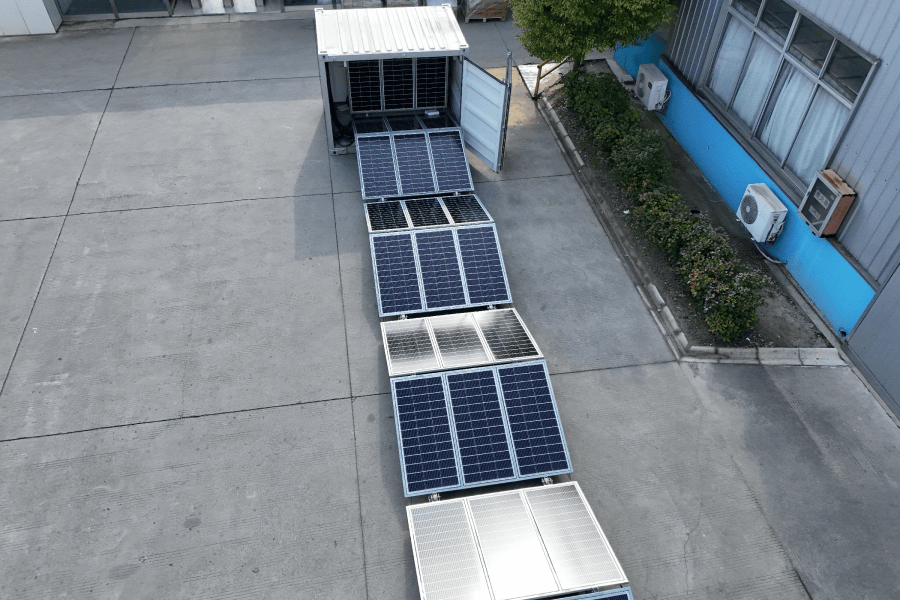
Table of Contents
- The Real Grid Problem Nobody Talks About
- Why "Hot Batteries" Are Killing Your Project Economics
- The Blueprint: A Site Engineer's Walkthrough
- Beyond the Installation: The Hidden Value of Smart Thermal Management
- Is Your Next EV Charging Hub Truly Future-Proof?
The Real Grid Problem Nobody Talks About
Honestly, if I had a dollar for every time a commercial property developer told me their main hurdle was "just getting the permits" for a new EV fast-charging hub, I'd be retired by now. The permits are tough, sure. But the real monster hiding in the closet, the one that derails budgets and timelines, is the grid connection.
I've seen this firsthand on sites from California to North Rhine-Westphalia. You secure a prime location, the demand is there, but the local distribution network is at capacity. The utility comes back with a quote for a transformer upgrade and line extension that adds six figures to your CAPEX and pushes the project out by 18 months. Or worse, they simply say "no." According to the International Energy Agency (IEA), grid integration challenges are one of the top barriers to rapid EV infrastructure rollout. This isn't a hypothetical; it's a daily reality blocking clean transportation.
That's where the conversation shifts from "how do we connect to the grid?" to a more powerful question: "How much of this load can we take off the grid?" This is the precise pain point that makes a Step-by-step Installation of Liquid-cooled Off-grid Solar Generator for EV Charging Stations not just an interesting tech demo, but a critical, financially-savvy business decision.
Why "Hot Batteries" Are Killing Your Project Economics
Let's talk about the heart of any off-grid system: the battery. Now, most folks focus on the nameplate capacity C the kilowatt-hours. But anyone who's spent a summer afternoon watching a containerized BESS on a concrete pad knows the real enemy is heat.
Air-cooled systems, while simpler upfront, struggle with consistency. On a hot day, to prevent the battery cells from degrading (or worse), the system derates itself. You paid for 500 kW of power, but you're only getting 350 kW when you need it most. This directly hits your revenue, especially during peak charging hours. It also shortens the battery's life, increasing your long-term Levelized Cost of Energy (LCOE) C the true metric of your system's cost over its lifetime.
For an EV station, reliability is currency. A driver encountering a throttled charging speed due to thermal limits is a driver who won't come back. This operational risk is what makes the thermal management choice a strategic one, not just a technical checkbox.

The Blueprint: A Site Engineer's Walkthrough
So, what does a robust, future-proof installation actually look like? Forget the glossy brochures. Here's the on-the-ground sequence for a system designed to last, based on our deployments for clients like a logistics park in Texas that needed overnight fleet charging without a $2M grid upgrade.
Phase 1: Site Prep & Foundation C More Than Just a Slab
This is where you avoid 80% of future headaches. We're not just pouring concrete for weight. We're planning for:
- Thermal Mass & Airflow: The pad is sized and oriented to minimize direct afternoon sun exposure on the BESS container. We also ensure clear, unobstructed pathways for the liquid cooling system's external radiators or dry coolers.
- Conduit Raceways: Separate, oversized conduits are laid for power cables (DC from solar, AC to chargers) and communication/control lines. Mixing them is asking for noise interference.
- Local Compliance: This is non-negotiable. All structural plans are stamped for local seismic and wind loads, and every component is pre-certified to UL 9540 (Energy Storage Systems) and IEC 62443 (security). Having these certs in hand before the inspector arrives is what separates a smooth project from a stalled one.
Phase 2: The Core Installation C Precision Over Speed
- BESS Placement & Hardening: The liquid-cooled container is craned onto its dedicated anchor points. The immediate next step is verifying the integrity of the coolant loop before power-on C a step our Highjoule field teams treat with the same seriousness as a high-voltage test.
- DC/AC Integration: Here, the "off-grid" design shines. The solar array connects to the BESS's integrated MPPT charge controllers. The BESS output is then fed through a dedicated, grid-forming inverter that creates a stable, clean "mini-grid" for the charging dispensers. The key is the communication backbone; the BESS controller must talk in real-time to both the solar inverters and the EV chargers to manage load and generation seamlessly.
Phase 3: Commissioning C The Proof is in the Protocol
We don't just flip a switch. We execute a written test protocol, often witnessed by the client's engineer. This includes a full-load test: simulating four EVs charging at max rate simultaneously on a simulated hot day. We monitor the coolant temperature delta (inlet vs. outlet) to confirm the thermal system is maintaining cell temperature within a 2-3C band. That tight control is what ensures you get the full C-rate (the speed at which the battery can discharge) you paid for, year after year.
Beyond the Installation: The Hidden Value of Smart Thermal Management
When we at Highjoule Technologies design a system, we're thinking about the 10-year horizon. Liquid cooling isn't just about avoiding throttling. It's about predictability.
By keeping cells at an optimal, uniform temperature, we drastically slow the chemical aging process. In practical terms, this means the battery's capacity fade curve is flatter. Where an air-cooled system might hit 80% of its original capacity in 5 years, a properly liquid-cooled one might take 8 or 9 years to reach that same point. This has a direct, positive impact on your project's financial model, improving the LCOE and safeguarding your ROI.
It also allows for a denser, more compact system footprint C a huge advantage for urban or space-constrained sites where every square meter counts. Our modular design philosophy means that system, once installed, can also be more easily upgraded or serviced by local technicians, a cornerstone of our long-term service commitment.
Is Your Next EV Charging Hub Truly Future-Proof?
Looking at the road ahead, demand for charging will only intensify. Regulatory pressures for grid decarbonization will grow. The projects that will thrive are those built on a foundation of resilience and independence.
A Step-by-step Installation of Liquid-cooled Off-grid Solar Generator for EV Charging Stations is more than an installation manual. It's a strategic framework for building energy resilience. It's about taking control of your power costs, your operational reliability, and your project timeline.
The question isn't really about the complexity of the installation. It's about the complexity of the problem you're trying to solve. If the goal is to deploy reliable, high-uptime EV charging where the grid can't or won't help, in a way that makes economic sense for the next decade, then the path forward becomes much clearer, doesn't it?
Tags: UL Standard BESS LCOE Renewable Energy Off-grid Solar EV Charging
Author
James Zhang
20+ years agricultural energy storage engineer / Highjoule CTO