
Step-by-step Installation of Liquid-cooled Pre-integrated PV Container for Military Bases
From Blueprint to Boots on the Ground: A Real-World Guide to Deploying Secure, Resilient Power for Military Sites
Hey there. If you're reading this, chances are you're tasked with a critical mission: securing reliable, resilient, and independent power for a forward operating base, a remote surveillance post, or a domestic military facility. I've been in your shoes, standing on a dusty site or a windswept plain, looking at a stack of components and a tight deadline. Over two decades, I've seen the good, the bad, and the downright dangerous in energy storage deployments. Honestly, the shift towards pre-integrated, liquid-cooled PV container solutions is one of the most significant leaps I've witnessed for mission-critical applications. It's not just about technology; it's about transforming a complex, high-stakes logistical puzzle into a predictable, secure process. Let's talk about how, step-by-step.
Quick Navigation
- The Real Problem: It's More Than Just "Plug and Play"
- Why Getting It Wrong Matters (A Lot)
- The Solution Path: Pre-Integration & Liquid Cooling
- The Step-by-Step Field Breakdown
- Lessons from the Field: A Case in Point
- Key Technical Considerations (Without the Jargon)
The Real Problem: It's More Than Just "Plug and Play"
In the commercial world, a few days of delay might mean a financial penalty. In the military context, it can mean a critical gap in operational readiness. The traditional approach to building a solar-plus-storage microgrid for a base is what we call a "stick-build" on site. You're essentially a general contractor managing a dozen different trades: civil teams for the pad, electrical crews for the medium-voltage connection, specialists for the battery racks, another team for the power conversion system (PCS), and HVAC experts for thermal management. The coordination is a nightmare. I've seen projects where the battery containers arrived, but the custom-fabricated cooling ducts weren't ready for another three weeks. Or worse, the site's soil analysis wasn't thorough, leading to costly foundation rework. The problem isn't the intent; it's the execution risk that multiplies in remote or high-security environments.
Why Getting It Wrong Matters (A Lot)
Let's agitate that pain point a bit. What's the real impact? First, timeline vulnerability. Every day of delay is a day the base relies on vulnerable fuel convoys or an unstable local grid. The U.S. Department of Defense has highlighted energy security as a critical strategic priority, noting that distributed generation reduces logistical risks. Second, safety and compliance risk. A field-assembled system has more points of potential failure - a loose connection here, an improperly torqued thermal interface there. In a container, heat buildup is the enemy. Without superior thermal management, you're not just losing efficiency; you're accelerating battery degradation and, in extreme cases, creating a safety hazard. Third, total cost of ownership. The initial capital expense is just the entry fee. The real cost is in the maintenance, the efficiency losses over 15+ years, and the potential for unscheduled downtime. A poorly integrated system will bleed money and resources for its entire life.
The Solution Path: Pre-Integration & Liquid Cooling
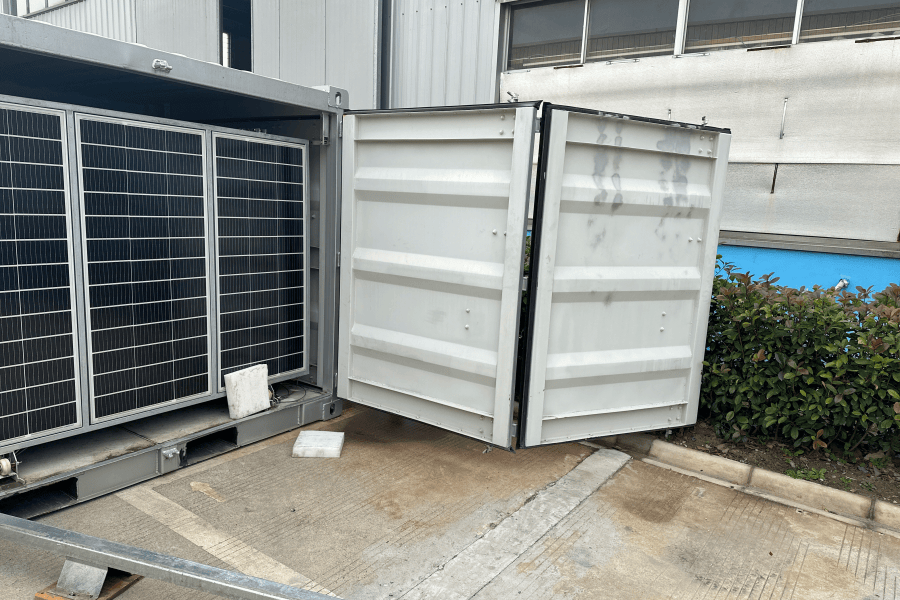
This is where the concept of a Step-by-step Installation of Liquid-cooled Pre-integrated PV Container changes the game. The solution isn't a single product; it's a methodology. At Highjoule, we think of it as delivering a "power plant in a box." The core idea is to move 95% of the integration work - battery modules, liquid cooling loops, PCS, fire suppression, and controls - from the challenging field environment into our controlled, UL-certified factory environment. What arrives on the flatbed truck is essentially a fully tested, commissioned unit. Our role on site transitions from system integrators to system connectors. The step-by-step process becomes less about construction and more about precise, repeatable connection and verification.

The Step-by-Step Field Breakdown
Based on our deployments for critical infrastructure, here's what a streamlined installation looks like:
- Step 1: Site Prep & Foundation (Weeks 1-2). This is the most critical variable. Our team provides exact specs for the reinforced concrete pad. The key is doing this in parallel while the container is being built. We've learned to insist on a third-party geotech report. A stable, level foundation is non-negotiable.
- Step 2: Delivery & Placement (Day 1). The pre-integrated container arrives. With all internal components mounted and secured, it's a single heavy lift. Using a crane, we place it on the pre-positioned anchor bolts. The beauty? There's no delicate internal equipment to shift or damage during this move.
- Step 3: The Four Core Connections (Days 2-4). This is the heart of the "step-by-step" field work.
- Electrical (AC & DC): We connect pre-determined cables from the site's PV array and grid/incoming power to the clearly marked, UL-listed terminals on the container's external connection panel.
- Cooling: We hook up the external dry cooler or chiller to the container's internal liquid cooling loop via quick-connect fittings. This closed-loop system is pre-filled and tested.
- Data & Controls: A single fiber or Ethernet cable connects the container's built-in SCADA system to the base's energy management or command center.
- Fire Safety Interface: Connection to the site's central alarm system is standardized and straightforward.
- Step 4: Commissioning & Acceptance (Days 5-6). We power up the system and run through a predefined protocol. Because the entire internal system was factory-tested, this phase is a verification, not a debugging session. We check grid synchronization, perform a partial charge/discharge cycle, and verify all safety interlocks.
Lessons from the Field: A Case in Point
Let me give you a real example, though I have to keep the specifics generic for security. We deployed a system for a European NATO member at a remote Arctic monitoring station. The challenge: a 3-month annual weather window, no local skilled labor, and a requirement for 99.99% uptime in -40C conditions. The "stick-build" approach was impossible.
Our pre-integrated, liquid-cooled container was built and tested in our facility over the winter. When spring came, it was shipped, placed, and connected in under 10 days on site. The liquid cooling system was crucial - it not only managed heat during high C-rate discharges (like starting large diesel generators as a backup) but also provided heating for the battery cells in the extreme cold, maintaining optimal efficiency. The local crew only needed to handle the four core connections I mentioned. The system met all relevant IEC and IEEE standards for islandable microgrids and has been running autonomously for over 3 years now. The lesson? Pre-integration compresses the high-risk site work into a simple, repeatable procedure.

Key Technical Considerations (Without the Jargon)
When evaluating a solution like this, here's what I'd be asking about, based on what keeps me up at night:
- Thermal Management (The Liquid Cooling Advantage): Air cooling simply can't keep up with the high power demands (high C-rate) of military applications. Liquid cooling directly targets each battery cell, keeping temperature variation across the pack within 2-3C. This isn't just about safety; it can double the cycle life of the batteries compared to an air-cooled system under similar stress. That's a massive reduction in long-term Levelized Cost of Storage (LCOE).
- Safety by Design, Not by Add-on: The system must be built to UL 9540 and UL 9540A standards from the ground up. In a pre-integrated design, the fire suppression (typically a clean agent like NOVEC 1230) is engineered into the container's airflow and detection system. It's not an afterthought.
- Cybersecurity from the Hardware Up: The control system must be compliant with standards like NIST frameworks. In our units, this means hardware-level security modules and encrypted communications that are configured during factory integration, eliminating a major configuration risk on site.
The goal isn't to sell you a container. It's to provide a predictable, secure, and resilient energy asset that becomes a silent, reliable partner to your mission. The step-by-step installation process is the proof point - it's where theory meets the ground, and where our 20 years of learning from field mistakes translates into a smooth, successful deployment for you.
What's the single biggest site constraint you're facing in your next project's deployment phase?
Tags: UL Standard BESS Liquid Cooling Renewable Energy Pre-integrated Container Military Energy Security IEEE Standard Project Deployment
Author
James Zhang
20+ years agricultural energy storage engineer / Highjoule CTO