
Step-by-step Installation of Novec 1230 Fire Suppression for Solar Container Data Center Backup
Contents
- The Silent Threat in Your Backup Power Plan
- Why This Hurts More Than You Think: Cost, Compliance, and Downtime
- A Better Way: Integrating Safety from the Ground Up
- The Installation Playbook: Novec 1230 in a Solar-BESS Container
- Lessons from the Field: A German Case Study
- Thinking Beyond the Box: Your LCOE and Peace of Mind
The Silent Threat in Your Backup Power Plan
Let's be honest. When you're planning a solar-plus-storage container for data center backup, the conversation is all about power. Megawatt-hours, C-rates, inverter compatibility, and of course, the Levelized Cost of Energy (LCOE). The fire suppression system? It often gets tacked on as a compliance checkbox, a line item from a different vendor. I've seen this firsthand on site, from California to North Rhine-Westphalia. That disconnect between the energy system and its safety system is where the real risk lives. You're essentially building a highly resilient power island, but its last line of defense might be an afterthought.
Why This Hurts More Than You Think: Cost, Compliance, and Downtime
This "bolt-on" approach creates a cascade of problems. First, it complicates compliance. UL 9540 and IEC 62933 are clear about system-level safety. If your fire suppression isn't fully integrated and validated with the BESS thermal management system, you're facing potential delays and costly rework. Second, and more critically, it impacts your actual bottom-line protection. A generic system might not account for the unique thermal runaway characteristics of Li-ion batteries or the specific airflow patterns inside a densely packed container. In a real event, that could mean the difference between containing a single module and a total loss. According to the National Renewable Energy Lab (NREL), effective thermal management is the single biggest factor in mitigating battery fire propagation. A poorly integrated system fails that test.

A Better Way: Integrating Safety from the Ground Up
The solution is to treat fire suppression not as an accessory, but as a core, integrated subsystem of your Battery Energy Storage System (BESS) container. For critical backup power, like data centers, the agent of choice is often Novec 1230. It's clean, effective, and leaves no residue - perfect for protecting sensitive electronics. But the magic isn't just in the chemical; it's in the step-by-step installation and integration process. At Highjoule, we design our containerized solutions with the pipe routes, agent distribution nozzles, and control interfaces for Novec 1230 baked into the initial layout. This isn't an add-on; it's part of the DNA of the unit, ensuring seamless compliance with UL and IEC standards from day one.
The Installation Playbook: Novec 1230 in a Solar-BESS Container
So, what does this integrated, on-the-ground process actually look like? Forget generic manuals. Here's the sequence we follow, honed from dozens of deployments:
- Pre-Fab Integration: Before the container even leaves our facility, the primary pipe runs and mounting points for the Novec 1230 cylinders and detection system are installed. This is crucial. It avoids field-cutting and welding, which introduces contamination risk and weak points.
- Site Positioning & Utility Hookup: Once the container is placed and anchored, and the primary solar and grid connections are underway, our team stages the fire suppression components. This means the BESS internal environment (temperature, humidity) is already stabilized.
- Agent Distribution Network: This is the meticulous part. Nozzles are installed at precisely calculated points above the battery racks, power conversion systems (PCS), and switchgear. The goal isn't just to flood the space, but to create a uniform concentration of agent where a thermal event is most likely to start - often at the module or cell level. We map this against the CFD (Computational Fluid Dynamics) models from the design phase.
- Detection System Marriage: Here's the key integration point. The smoke/heat detectors aren't standalone. They're wired directly into the BESS's main control system and the container's thermal management controls. If detector A triggers, the system doesn't just release gas. It can first command the HVAC to shut down (to prevent spreading and maintain agent concentration) and initiate a controlled ramp-down of the battery racks if safe to do so.
- Commissioning & Acceptance Test: We don't just test the fire system in isolation. We perform a full functional test with the BESS online at various C-rate discharges (simulating a real backup event). We validate that the control logic between all systems works as intended. This integrated test report becomes a gold star for your compliance paperwork.
Lessons from the Field: A German Case Study
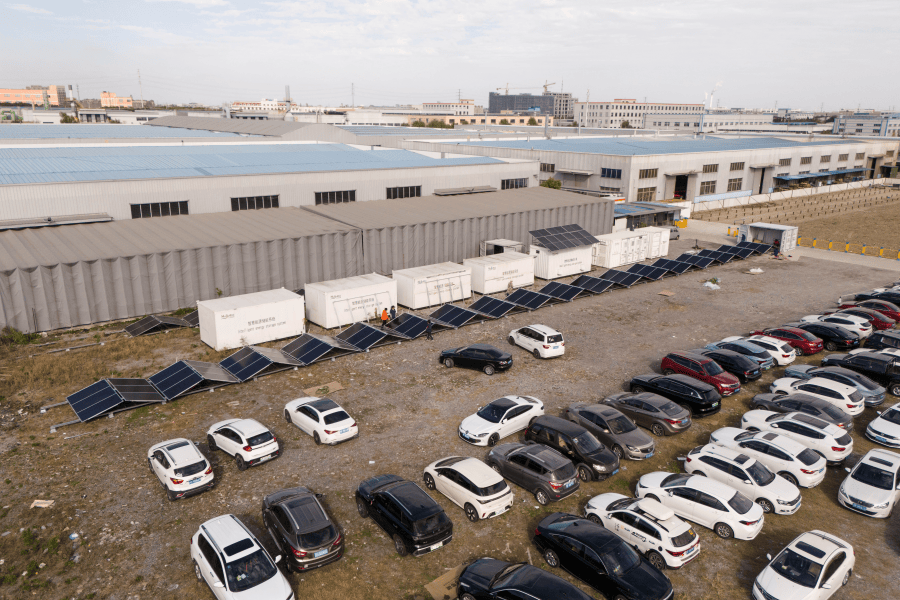
Let me give you a real example. We deployed a 2 MWh solar-container BESS for a hyperscale data center campus in Germany. Their primary concern was achieving the highest possible local fire marshal approval (which is stringent) without delaying their green power backup timeline. The challenge was the tight space constraints and the need for the system to be serviceable without a full agent dump.
Our integrated Novec 1230 design allowed for a zoned approach. We divided the container into two suppression zones - one for the battery racks, one for the PCS and transformers. This allowed for targeted protection and meant maintenance in one zone wouldn't disable the entire system. During commissioning, the local inspector was impressed that our fire system controls shared a unified interface with the BESS performance data. It wasn't two systems; it was one resilient unit. That project passed inspection on the first try, a rarity that saved months.
Thinking Beyond the Box: Your LCOE and Peace of Mind
When you get this right, the benefits extend far beyond avoiding a disaster. A properly integrated safety system protects your asset's lifespan. By ensuring rapid, targeted suppression, it minimizes potential damage from even a small event, preserving your battery investment. This directly impacts your long-term LCOE. It also simplifies insurance underwriting - a huge factor in total cost of ownership now.
Honestly, the step-by-step process for Novec 1230 installation is a proxy for a larger philosophy: true resilience comes from holistic design. At Highjoule, our job isn't just to sell you a container. It's to deliver a fully integrated, compliant power asset that you can forget about until the very moment you need it. And when that moment comes, you'll be glad that the safety system was in the room from the very first design meeting, not just an afterthought bolted to the wall.
What's the single biggest compliance hurdle you're facing with your backup power site plan right now?
Tags: UL Standard BESS Data Center Backup Microgrid Novec 1230 Fire Suppression Energy Storage Safety
Author
James Zhang
20+ years agricultural energy storage engineer / Highjoule CTO