
Step-by-step Installation of Scalable Modular Energy Storage for Telecom

Table of Contents
- The Silent Challenge for Telecom Networks
- Beyond the Diesel Genset: The Modular Shift
- The Installation Playbook: A Step-by-Step Walkthrough
- The Real-World Proof: A German Case Study
- The Expert Corner: What Really Matters On-Site
- The Future is Modular, The Future is Scalable
The Silent Challenge for Telecom Networks
Honestly, when we talk about telecom base stations, most folks think about the antenna, the signal strength, maybe the fiber backhaul. Hardly anyone thinks about the power system tucked away in a corner or a shed. But after 20+ years in this field, I can tell you this: that's the single point of failure that keeps network operators awake at night. The problem isn't just about keeping the lights on during a grid outage - it's about doing it reliably, safely, and affordably for 10, 15, even 20 years.
I've seen this firsthand on site. The traditional approach? A room full of lead-acid batteries, a couple of diesel generators on standby, and a maintenance schedule that's both expensive and prone to human error. When a storm hits or the grid flickers, the batteries take over. But if the outage lasts more than a few hours, those batteries deplete, the diesel kicks in - if it starts - and you're burning fuel at a crazy rate, creating noise, emissions, and a logistical nightmare for refueling. The International Energy Agency (IEA) notes that the telecom sector's energy demand is growing, and its resilience is directly tied to reliable, clean backup power. This isn't a niche concern anymore; it's a core business continuity issue.
Beyond the Diesel Genset: The Modular Shift
So, where's the industry heading? The aggravation with old-school systems is real. The total cost of ownership (TCO) for diesel is skyrocketing, and static battery rooms are inflexible. You build for peak capacity on day one, even if you only need 30% of it for the first five years. That's sunk capital just sitting there. What we need is a solution that scales with demand, deploys fast, and meets the stringent safety codes that govern our industry, especially in North America and Europe.
This is where the concept of a Step-by-step Installation of Scalable Modular Energy Storage Container becomes the game-changer. It's not just a product; it's a methodology. Think of it like building with LEGO blocks. Instead of pouring a custom foundation and building a permanent battery room, you start with a pre-engineered, self-contained unit. This containerized Battery Energy Storage System (BESS) is your base module. It arrives on-site with the batteries, thermal management, fire suppression, and power conversion systems all integrated and pre-tested. Your job shifts from complex electrical construction to precise placement and connection.
The Installation Playbook: A Step-by-Step Walkthrough
Let me break down what this scalable installation process actually looks like on the ground. It demystifies the whole thing.
- Site Assessment & Foundation (Week 1-2): This is the most critical phase. We're not building a heavy building, but the site must be level and have a simple, reinforced concrete pad. We check for clear access for a crane and a truck. The goal is minimal civil work. A big part of my job is ensuring the local site conditions align with the container's design specs - things like wind load, snow load, and seismic ratings, which are all part of the UL 9540 and IEC 62933 standards these units are built to.
- Delivery & Positioning (Day 1): The container arrives on a flatbed. With a crane, it's lifted and placed onto the pre-prepared pad. This takes a few hours, not weeks. The beauty is the modularity. At Highjoule, our standard 20ft or 40ft containers are designed for this exact purpose. They're weatherproof, tamper-resistant, and their footprint is predictable.
- Electrical Interconnection (Week 2): Here's where the "step-by-step" shines. We connect the first container to your site's main power distribution panel and critical load (your telecom gear). This is a defined scope: a set of AC and DC cables, grounding, and the grid interconnection point. Because the container is a pre-certified system, the local electrical inspector is dealing with a known, UL-listed entity, which significantly streamlines approvals.
- Commissioning & Go-Live (Week 2-3): We power up the system, run diagnostics, and simulate grid failures. The system is designed to automatically switch to backup power within milliseconds - seamless for your network.
- Future Scaling (Year 3, 5, or 10): When your power needs grow (maybe you're adding 5G radios or edge computing servers), you don't rip and replace. You order a second, identical container. Place it next to the first, run the pre-designed cable trough between them, and parallel the systems. Your capacity and power (your C-rate) scale linearly. This phased CAPEX approach is a CFO's dream, optimizing your Levelized Cost of Energy (LCOE) for storage over the asset's entire life.
The Real-World Proof: A German Case Study
Let me give you a real example from the field. We worked with a major telecom operator in North Rhine-Westphalia, Germany. They had a cluster of rural base stations that were vulnerable to grid fluctuations and needed to integrate on-site solar. The challenge was space, strict local Bauvorschriften (building codes), and a need to phase investment.
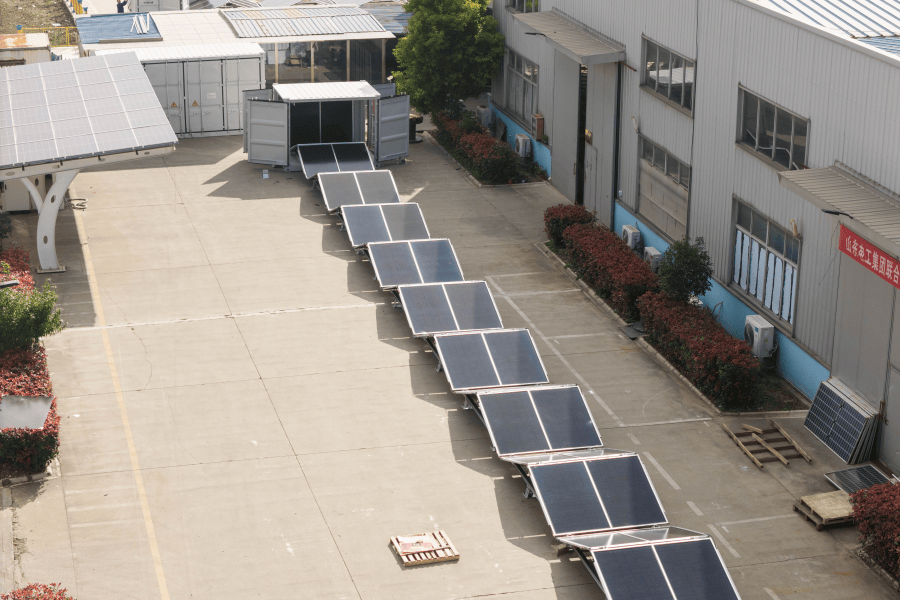
We started with one 40ft Highjoule modular container at their most critical site. The installation followed the steps above. The pad was poured in 10 days. The container, with its built-in HVAC and Novec? fire suppression system, passed the local authority review quickly because it carried full IEC and CE marks. It was connected to their existing switchgear and a new solar canopy.
Within the first year, the reduction in diesel usage was over 90%. Two years later, as they upgraded to 5G, they simply added a second container module. The site's power capacity doubled without a single modification to the original electrical room. The site manager told me, "It was like adding a USB drive to a computer - plug and play." That's the modular advantage in action.
The Expert Corner: What Really Matters On-Site
In all these installations, two technical aspects are non-negotiable: Thermal Management and Safety by Design.
People obsess over battery chemistry, but honestly, a well-managed lithium-ion battery is a happy battery. The C-rate - how fast you charge or discharge - generates heat. In a sealed container, managing that heat is everything. Our systems use a closed-loop liquid cooling system that's vastly more efficient and uniform than old fan-based methods. It keeps every cell within a 2-3C range, which is the single biggest factor in extending battery lifespan. This isn't a nice-to-have; it's what makes the 15-year performance warranty possible.
And safety - it can't be bolted on. It has to be baked in. From the cell selection to the module design, to the container-level gas detection and suppression, every layer is designed to meet and exceed UL 9540A, the benchmark test for fire safety. When I'm on site, I sleep better knowing the system has multiple, independent failsafes. This is what allows us to deploy these systems in populated areas or sensitive telecom locations without hesitation.
The Future is Modular, The Future is Scalable
The conversation around telecom power is changing. It's no longer just about backup; it's about creating a resilient, efficient, and sustainable energy asset. The step-by-step, modular container approach turns a complex, capital-intensive construction project into a predictable, repeatable, and scalable logistics operation.
If you're planning a network upgrade or building new sites, the question isn't whether you need storage. The question is: how can you deploy it in the most future-proof way? What does your scaling roadmap look like for the next decade? We find that starting that conversation over a site diagram is where the real planning begins.
Tags: UL Standard BESS Europe US Market Telecom Energy Storage Microgrid Modular Installation
Author
James Zhang
20+ years agricultural energy storage engineer / Highjoule CTO