
Industrial Park BESS: Solving Grid Constraints & High Energy Costs with 215kWh Cabinet Systems
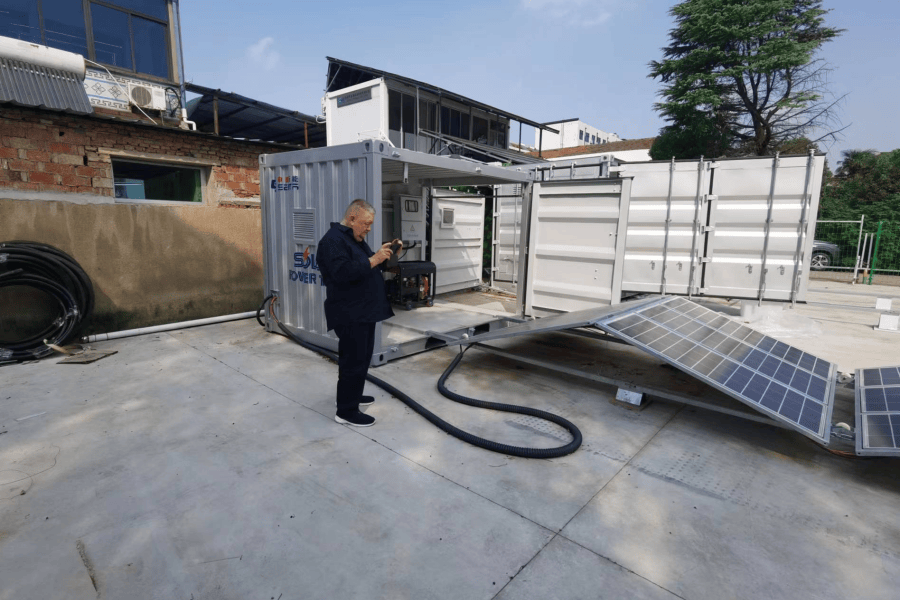
Table of Contents
- The Real Problem Isn't Just High Bills, It's Predictable Grid Strain
- The Agitation: When Peak Demand Charges and Downtime Bite
- The Solution: A Right-Sized, Rugged Partner for Your Plant
- Looking Beyond the Spec Sheet: What Really Matters On-Site
- A Case in Point: How a Midwest Factory Took Control
- Your Next Step: Asking the Right Questions
The Real Problem Isn't Just High Bills, It's Predictable Grid Strain
Let's be honest. If you're managing energy for an industrial park or a large manufacturing facility in the US or Europe right now, you're feeling the squeeze from two sides. On one hand, your finance team is waving the latest utility bill, highlighting those brutal peak demand charges. On the other, your operations lead is concerned about grid reliability C maybe they've already experienced a momentary dip or two that caused a costly production hiccup. And if you're trying to be a good corporate citizen by adding solar, you're finding that the grid isn't always as receptive to your clean power as you'd hoped.
This isn't a hypothetical. I've walked through dozens of facilities where the energy manager points to the main transformer and says, "That's our bottleneck. We can't add more load, and sometimes we're worried it'll trip." The core problem we're seeing isn't a lack of power; it's a mismatch in timing. The grid and your utility rate structure are designed for a bygone era of predictable, flat consumption. Modern industry, with its high-power processes and sustainability goals, doesn't fit that mold anymore.
The Agitation: When Peak Demand Charges and Downtime Bite
Let's put some numbers to the pain. According to the National Renewable Energy Laboratory (NREL), for many commercial and industrial users, demand charges can constitute 30-70% of their total electricity bill. One spike in power draw in a 15-minute interval can set your rate for the entire month. It's like being charged for the highest speed you ever drove all month, not the total distance.
Then there's resilience. A study by the International Energy Agency (IEA) emphasizes the growing need for grid flexibility as renewables penetration increases. For you, that translates to volatility. The grid is becoming more dynamic, and sensitive manufacturing lines C think precision machining, food cold storage, or chemical processes C can't tolerate frequent sags or interruptions. The cost of unplanned downtime? We all know it's measured in tens of thousands per hour, not just in lost production but in wasted material and missed orders.
Honestly, I've seen this firsthand on site. A facility in Ohio had a beautiful solar array, but during cloudy days, their power draw from the grid would ramp up so fast it looked like a cliff edge to the utility, triggering demand charges and frowns from the grid operator. They had the generation, but no buffer.
The Solution: A Right-Sized, Rugged Partner for Your Plant
This is where a well-specified Battery Energy Storage System (BESS) moves from a "nice-to-have" to a core piece of industrial equipment. We're not talking about a massive, multi-acre installation here. For many industrial parks, the sweet spot is a modular, containerized or cabinet-based system that can be dropped in, connected, and start working without a massive civil works project.
Take, for example, the technical specs of a 215kWh Cabinet BESS. Why is this size relevant? It's designed to tackle those specific industrial pain points:
- Peak Shaving: It's sized to absorb that "cliff edge" power draw, discharging during your short, high-demand periods to keep your grid import below a target threshold.
- Back-up Power: For critical loads, 215kWh can provide bridging power during outages, allowing for a safe shutdown or keeping essential processes online.
- Solar Smoothing: It soaks up excess solar generation during midday and releases it in the evening, increasing your self-consumption and reducing grid export issues.
The cabinet format is key. It's a self-contained unit, pre-assembled and tested in the factory. This isn't a lab prototype; it's built for the harsh environment of an industrial yard. At Highjoule, when we engineer a cabinet system like this, we're thinking about UL 9540 and IEC 62619 from the ground up. These aren't just stickers; they're a design philosophy. It means the battery cells, the power conversion system (PCS), the cooling, and the safety controls are all integrated to meet the rigorous safety standards that plant managers and their insurers demand in North America and Europe.

Looking Beyond the Spec Sheet: What Really Matters On-Site
Anyone can list kWh and kW ratings. Where the rubber meets the road C or rather, where the cable meets the switchgear C is in the details that affect total cost of ownership and reliability.
Let me break down three things I always look at:
- C-rate (Charge/Discharge Rate): This tells you how "athletic" the battery is. A 1C rate means a 215kWh system can, in theory, discharge 215kW for one hour. But for peak shaving, you often need higher bursts for shorter periods. A system engineered for a higher C-rate (like 1.5C or 2C) can deliver more power quickly, meaning a smaller kWh system (like our 215kWh cabinet) can meet a larger kW demand spike. It's about power, not just energy.
- Thermal Management: This is the unsung hero. Batteries generate heat, and heat is the enemy of lifespan. A passive air-cooled system might look cheaper, but in a dusty industrial park or a hot Texas summer, it will struggle. An active liquid-cooling system, like we use in our Highjoule cabinets, keeps cells at an optimal temperature uniformly. This directly translates to more cycles over a 15-20 year life, protecting your investment. I've opened up units after 5 years in the field, and the difference in cell degradation between good and poor thermal management is stark.
- Levelized Cost of Storage (LCOS): This is your true north metric. It's the total cost of owning and operating the system over its life, divided by the total energy it delivered. A cheaper upfront system with poor thermal management and a low cycle life will have a terrible LCOS. You want a system designed for daily, aggressive cycling for years. Optimizing for LCOS is what we do C it's why we might specify a slightly more expensive cell chemistry or cooling method, because we know it pays back 10x over in longevity.
A Case in Point: How a Midwest Factory Took Control
Let me give you a real, anonymized example from a client in Indiana. They're a precision metal parts manufacturer. Their challenge was classic: four massive presses would cycle simultaneously, causing a 950kW demand spike for 20 minutes every two hours. Their utility demand charge was killing them.
They looked at upgrading their service, but the grid connection cost was prohibitive. Instead, we deployed two of our 215kWh cabinet BESS units in parallel. The system was programmed for one job: watch the main meter. The moment the facility's total power draw approached a set limit, the cabinets would instantly discharge, supplying the extra 430kW needed to fill the gap from the presses. The grid never saw the spike.
The result? A 22% reduction in their monthly demand charges, paying back the system in under 4 years. But just as importantly, they now have 430kWh of on-site power resilience. During a recent grid fault, the system seamlessly islanded a portion of their QC lab and administrative wing, preventing data loss and keeping their orders flowing. That's the dual benefit a well-specified system delivers.

Your Next Step: Asking the Right Questions
So, when you're evaluating a Technical Specification of 215kWh Cabinet BESS for your industrial park, don't just get lost in the capacity numbers. Talk to your provider like you'd talk to an engineer who's going to help you install it.
Ask them: "Walk me through the thermal management under full load on a 40C day." Or, "Show me the UL 9540 certification for this specific cabinet assembly." And definitely ask, "Based on my load profile, what's the projected cycle life and LCOS?"
At Highjoule, these are the conversations we have every day over coffee (or site plans). Our job isn't just to sell you a cabinet; it's to engineer a solution that becomes a reliable, profit-protecting part of your operations for the next two decades. The right battery system isn't an expense; it's a strategic asset for managing energy risk. What's the one energy cost or risk you'd like to have more control over?
Tags: UL Standard LCOE Optimization Industrial BESS Grid Resilience Battery Energy Storage System
Author
James Zhang
20+ years agricultural energy storage engineer / Highjoule CTO