
Industrial Park Black Start: Off-Grid Solar & BESS for Reliable Power
Contents
- The Real Problem Isn't Just Outages, It's the Restart
- The Staggering Cost of "Waiting for the Grid"
- The Solution: Moving Beyond Simple Backup to True Energy Independence
- A Case in Point: How a German Auto-Parts Maker Stopped Worrying
- Key Specs Decoded: What to Look For in a Black Start System
- Making It Work for You: The Practical Side of Deployment
The Real Problem Isn't Just Outages, It's the Restart
Honestly, after twenty-plus years on sites from Texas to Bavaria, I've had this conversation a hundred times. A plant manager shows me their backup diesel genset with pride. "We're covered for outages," they say. Then I ask the simple question: "How long from a total blackout until your most sensitive production line is back at full throughput?" That's when the confidence often fades. The truth is, most traditional backup systems only solve half the problem. They provide power to the facility, but they don't provide the controlled, stable burst of energy needed to re-energize the facility's own internal grid and simultaneously crank up heavy industrial loads. That capability is called Black Start, and for modern industrial parks, it's the difference between a minor inconvenience and a million-dollar standstill.
The Staggering Cost of "Waiting for the Grid"
Let's agitate that pain point a bit. According to a study by the National Renewable Energy Laboratory (NREL), even a short-duration power interruption can cost an industrial facility tens of thousands of dollars per hour. But a full blackout, where you're waiting for the main grid to be restored and then going through a sequential, manual restart of your systems? That's a different league. I've seen firsthand how a 12-hour outage turned into a 36-hour recovery process for a chemical processing park because their systems couldn't handle the inrush currents of a coordinated restart. The financial impact wasn't just lost production; it was spoiled batch materials, contractual penalties, and a brutal hit to their operational reliability metrics. The grid is an amazing resource, but relying on it as your sole restart mechanism is a massive business risk.
The Hidden Inefficiency of Diesel-Only Plans
And let's talk about those diesel gensets. They're great for steady-state backup, but for black start? They're often undersized for the simultaneous load demand of a cold start. You end up staging equipment restarts over hours, which defeats the purpose. Plus, fuel supply, maintenance, emissions regulations - it's a growing operational headache, especially in Europe and parts of the US with strict carbon goals.
The Solution: Moving Beyond Simple Backup to True Energy Independence
This is where the specification for a Black Start Capable Off-grid Solar Generator for Industrial Parks becomes the game-changer. We're not talking about a simple solar array with some batteries. We're talking about an integrated, intelligent system designed from the ground up to do one critical job: be your park's independent, always-ready power plant that can boot itself and your operations from a dead stop.
The core of this solution is a high-performance Battery Energy Storage System (BESS) paired with solar PV, but with a specific set of technical muscles. It's engineered to provide that massive, instantaneous power surge (we call this high C-rate discharge) to energize transformers, motor control centers, and HVAC systems all at once, then seamlessly balance that with solar generation for sustained off-grid operation. Honestly, it turns your energy strategy from reactive to proactive.
A Case in Point: How a German Auto-Parts Maker Stopped Worrying
Let me give you a real example. We worked with a mid-sized automotive supplier in North Rhine-Westphalia. Their challenge was pure reliability: grid fluctuations from regional renewables were causing micro-outages that tripped their precision machinery. A standard UPS wasn't scalable for the whole plant.
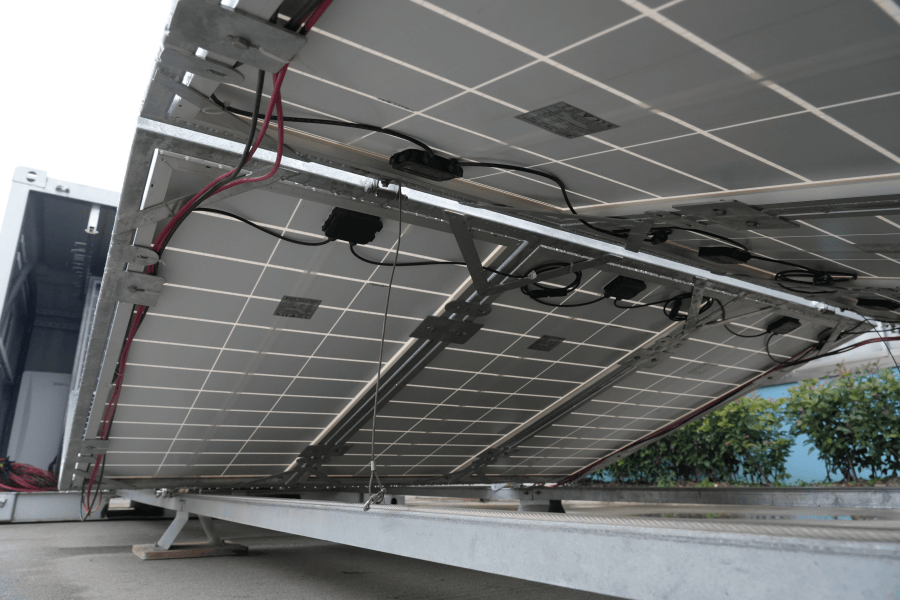
We deployed a containerized, off-grid capable system centered on a 2 MWh BESS with black start functionality, coupled with a 1 MW rooftop solar array. The key specs were the BESS's 2C peak discharge rate (meaning it could, for short periods, deliver double its rated capacity in power) and its UL 9540 / IEC 62933 certification, which was non-negotiable for their insurance and local regulations.

The result? Last winter, a major grid fault caused a total site blackout. Their system detected the outage, isolated the plant into a microgrid, and initiated a black start sequence. Within 90 seconds, critical loads were back online. The solar array then provided sustained power, with the BESS managing load shifts, for over 8 hours until grid restoration. The finance director later told me the system paid for its projected 5-year ROI in that single event by preventing a line shutdown that would have halted customer deliveries.
Key Specs Decoded: What to Look For in a Black Start System
When you're evaluating these systems, don't just look at the kWh and kW numbers. Dig into the specs that matter for black start and off-grid resilience:
- Peak Discharge Capability (C-rate): This is the system's "sprinting" power. If you have a 1 MWh battery, a 2C rate means it can deliver 2 MW of power to handle those simultaneous motor starts. A 1C system might struggle.
- Grid-Forming Inverters: This is the brains. Unlike grid-following inverters that need an existing grid signal, grid-forming inverters create a stable voltage and frequency waveform from scratch - the essential foundation for a black start.
- Advanced Thermal Management: High C-rate discharges generate heat. A liquid-cooled thermal management system, like we use in Highjoule's designs, is crucial. It maintains optimal cell temperature for performance and, frankly, is the biggest factor in long-term battery lifespan and safety. I've seen air-cooled systems derate power output on a hot day just when you need them most.
- Compliance & Standards: This isn't just paperwork. For the US market, UL 9540 for the overall system and UL 9540A for fire safety are becoming the benchmark. In Europe, IEC 62933 and local grid codes are paramount. It ensures the system has been tested for the real-world conditions of an industrial park.
- Levelized Cost of Energy (LCOE): Think beyond capex. A robust system with superior cycle life and thermal management will have a lower LCOE over 15 years. Pair it with solar, and your "insurance policy" starts generating daily energy savings, offsetting your peak demand charges from the utility.
Making It Work for You: The Practical Side of Deployment
So, how does this transition from spec sheet to your site? At Highjoule, our approach is based on two decades of field deployment. It starts with a deep dive into your load profiles - not just what you use, but the sequence and power draw of every major motor and process start. We model the inrush currents to right-size the BESS's power specs.
The deployment itself is often containerized for speed and flexibility. The beauty of a pre-engineered, tested solution is that we're not building a one-off prototype on your site. We're delivering a known, certified asset. Our local teams handle the interconnection studies, utility approvals (for when you're exporting or grid-supporting), and commissioning, including the critical black start sequence testing. We don't just hand over the keys; we run the drills with your team to ensure everyone knows how this new energy asset operates.
The goal is to give you more than a battery. It's to provide a pillar of operational and financial resilience. What would a black start capability allow your industrial park to do that it can't do today? Could it open up opportunities for energy arbitrage or participation in grid services programs? The conversation starts there.
Tags: UL Standard BESS LCOE Black Start Off-grid Solar Microgrid Industrial Park
Author
James Zhang
20+ years agricultural energy storage engineer / Highjoule CTO