
Grid-Forming BESS for EV Charging: Solving the Grid Congestion Challenge
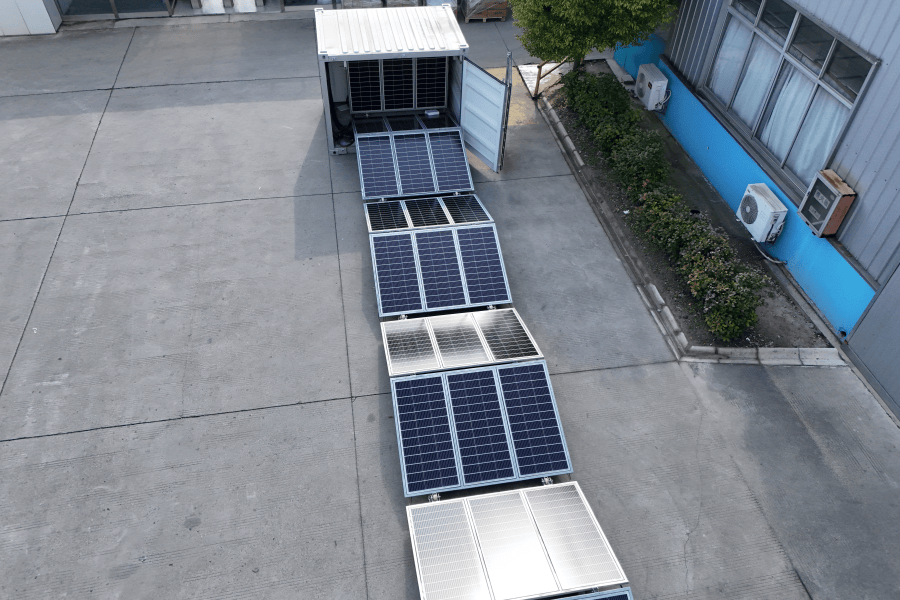
Table of Contents
- The Silent Roadblock to Mass EV Adoption
- Beyond Just Power: The Real Cost of Grid Dependency
- A Self-Sufficient Answer: The Grid-Forming BESS Container
- The Texas Test: A Real-World Case in Grid Resilience
- Decoding the Spec Sheet: What Matters for Your Bottom Line
- Your Next Step: From Blueprint to Reality
The Silent Roadblock to Mass EV Adoption
Let's be honest. When most people think about EV charging, they picture the sleek charger itself. The real story, the multi-million dollar challenge hiding in plain sight, is what happens behind that plug. I've been on site for enough depot and public fast-charging projects across the U.S. and Europe to see the pattern. The grid connection study comes back, and the utility says, "Sure, we can give you the 5 MW you need for your 20-station hub... but the upgrade to your local substation and feeders will cost you $2.8 million and take 36 months." The project just hit a wall.
This isn't an exception; it's the rule. The International Energy Agency (IEA) projects global electricity demand from EVs to skyrocket, putting immense strain on distribution networks. The dream of ubiquitous, reliable fast-charging is running headfirst into a century-old grid that wasn't built for this concentrated, unpredictable load.
Beyond Just Power: The Real Cost of Grid Dependency
Okay, so maybe you can afford the grid upgrade, or your site has enough capacity. The pain doesn't stop there. Agitating this problem a bit more, let's talk about the monthly bill. Commercial and industrial demand charges - fees based on your highest 15-minute power draw in a month - can turn a profitable charging station into a money pit. A few simultaneous fast-charging sessions can spike that demand, leading to shocking penalties.
Then there's power quality. I was at a site in Germany where voltage sags from the grid, completely normal grid behavior, were causing charging sessions to fault out. Customers were frustrated, and the operator's revenue was literally dipping with the voltage. Relying solely on the traditional grid for mission-critical EV infrastructure introduces cost, reliability, and power quality risks that most business plans simply don't account for.
A Self-Sufficient Answer: The Grid-Forming BESS Container
This is where the conversation gets interesting, and where the Technical Specification of a Grid-forming Energy Storage Container for EV Charging Stations transitions from a document to a strategic asset. We're not talking about a simple battery backup. A grid-forming BESS is a different beast entirely.
Think of the traditional grid as a symphony orchestra needing a conductor (the grid's rotating generators) to set the rhythm (frequency and voltage). A standard "grid-following" battery waits for that conductor. A grid-forming battery becomes

The Texas Test: A Real-World Case in Grid Resilience
Let me give you a concrete example from our work at Highjoule. A logistics company in Texas operating a fleet of 50 electric delivery vans needed overnight charging. Their grid connection was limited, and Texas weather, as we know, can be... eventful. A standard system wouldn't cut it.
We deployed a 1.5 MWh grid-forming BESS container, pre-integrated with our power conversion system and controls. The spec sheet wasn't just about capacity; it was about the UL 9540 certification for the entire system, the IEEE 1547-2018 compliance for grid interconnection, and the specific C-rate capability to handle the simultaneous high-power charge cycles of the fleet. During a localized grid disturbance last summer, the site seamlessly islanded. The vans kept charging on schedule while the surrounding neighborhood was dark. For the operator, it was zero downtime. For us, it was validation that the right specs, built for purpose, deliver real-world resilience.
Decoding the Spec Sheet: What Matters for Your Bottom Line
So, when you're looking at that technical specification, don't just skim to the energy capacity (MWh). As an engineer who's had to make these systems last in Arizona heat and Canadian winters, here's what I focus on, and what you should too:
- Grid-Forming Capability (The Core): It must explicitly state it can form a stable grid (voltage and frequency) in island mode, per IEEE standards. This isn't a nice-to-have.
- Thermal Management: This is the unsung hero. A phrase like "liquid cooling with independent cell-level monitoring" tells me the system is designed for the high, sustained C-rate discharges of fast-charging without degrading battery life prematurely. I've seen air-cooled systems throttle power on a hot day, frustrating customers.
- Safety Certifications: Look for UL 9540 (the U.S. standard for ESS safety) and IEC 62933 series equivalents. This isn't just paperwork; it's a rigorous testing protocol for fire safety and electrical safety that impacts your insurance and permitting.
- LCOE (Levelized Cost of Energy): This is the ultimate metric. A higher-quality, properly cooled system with a longer cycle life might have a higher upfront cost but a significantly lower LCOE over 10-15 years. The spec should support that longevity calculation.
At Highjoule, when we build a container for this application, these aren't checkboxes. They're the foundation. Our design philosophy is to engineer out field failure points from the start - like using robust, UL-listed components and designing for easy serviceability - because a service call across the Atlantic can wipe out a year's profit from a charging station.
Your Next Step: From Blueprint to Reality
The technology is here, proven, and standardized. The business case, when you factor in avoided grid upgrade costs, demand charge management, and resilience, is stronger than ever. The question I leave you with is this: As you plan your next EV charging deployment, are you evaluating it as a simple electrical load, or as an opportunity to build a resilient, cost-controlled energy asset?
Getting the technical specification right is the first step to the latter. It's the blueprint for a system that doesn't just take from the grid, but actively manages and optimizes energy for your specific business. The future of EV infrastructure isn't just about more grid; it's about smarter, self-sufficient nodes. And that's a future we can build today.
Tags: UL Standard BESS LCOE EV Charging Infrastructure Microgrid IEEE 1547 Grid-Forming Inverter
Author
James Zhang
20+ years agricultural energy storage engineer / Highjoule CTO