
Grid-Forming BESS for EV Charging: Solving Grid Constraints & High Costs
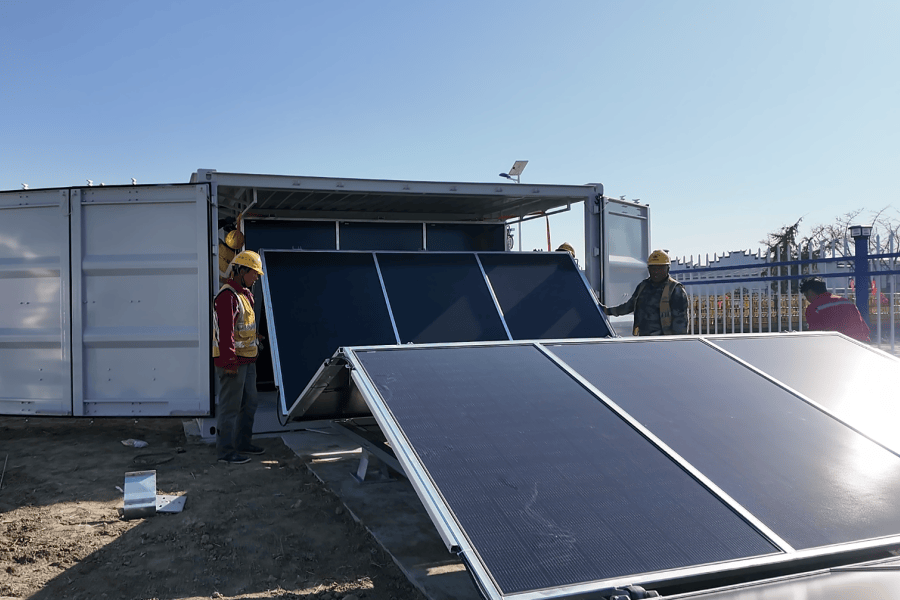
Table of Contents
- The Real Problem Isn't EVs, It's the Grid
- The Cost Spiral of "Wait-and-See"
- The All-in-One Box: More Than Just a Battery
- From Blueprint to Reality: A German Logistics Park Case
- Under the Hood: What Makes a Grid-Former Different
- Beyond the Spec Sheet: Making It Work for You
The Real Problem Isn't EVs, It's the Grid
Let's be honest. If you're planning an EV charging hub - whether for a fleet depot, a public fast-charging plaza, or a corporate campus - you've already run the numbers on power. And that's where the headache starts. The conversation with your utility often goes like this: "You need 2 MW for 50 chargers? Sure, we can do that. The infrastructure upgrade will cost $1.2 million, and we can schedule it for... let's see... Q3 2027."
This isn't a hypothetical. I've sat in on these meetings from California to North Rhine-Westphalia. The bottleneck isn't the availability of chargers or even the EVs themselves; it's the aging grid infrastructure and the monumental cost and time required to reinforce it. The International Energy Agency (IEA) highlights that grid delays are now one of the top blockers for clean energy projects, including EV integration. You're stuck between the demand of your customers or your ESG goals and the physical (and financial) limits of the local transformer and distribution lines.
The Cost Spiral of "Wait-and-See"
So, you might think, "Okay, we'll phase it in slowly." But here's where the pain gets amplified. First, there's the lost revenue from not being able to serve charging demand today. Second, and more brutally, are the demand charges. In many commercial utility rate structures in the US and parts of Europe, you're billed not just for the total energy you use (kWh), but for your peak power draw (kW) in any 15-minute window each month. A simultaneous session of just a few DC fast chargers can spike that demand, leading to staggering bills that can wipe out your operating margin.
You end up with a business model that's either delayed by years or crippled by monthly costs. It's a classic grid constraint problem, and traditional "grid-following" battery systems only partly solve it. They can shave peaks, but they can't start independently if the grid goes down, and they don't provide the essential stability services the local grid needs when you add a massive, intermittent load like EV charging.
The All-in-One Box: More Than Just a Battery
This is precisely where the concept of a grid-forming pre-integrated PV container shifts the paradigm. We're not talking about a rack of batteries you need to engineer a building for. I'm talking about a solution that arrives on a truck: a factory-tested, plug-and-play container that has the solar PV input, the grid-forming battery storage, the power conversion system, and the thermal management all pre-wired and pre-validated inside a single, robust enclosure.
The magic word is grid-forming. Unlike traditional inverters that need to "see" a stable grid signal to sync up (grid-following), a grid-forming inverter creates its own stable voltage and frequency waveform. It acts like an independent, mini power grid. This means your EV charging station can operate in island mode during an outage - a huge resiliency bonus. More importantly for daily operation, it provides instantaneous voltage and frequency support to the local grid, making your entire connection point more stable and robust. It's not just taking power; it's actively supporting the network, which utilities are increasingly valuing and incentivizing.
At Highjoule, when we design these pre-integrated containers, we start with the end in mind: rapid deployment and unwavering safety. Every component, from the cell-level fusing to the container-level fire suppression, is selected and integrated with UL 9540 and IEC 62933 standards as the baseline. This isn't an afterthought; it's the blueprint. It's what allows a project in, say, Texas, to get through interconnection studies and fire marshal inspections without costly redesigns or delays.
What's Inside the Box?
- Grid-Forming Inverter(s): The brain and the muscle, creating a stable grid and managing power flow between PV, battery, chargers, and the main grid.
- Lithium-Iron-Phosphate (LFP) Battery Racks: Chosen for their safety, long cycle life, and thermal stability. We typically design for a C-rate that balances power delivery with longevity - you don't need a sprinting battery for a marathon application.
- Integrated Thermal Management: This is critical. I've seen too many systems derate or fail because of poor cooling. Our containers use a closed-loop, liquid-cooled system that maintains optimal cell temperature in the Arizona desert or the Norwegian winter, ensuring performance and maximizing lifespan.
- PV Combiner & MPPT: Ready to accept DC input from your onsite solar canopy or ground-mount array, turning your charging station into a true clean energy asset.
- Energy Management System (EMS): The conductor of the orchestra, intelligently dispatching power to minimize demand charges, maximize solar self-consumption, and ensure uptime.
From Blueprint to Reality: A German Logistics Park Case
Let me give you a real example from last year. A major logistics company near Dortmund, Germany, wanted to electrify its 80-vehicle delivery fleet. Their grid connection was maxed out. A traditional upgrade was quoted at over ?800,000 and an 18-month timeline.
We deployed a 1.5 MWh/1.25 MW grid-forming container, coupled with a 500 kWp PV array on their vast warehouse roof. The container was craned into place on a Tuesday, and by the following week, we were conducting commissioning tests. The system does three things: 1) It charges the fleet overnight using lower-cost grid energy stored in the BESS, 2) It uses solar power during the day to both charge vehicles and recharge the battery, and 3) Its grid-forming capability provides frequency regulation services to the German grid operator, generating a small but meaningful revenue stream.
The result? They avoided the ?800k upgrade. Their demand charges dropped by over 60%. And they now have a resilient power source for their critical logistics hub. The Levelized Cost of Energy (LCOE) for their fleet operations, when factoring in avoided costs and new revenue, became compelling from day one.

Under the Hood: What Makes a Grid-Former Different
You might hear terms like "virtual synchronous machine" or "droop control." Let me translate from engineer-speak. Think of the traditional power grid like a symphony orchestra following a single conductor (the grid frequency). A grid-following inverter is a musician who must listen carefully to stay in sync. If the conductor stops (a blackout), the music stops.
A grid-forming inverter is like a jazz combo. It can listen and play along when the orchestra is there, but if the conductor leaves, the combo can keep the music going on its own, maintaining the rhythm and tune for others (the EV chargers) to follow. Technically, it does this by using sophisticated software controls to instantly adjust power output to maintain voltage and frequency stability, even under large, sudden load changes - exactly what happens when multiple EVs plug in.
This capability directly impacts your bottom line. It future-proofs your site. As you add more chargers, the grid-forming BESS provides the cushion, potentially delaying or eliminating further grid upgrade costs. It also improves power quality, which can extend the life of your sensitive charging equipment.
Beyond the Spec Sheet: Making It Work for You
Specs on paper are one thing. A system that works for 15+ years on your site is another. Honestly, the key is in the integration and the long-term view. A pre-integrated container from a vendor like Highjoule isn't just about selling you hardware. It's about assuming the responsibility of making all those components - from different manufacturers - work together seamlessly, with a single point of warranty and support.
Our focus is on optimizing your total LCOE over the system's life. That means choosing the right battery chemistry (LFP for safety and life), designing the thermal system for your specific climate (a container in Florida needs different cooling than one in Colorado), and building an EMS with smart, adaptive logic for your specific utility rate structure.
The goal is to move you from seeing energy storage as a capital expense to viewing it as a strategic grid asset that manages cost, generates resilience, and accelerates your sustainability roadmap. So, what's the biggest grid constraint you're facing in your next EV charging project?
Tags: UL Standard BESS LCOE EV Charging Infrastructure Pre-integrated Container Grid-Forming Inverter
Author
James Zhang
20+ years agricultural energy storage engineer / Highjoule CTO