
High-Voltage DC 1MWh Solar Storage for Agricultural Irrigation: Solving Grid & Cost Challenges
Contents
- The Irrigation Power Dilemma: It's Not Just About Water
- Why Standard Solutions Fall Short on the Farm
- A Better Way: The High-Voltage DC 1MWh Solar Storage Approach
- Case in Point: California Almonds and the 4 PM Peak
- Key Specs Decoded for Decision-Makers
- What This Means for Your Bottom Line
The Irrigation Power Dilemma: It's Not Just About Water
Let's be honest. If you're managing a large-scale agricultural operation in the US or Europe, your biggest headache isn't just weather or commodity prices anymore. It's energy. I've been on-site from the vineyards of California to the wheat fields of Germany, and the story is the same: running massive irrigation pumps during peak demand periods is brutally expensive and puts a huge strain on often-rural grid infrastructure. You're competing with every home turning on its AC. The grid gets shaky, and your power bill looks like it has a comma in the wrong place.
This isn't a niche problem. The International Energy Agency (IEA) highlights that agriculture's energy intensity is rising, with irrigation being a major driver. The traditional fix - oversizing solar PV - doesn't cut it. The sun isn't always shining when you need to pump, especially for those critical evening irrigation cycles. So, you're left relying on the grid at the worst possible time.
Why Standard Solutions Fall Short on the Farm
Here's where the aggravation really sets in. Many farm managers look at standard, low-voltage battery systems. They seem like a good idea on paper. But on the ground, I've seen three core issues:
- Inefficiency at Scale: Moving enough power from your solar array to run a 500-hp pump requires massive currents at low voltage. That means huge, expensive copper cabling and significant power losses as heat. It's like trying to water a thousand acres with a garden hose.
- Thermal Runaway Jitters: Safety is non-negotiable. Packing enough low-voltage battery cells to reach 1MWh creates a complex thermal management puzzle. More cells, more connections, more potential hot spots. Ensuring safety to rigorous standards like UL 9540 and IEC 62485 becomes a tougher, costlier engineering challenge.
- Poor Return on Investment (ROI): When you factor in the installation complexity, efficiency losses, and lifecycle costs, the Levelized Cost of Energy Storage (LCOES) for a mismatched system just doesn't pencil out for the high-power, intermittent duty cycle of irrigation.
You need a system built for the job, not adapted to it.
A Better Way: The High-Voltage DC 1MWh Solar Storage Approach
This is precisely why the technical specification of a high-voltage DC 1MWh solar storage system is such a game-changer for agricultural irrigation. Think of it as the industrial-strength tool designed for the task. Instead of a garden hose, you get a mainline pipe.
The core idea is elegant: by operating at a higher DC voltage (typically in the 800-1500V range), the system drastically reduces current. Lower current means smaller, cheaper cables, lower loss, and higher overall system efficiency - often 2-3% higher than a low-voltage setup. That's pure savings, day in, day out. For a 1MWh system, that's a lot of wasted energy you're not paying for.
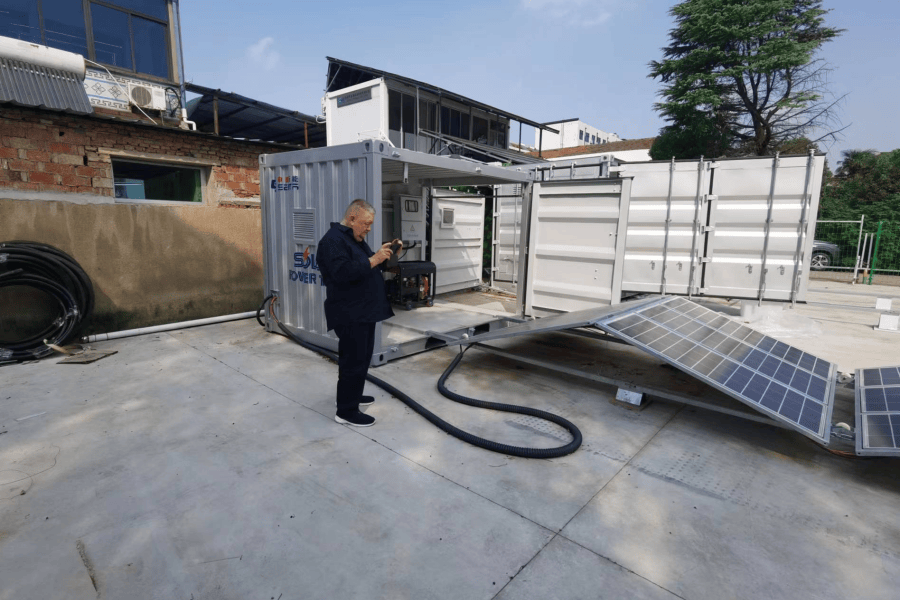
At Highjoule, our approach has always been to design from the site up. We saw this need early. Our containerized solutions are built around this high-voltage DC architecture from the get-go, with all the safety and grid-compliance features baked in. It's not an afterthought.
Case in Point: California Almonds and the 4 PM Peak
Let me give you a real example from last season. A 3,000-acre almond farm in California's Central Valley was getting hammered by demand charges. Their pumps needed to run hardest in the late afternoon, exactly when their solar production was tailing off and grid prices spiked.
We deployed one of our pre-integrated, UL 9540-certified Highjoule HJ-IrrigateMax systems. The spec is key here: 1MWh capacity, 1.5MW peak discharge (that's a high C-rate of 1.5C, meaning it can deliver power very quickly for those pump starts), and a DC operating voltage of 1200V. The installation was straightforward - one main DC connection from the solar field and one to the pump inverter, minimizing on-site electrical work.

The result? They now run their pumps from 4 PM to 8 PM almost entirely from the battery, shaving their peak demand from the grid by over 90%. The high-voltage design meant the cable run from the solar field was cost-effective and efficient. Honestly, the thermal management system - a liquid-cooled design that's standard in our units - barely breaks a sweat in the 100F+ valley heat, which is something I always check personally on site visits. Peace of mind matters.
Key Specs Decoded for Decision-Makers
When you look at a technical spec sheet, don't get lost in the numbers. Here's what truly matters for your operation:
- High DC Voltage (e.g., 1200V): This is your efficiency and cost-saver. It directly reduces balance-of-system costs.
- C-rate (e.g., 1.5C): This tells you how fast the battery can discharge. Irrigation requires bursts of power to start pumps. A 1MWh system with a 1.5C rate can deliver 1.5MW of power instantly. That's capability you need.
- Thermal Management (Liquid Cooling): For a large, high-power system, passive air cooling often isn't enough, especially in a dusty farm environment or a hot climate. Liquid cooling, like we use, keeps every cell at an optimal temperature. This is critical for safety, performance, and battery lifespan - directly impacting your LCOE.
- Standards Compliance (UL/IEC/IEEE): This isn't just a checkbox. It's your insurance policy. A system certified to UL 9540 (for the overall ESS) and built with UL 1973 cells has undergone rigorous independent testing for fire and electrical safety. For interconnection, IEEE 1547 compliance is a must for your utility.
These aren't just fancy features; they're the direct answer to the pain points we talked about earlier.
What This Means for Your Bottom Line
So, what's the takeaway? Choosing a storage system with the right technical specification for high-voltage DC operation isn't about buying the most advanced tech for its own sake. It's about buying the appropriate tech for the specific, heavy-duty job of agricultural irrigation.
It translates to a lower total installed cost, lower operational costs through higher efficiency, and a safer, more reliable asset that will last through its intended lifecycle. The LCOE becomes genuinely attractive. The goal isn't just to add storage; it's to create a predictable, controllable energy asset for your farm.
I've walked enough muddy fields and talked to enough frustrated farm managers to know that the devil is in the details of the spec sheet. The right architecture makes all the difference between a project that looks good in a brochure and one that delivers real, lasting value on your land. What's the one energy constraint in your operation that, if solved, would change your numbers next season?
Tags: UL Standard BESS LCOE Agricultural Irrigation Renewable Energy Solar Storage High-voltage DC
Author
James Zhang
20+ years agricultural energy storage engineer / Highjoule CTO