
Novec 1230 Fire Suppression for Off-grid BESS in Industrial Parks
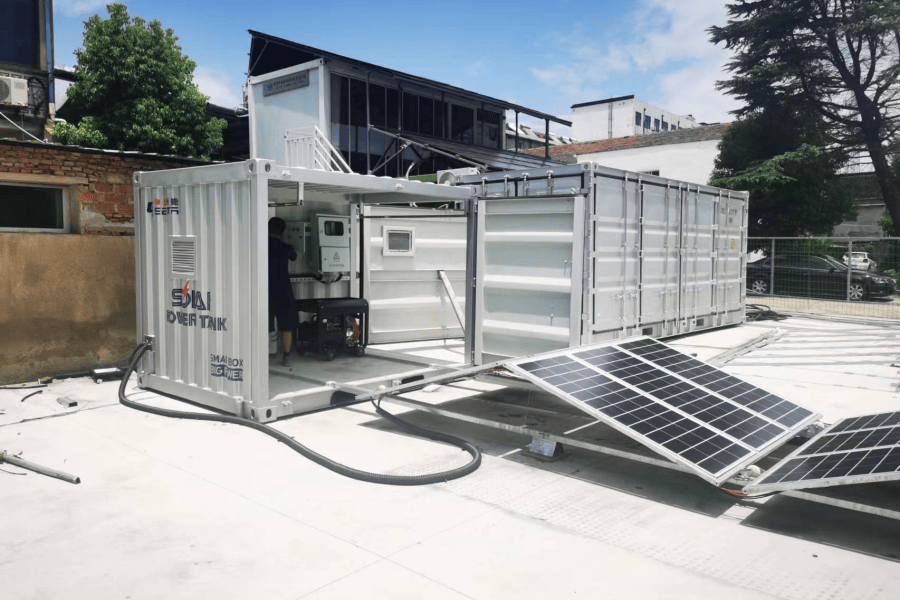
Table of Contents
- The Safety Paradox in Off-Grid Industrial BESS
- Beyond the Spark: The Real Cost of a Thermal Event
- A Cleaner, Smarter Solution: Why Novec 1230 Makes Sense
- Case in Point: A German Automotive Supplier's Dilemma
- Expert Insight: It's Not Just About Putting Out Fires
- Built for the Real-World Grid Edge
The Safety Paradox in Off-Grid Industrial BESS
Let's be honest. When you're planning an off-grid solar and battery system for an industrial park, the checklist is massive: capex, LCOE, integration complexity, uptime guarantees. Fire safety? It's on there, sure, but sometimes it feels like a compliance box to tick - pick a system that meets the local code and move on. I've been on sites from Texas to North Rhine-Westphalia, and I've seen this mindset firsthand. The focus is overwhelmingly on energy density and cycle life, which is right, but it can accidentally push fire suppression into a secondary thought.
Here's the paradox: these industrial-scale Battery Energy Storage Systems (BESS) are your park's energy lifeline. They're ensuring critical processes run during outages, managing peak demand, and stabilizing your microgrid. Yet, the very technology that provides this resilience - high-density lithium-ion batteries - carries a unique thermal risk. A single cell going into thermal runaway can, under the wrong conditions, cascade. Traditional suppression methods, like water or even some generic clean agents, often treat the symptom (the open flame) but not the root cause (the chemical reaction inside the battery pack). This is the core, often unspoken, challenge we face when specifying a system.
Beyond the Spark: The Real Cost of a Thermal Event
The agitation isn't just about the fire itself. Think about the domino effect. A thermal event in an off-grid BESS isn't just a firefighting incident; it's a complete business continuity failure. Your primary power source is now offline and potentially destroyed. The cost? Let's break it down beyond the hardware replacement, which is substantial.
- Downtime: Your industrial processes halt. According to a National Renewable Energy Lab (NREL) analysis on grid resilience, downtime costs for manufacturing can run into tens of thousands of dollars per hour.
- Secondary Damage: Many suppression agents are corrosive or leave residue. I've seen control cabinets and switchgear ruined not by fire, but by the cleanup after a suppression discharge. This adds weeks to recovery.
- Regulatory & Insurance Scrutiny: After an incident, your entire energy infrastructure faces renewed, intense scrutiny. Permitting for a replacement system becomes a nightmare, and insurance premiums can skyrocket, or worse, coverage is dropped.
The real pain point is that a standard suppression choice might save the building structure but fail to protect the asset and the business operation it supports. That's a flawed equation.
A Cleaner, Smarter Solution: Why Novec 1230 Makes Sense
This is where the technical specification of a Novec 1230 fire suppression system transitions from a compliance document to a strategic asset protection plan. For off-grid generators in industrial settings, it directly addresses the paradox.
Novec 1230 is a clean agent - it extinguishes fire by removing heat, not oxygen, which is crucial in occupied spaces. But for BESS, its magic is in the details. It has a remarkably low global warming potential (GWP of 1) and zero ozone depletion, which aligns with the sustainability goals of your solar project. More critically, it's non-conductive and leaves no residue. This means if the system ever activates (and a well-designed one with early VESDA detection might suppress an event before open flame), your cleanup is minimal. The battery racks, busbars, and sensitive controls aren't coated in a corrosive foam or powder. You can inspect, isolate a module if needed, and potentially return to service faster.
When we at Highjoule design a containerized or skid-mounted off-grid solution, integrating Novec 1230 isn't an afterthought. It's engineered in from day one. We model the airflow and gas dispersion within the BESS enclosure to ensure the agent reaches the seat of a potential thermal event effectively. This system is then rigorously tested to meet not just local fire codes, but the more stringent UL 9540A test method for evaluating thermal runaway fire propagation. This is the standard authorities like AHJs in California or consultants in Europe are increasingly looking for. It gives them, and you, quantifiable confidence.
Case in Point: A German Automotive Supplier's Dilemma
Let me give you a real example. We worked with a precision automotive parts supplier in Bavaria. Their new facility was off the reliable grid, and a 2 MWh BESS was non-negotiable for 24/7 operation. Their risk manager was adamant: zero tolerance for production stoppage from a BESS incident, and their insurer had flagged lithium-ion storage as a "risk to be mitigated."
The challenge was space. The BESS container was close to other critical infrastructure. Water-based systems were a non-starter due to freeze risk and collateral water damage. A traditional clean agent had a high GWP, conflicting with the company's public carbon neutrality pledge. Our solution centered on a Technical Specification of Novec 1230 Fire Suppression Off-grid Solar Generator for Industrial Parks.
We provided a full safety dossier, including the UL 9540A design basis and the agent's environmental profile. The clincher was demonstrating the clean, non-destructive discharge. We showed them simulations and test videos. Honestly, seeing the "no mess" factor convinced their operations team more than any data sheet. The system passed the insurer's review, and it's been running flawlessly for 18 months, giving them the resilience they needed without the safety anxiety.
Expert Insight: It's Not Just About Putting Out Fires
From a technical perspective, a good fire suppression system is a critical component of the overall thermal management strategy. Think of it as the ultimate safety net. Your primary job is to manage the battery's temperature through cooling systems and control the C-rate (the speed of charge/discharge) to prevent stress. But the suppression system is what contains a failure.
Here's a key insight: the goal of a modern system like one with Novec 1230 isn't necessarily to save the specific battery module that fails - once thermal runaway starts, that module is often a loss. The goal is to absorb enough heat to prevent propagation to the adjacent modules. This compartmentalizes the damage. It's the difference between losing a $5,000 module and losing a $500,000 container. This directly protects your Levelized Cost of Energy (LCOE), because it avoids a catastrophic, total-replacement event that would spike your lifetime costs.
Built for the Real-World Grid Edge
So, when you're evaluating an off-grid solar generator spec sheet, don't just glance at the "fire suppression" line item. Dig into the "what" and the "how." Ask your provider:
- Is the agent clean and non-destructive to sensitive electronics?
- How is the dispersion designed to protect tightly packed battery racks?
- What standards (UL, IEC, NFPA) does the integrated system comply with?
- Can you provide the test reports or engineering analysis?
At Highjoule, this depth of engineering is what we bring. Our off-grid solutions are built with this holistic safety-first approach because we've managed the aftermath of the alternative. It's not just about selling a battery box; it's about delivering resilient, worry-free power that your industrial operations can truly depend on, 365 days a year. Because when you're off-grid, there's no backup to the backup. Your BESS is the grid. Shouldn't its protection be as robust as the power it provides?
What's the one safety concern keeping you up at night about your planned energy storage deployment?
Tags: UL Standard BESS Europe US Market Industrial Energy Storage Off-grid Solar Novec 1230 Fire Safety
Author
James Zhang
20+ years agricultural energy storage engineer / Highjoule CTO