
Grid-Forming Solar Containers: Ultimate Guide for Data Center Backup Power
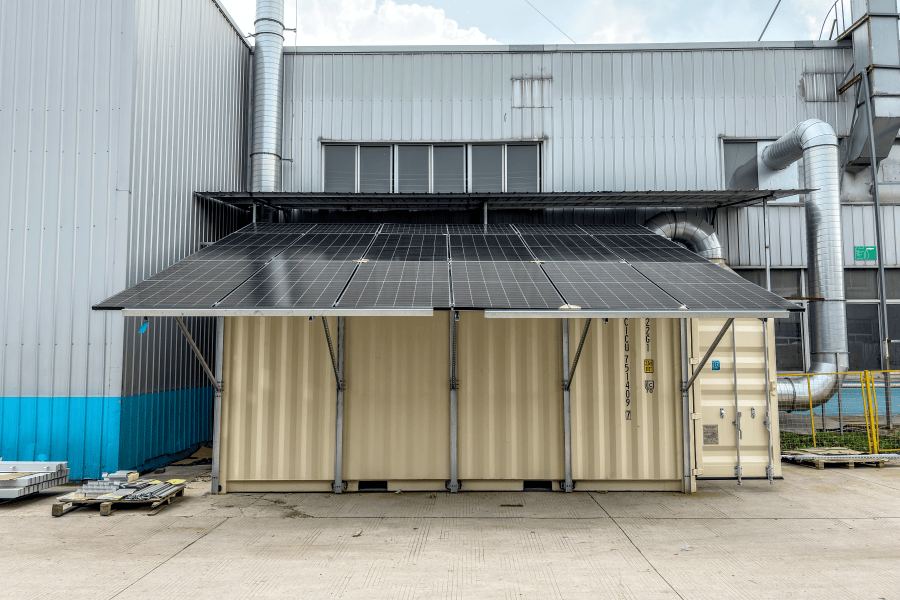
Table of Contents
- The Silent Problem: More Than Just a Power Outage
- Why Old Backup Solutions Fall Short (And Cost More)
- Enter the Grid-Forming Solar Container: A Paradigm Shift
- Real-World Proof: A Case Study from Northern Germany
- Key Tech Explained (Without the Jargon)
- Making It Work for Your Data Center
The Silent Problem: More Than Just a Power Outage
Let's be honest. When we talk about data center backup power, most folks immediately think of diesel generators. They're the loud, smoky, "necessary evil" in the parking lot. But having spent over two decades on sites from California to Bavaria, I've seen the real, silent problem isn't just the outage itself - it's the fragility of the transition.
Modern data centers have hypersensitive loads. That switch from grid to backup, even if it's just for seconds, can cause voltage dips or frequency fluctuations that crash servers and corrupt data. The traditional "grid-following" inverters used in most solar-plus-storage setups? They need a strong grid signal to sync up. In a blackout, with no grid to follow, they go silent until the generator stabilizes everything. That creates a dangerous gap, or forces you to oversize the generator. It's a clunky, inefficient dance.
Why Old Backup Solutions Fall Short (And Cost More)
So we agitate the problem a bit. Relying solely on diesel is becoming a financial and operational headache. Fuel costs are volatile, maintenance is stringent (and often overlooked until it's too late), and emissions regulations, especially in the EU and California, are tightening every year. I've seen facilities where the generator's annual test alone costs more in fuel and service than some people's car payments.
Pairing solar with basic battery storage helps, but if that system can't "start" the grid, its usefulness during an islanded outage is limited. You're left with a great tool for energy arbitrage, but not a truly resilient backup source. According to the National Renewable Energy Laboratory (NREL), the ability to form a grid - to create stable voltage and frequency from a standstill - is the single most critical feature for building renewable-driven microgrids. Without it, you're only solving half the equation.
Enter the Grid-Forming Solar Container: A Paradigm Shift
This is where the solution comes into sharp focus: the grid-forming solar container. Think of it as a self-contained, plug-and-play energy fortress. It combines solar PV, a high-density battery storage system (BESS), and crucially, grid-forming inverters all in a single, UL 9540/ IEC 62933 certified enclosure.
The magic is in the inverter. Unlike grid-followers, a grid-forming inverter acts like a conductor of an orchestra. It establishes the voltage and frequency itself, creating a stable "mini-grid" (a microgrid) from scratch. When the main grid fails, this system doesn't hesitate. It seamlessly takes over, powering critical loads immediately using solar and stored energy. The diesel generator, if needed at all, can be started in a calm, controlled manner to recharge the batteries, not to handle the brutal inrush of all loads at once.

Real-World Proof: A Case Study from Northern Germany
Let me give you a real example. We worked with a colocation data center in North Rhine-Westphalia, Germany. Their challenge was twofold: meet strict local environmental directives and achieve 99.99% uptime for a financial services client. Their old diesel setup was reliable but expensive and carbon-intensive.
We deployed a 1.5 MWh Highjoule GridFormTM Solar Container alongside their existing infrastructure. The container housed our UL-certified battery racks and our proprietary grid-forming power conversion system (PCS). The key?? detail was the control logic. The system was programmed to prioritize solar for base-load and continuous battery charging. During a simulated grid failure - we tested this live on-site - the container islanded the critical load block in less than 20 milliseconds, maintaining perfect 50 Hz frequency. The diesel generators never even received the start signal because the sun was shining, and the batteries were full. The client now uses the generator 70% less, saving on fuel and maintenance, and has a verifiable green backup story for their tenants.
Key Tech Explained (Without the Jargon)
When evaluating these systems, don't get lost in spec sheets. Focus on these three things, explained simply:
- C-rate (The "Sprint vs. Marathon" Rate): This is how fast the battery can charge or discharge relative to its size. A 1C rate means a 1 MWh battery can output 1 MW for 1 hour. For backup, you need a battery chemistry and design that can handle high C-rates (like 1C or more) to support sudden data center loads. But high C-rates generate heat, which leads to my next point...
- Thermal Management (The Unsung Hero): Honestly, I've seen more system failures from poor thermal design than from battery chemistry itself. A container sitting in Arizona sun or a packed data center yard needs a robust, active liquid cooling system. It keeps cells at optimal temperature, ensuring longevity (more cycles) and safety. Our containers use a patented indirect liquid cooling loop that keeps the internal ambient within a 2C variance - critical for stable performance.
- LCOE - Levelized Cost of Energy (The True Cost Picture): Don't just look at upfront cost. LCOE factors in capital cost, installation, operations, maintenance, and energy output over the system's life. A grid-forming solar container might have a higher capex than a generator, but its LCOE plummets because its "fuel" (sunlight) is free and it requires minimal maintenance. Over 10 years, the total cost story is overwhelmingly in its favor.

Making It Work for Your Data Center
So, how do you move forward? The beauty of the containerized approach is its modularity. You're not building a power plant; you're deploying an asset. Look for a provider with deep, local field service. Can they handle the interconnection studies and navigate the IEEE 1547-2018 (for the US) or grid code compliance in Europe? At Highjoule, our team doesn't just ship a box. We provide a full solution that includes the ongoing performance monitoring and preventative maintenance, because a backup system you can't trust is worse than no backup at all.
The question isn't really if renewable-based backup is the future - for data centers under public and tenant pressure, it's the present. The real question is: does your next resilience upgrade just sit there waiting for a crisis, or does it work for you every single day, cutting costs and carbon, until the moment it's heroically needed?
Tags: UL Standard BESS Solar Container Data Center Backup Microgrid IEEE 1547 Grid-Forming Inverter
Author
James Zhang
20+ years agricultural energy storage engineer / Highjoule CTO