
Liquid-Cooled Solar Container Guide: Reliable Power for Remote Irrigation
Contents
- The Real Problem Isn't Sunlight, It's Consistency
- Why This Hurts Your Bottom Line More Than You Think
- The Quiet Revolution: The All-in-One Power Plant
- A Case in Point: Almonds in California's Central Valley
- What's Inside the Box? It's All About Thermal Management
- Your Next Step: Asking the Right Questions
The Real Problem Isn't Sunlight, It's Consistency
Let's be honest. If you're managing a large-scale farm or agri-business in the US Midwest or Southern Europe, you already know solar makes sense. The sun is there. The land is there. The motivation to cut diesel costs and go green is stronger than ever. But here's the rub I've seen firsthand on site: solar panels alone don't solve the core operational issue for irrigation.
The problem is misalignment. Your peak water demand often hits in the early evening, when soil temperatures drop. But your solar array's peak production is midday. You're either forced to oversize your solar system massively (a huge CAPEX hit) or you're still relying on the grid or diesel generators when you need power most. According to the National Renewable Energy Laboratory (NREL), this intermittency is the single biggest barrier to deeper solar penetration in agriculture. You're left with a system that's either inefficient or unreliable.
Why This Hurts Your Bottom Line More Than You Think
This isn't just a minor scheduling headache. It directly impacts your Levelized Cost of Energy (LCOE) C that's the total lifetime cost of your power divided by the energy produced. Think about it: an underutilized solar asset sitting idle when you need power, while you're still paying for grid peaks or burning expensive diesel. It's a double whammy.
Then there's the equipment stress. Pump motors don't like variable, "jumpy" power. Starting and stopping heavy irrigation pumps with direct solar can lead to more maintenance, shorter lifespans, and unexpected downtime. In the middle of a growing season, a failed pump isn't an inconvenience; it's a threat to your entire yield. I've walked fields where a 48-hour pump outage would have meant a total loss. The financial risk is real.
The Quiet Revolution: The All-in-One Power Plant
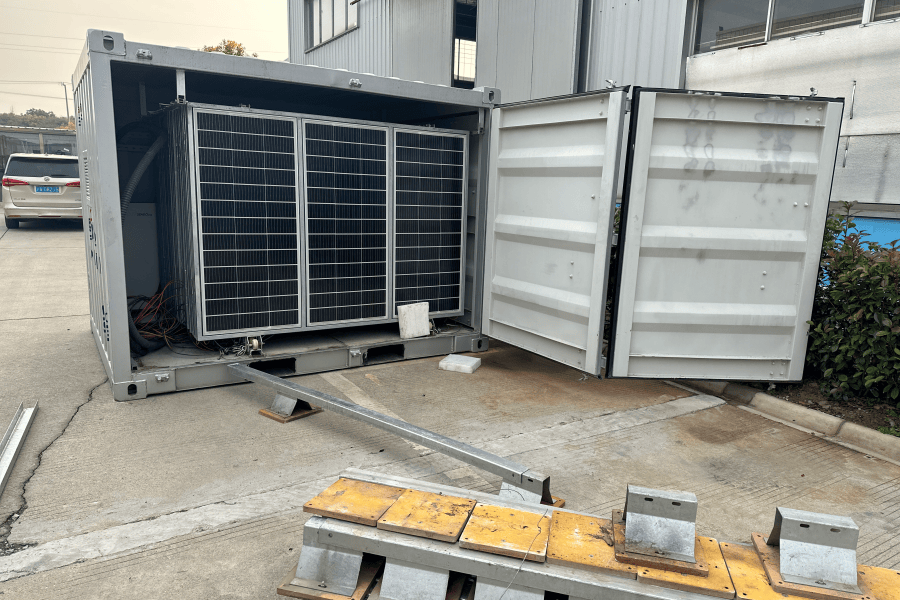
This is where the concept of the liquid-cooled solar container shifts from a "nice-to-have" to a "must-consider." It's not just a battery. Honestly, calling it a battery is like calling a tractor an engine. It's a complete, self-contained power station engineered for your environment.
The solution integrates three key elements in one robust, shipping-container format: a high-density battery energy storage system (BESS), a sophisticated power conversion system (PCS), and an advanced liquid-cooled thermal management system. It takes your solar PV input, stores it efficiently, and dispatches it exactly when your irrigation schedule demands C at dawn, at dusk, or even throughout the night. It flattens those cost peaks and turns your solar investment into a 24/7 workhorse.
A Case in Point: Almonds in California's Central Valley
Let me give you a real example. We worked with a 1,200-acre almond farm in Fresno County, California. Their challenge was classic: high peak demand charges from the utility for running massive center-pivot irrigators, combined with a desire to use their existing solar more effectively. Diesel was a non-starter due to air quality regulations.
We deployed a 2 MWh Highjoule HydroCool? containerized BESS alongside their solar array. The key specs that mattered to them:
- UL 9540 / IEC 62933 Certified: Non-negotiable for insurance and permitting. This gave them and the local fire marshal peace of mind.
- Liquid Cooling: Critical for the Central Valley, where summer ambient temperatures regularly exceed 40C (104F). Air-cooled systems derate or shut down in that heat. Ours maintained optimal cell temperature, ensuring full power output during the hottest, most critical irrigation days.
- Grid-Forming Capability (IEEE 1547): This allowed the system to act as a stable microgrid if grid power dipped, preventing pump shutdowns.
The result? They shifted over 85% of their irrigation load to solar+storage, cut their peak demand charges by 60%, and eliminated the need for a planned diesel backup generator. The container was pre-assembled and tested at our facility, so on-site commissioning took days, not weeks.

What's Inside the Box? It's All About Thermal Management
You'll hear a lot of technical terms, but let me break down the most important one in simple terms: C-rate. It's basically how fast you can charge or discharge the battery safely. For irrigation, you need a high discharge C-rate to start those big pumps. But high C-rate operation generates heat C a lot of it.
This is where cheap storage fails. Air-cooling can't keep up with the heat from high-power, cyclic agricultural loads. Cells overheat, degrade faster, and safety risks increase. Liquid cooling, like what we use in our Highjoule systems, directly surrounds each cell or module with a cooled fluid. It's like giving each battery cell its own personal air conditioner. This allows for a sustained high C-rate (so your pumps get the surge power they need), extends the battery's life by up to 30%, and maintains safety integrity. It's the core tech that makes the system bankable for a 15-20 year asset life.
When you're evaluating options, don't just look at the kWh rating. Ask about the thermal management system and its proven performance data at 40C+ ambient. Ask about the expected degradation rate at your specific duty cycle. That's where you'll see the difference between a commodity product and an engineered solution.
Your Next Step: Asking the Right Questions
So, where does this leave you? The move to solar-powered irrigation isn't a question of "if" anymore. It's about "how" to do it right. The integrated, liquid-cooled container model is proving to be the most robust answer for commercial-scale operations.
The next time you're talking to a vendor, move beyond the basic specs. Ask them:
- "Can you show me a similar project in a similar climate with 2+ years of operational data?"
- "How does your thermal system perform at a continuous 45C ambient, and what is the derating?"
- "What is the projected LCOE of your system over 20 years, including all degradation and maintenance?"
- "Is your system UL 9540 certified, and can you provide the full certification documentation for our engineering team?"
At Highjoule, we build our containers to answer these questions confidently. Because after 20 years in this field, I know that reliability isn't a feature; it's the entire product for a farmer. The goal isn't just to store energy C it's to guarantee water.
What's the one operational pain point in your irrigation schedule that keeps you up at night?
Tags: UL Standard BESS Energy Storage Liquid Cooling Solar Container Agricultural Irrigation IEEE Standard
Author
James Zhang
20+ years agricultural energy storage engineer / Highjoule CTO