
LFP (LiFePO4) Industrial ESS for EV Charging: Benefits, Drawbacks & Real-World Insights
LFP for EV Charging: The Good, The Tough, and The Smart Choice
Honestly, if I had a dollar for every time a client asked me, What's the real story with LFP batteries for our EV charging hub? I'd probably be retired by now. The hype is everywhere. But after two decades on sites from California to Bavaria, wrestling with cables and commissioning systems, I've learned that the best choice isn't about the trendiest tech - it's about what solves your specific, gritty, real-world problems. Let's talk about LFP (LiFePO4) Industrial Energy Storage Systems (ESS) for EV charging, not from a datasheet, but from the ground up.
Quick Navigation
- The Silent Grid Problem Every Charging Operator Faces
- Why LFP Shines for Demanding EV Charging Hubs
- The Honest Trade-Offs: What LFP Asks of You
- Making It Work: A Glimpse from a Real Project
- My Take: The Practical Path Forward
The Silent Grid Problem Every Charging Operator Faces
Picture this: You're finalizing plans for a high-power EV charging station on a prime commercial lot. The utility comes back with the impact study. The cost for a grid upgrade to handle simultaneous 350kW fast charging? It's astronomical. Or worse, they tell you the local substation is at capacity, and you're looking at a 2-3 year wait. This isn't a hypothetical; it's the daily reality slowing down the EV transition across the U.S. and Europe.
The core pain point is simple: the grid wasn't built for this. According to the National Renewable Energy Laboratory (NREL), high-power charging can impose demand charges that can make up over 90% of a commercial site's electricity bill. That's a business model killer. You need a buffer - a shock absorber for the grid. That's where an Industrial ESS Container comes in, acting as a local reservoir of power. But which battery chemistry do you trust to sit in your parking lot, cycle heavily multiple times a day, and not keep you up at night worrying about safety? That's where the LFP conversation truly begins.
Why LFP Shines for Demanding EV Charging Hubs
Let's break down the benefits, the reasons I've seen LFP become the go-to for responsible operators.
1. The Safety Card You Can't Bluff On
Thermal runaway. It's the nightmare scenario. LFP's chemistry is inherently more stable. The phosphate-based cathode has a much higher thermal runaway threshold and doesn't release oxygen when it fails, which drastically reduces fire risk. On-site, this translates to simpler thermal management systems and, crucially, easier approvals from fire marshals and insurers. For a containerized system sitting near public infrastructure, this isn't just a feature; it's a license to operate, especially under strict codes like UL 9540 and IEC 62619.
2. Longevity That Actually Hits the Spreadsheet
EV charging is a brutal cycle regime: rapid discharge during charging peaks, then rapid recharge. LFP batteries typically offer a significantly higher cycle life - think 6,000+ cycles to 80% depth of discharge (DoD). This directly drives down your Levelized Cost of Storage (LCOS), the real metric that matters. You're spreading the capital cost over more MWh delivered over time. Honestly, the longer lifespan often offsets the upfront cost debate when you run the numbers for a 10-year horizon.
3. Power When You Need It, Reliably
Fast EV charging requires high C-rates - the speed at which you can pull energy from the battery. LFP cells excel at delivering high power consistently without significant degradation. This means your 500kW container can actually deliver 500kW when a line of trucks rolls in, not a degraded 450kW after a year of service. This performance reliability is non-negotiable for customer satisfaction.

4. A Simpler, More Forgiving Chemistry
LFP batteries have a flatter voltage curve and can tolerate a wider state of charge (SoC) range for daily operation without severe degradation. From an operational standpoint, this means the battery management system (BMS) doesn't have to work as hard to keep every cell in a perfect balance, leading to more robust performance in the field with less maintenance headache.
The Honest Trade-Offs: What LFP Asks of You
No technology is a silver bullet. Here are the drawbacks you must design around.
1. The Energy Density Reality Check
This is the big one. For the same physical space (or weight), LFP packs store less energy than some high-nickel chemistries. Your 40-foot container might provide 2 MWh with LFP where another chemistry could squeeze in 2.5 MWh. The implication? You need to be smarter with your footprint and system design. At Highjoule, we often combat this by optimizing the internal pack architecture and thermal system to maximize usable capacity within the standard container dimensions, ensuring you meet your runtime goals.
2. Navigating the Cold Weather Curve
LFP performance, particularly charging efficiency, dips in sub-freezing temperatures. I've seen this firsthand on site in Minnesota. The solution isn't complicated, but it's critical: integrated thermal management systems that precondition the battery. This requires energy, which slightly impacts round-trip efficiency. It's a manageable drawback, but one that must be part of the initial engineering, not an afterthought.
3. The Upfront Cost Perception
On a per-kWh basis, the initial capital expenditure for LFP can be higher. This is where many conversations stall. The key is to shift the discussion to Total Cost of Ownership (TCO). When you factor in the longer lifespan, reduced maintenance, lower insurance premiums, and minimal degradation, the TCO picture often flips in LFP's favor, especially for stationary storage where weight and size are less critical than in a vehicle.
Making It Work: A Glimpse from a Real Project
Let me give you a concrete example from a logistics depot in North Rhine-Westphalia, Germany. The operator needed to fast-charge 20 electric delivery vans overnight without triggering massive grid demand charges. The challenge was space constraint and stringent local safety regulations.
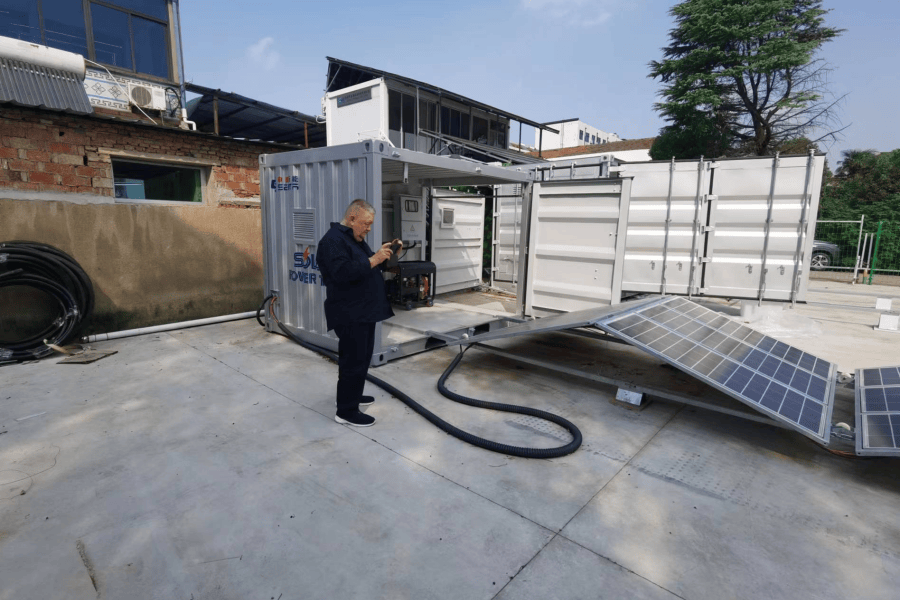
We deployed a 1.8 MWh Highjoule LFP container. The benefits we leveraged were its safety credentials for permitting and its high cycle life for twice-daily cycling. The drawback we engineered around was energy density: we custom-configured the container layout to fit the required capacity. The system manages the charge from the onsite solar canopies and provides scheduled, low-power grid charging during off-peak hours, then discharges at high power during the evening charging window. The result? Grid demand was capped, energy costs dropped by over 40%, and the safety design passed inspection without a hitch.
My Take: The Practical Path Forward
So, is an LFP Industrial ESS the right choice for your EV charging station? If your priorities are long-term operational safety, project bankability, and maximizing cycle life over a decade-plus, the answer is increasingly yes. The drawbacks are not deal-breakers; they are design parameters.
The critical insight is to partner with a provider that doesn't just sell a container but understands system integration. For instance, how the BMS communicates with your charging dispensers, how the thermal system is sized for your local climate, and how the whole package is certified to your regional standards (UL, IEC, IEEE). That's where the real-world success is found. At Highjoule, our engineering focus is on optimizing the complete LCOS, not just the sticker price, because that's what I've seen determine the success or failure of these projects on the ground.
What's the one constraint in your next EV charging project that keeps you most concerned - is it capex, permitting timelines, or long-term performance guarantees? Let's design for that.
Tags: Energy Storage Container BESS EV Charging Infrastructure LFP Battery UL IEC Standards
Author
James Zhang
20+ years agricultural energy storage engineer / Highjoule CTO