
Utility-Scale BESS for Rural Electrification: Lessons from a 5MWh Philippines Project for US & EU Developers
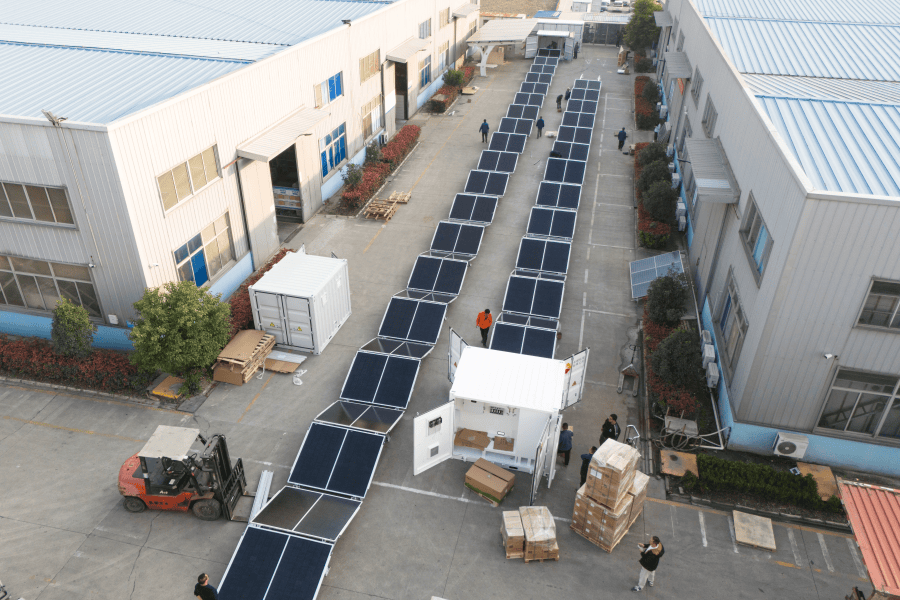
Table of Contents
- The Hidden Cost of "Standard" Utility-Scale BESS Deployment
- Agitation: What I've Seen On-Site When Projects Get Complex
- The Solution: Why All-in-One, Pre-Integrated Systems Are Changing the Game
- A Real-World Blueprint: The 5MWh Philippines Rural Electrification Project
- Expert Insight: Translating "Islanded Grid" Experience to US/EU Microgrids
- Making It Local: Why This Matters for Your Next Project in Texas or North Rhine-Westphalia
The Hidden Cost of "Standard" Utility-Scale BESS Deployment
Let's be honest. When we talk about utility-scale Battery Energy Storage Systems (BESS) in boardrooms from California to Berlin, the conversation often starts and ends with two numbers: the upfront capital cost per megawatt-hour and the projected levelized cost of energy (LCOE). It's a comfortable, spreadsheet-friendly approach. But after 20+ years on muddy construction sites and in humming substations, I can tell you that's where the real story - and the real costs - begin.
The hidden monster isn't the battery cells themselves anymore. It's the integration. It's the thousands of man-hours spent coordinating between half a dozen different vendors - the battery rack supplier, the power conversion system (PCS) manufacturer, the thermal management company, the fire suppression specialist, the SCADA integrator. I've seen projects where the BESS containers arrived on schedule, only to sit idle for weeks waiting for a certified electrician who understood the specific UL 9540 and IEC 62933 interplay to finally connect the last safety relay. According to the National Renewable Energy Laboratory (NREL), balance-of-system (BOS) and soft costs can account for over 30% of the total installed cost of a large-scale BESS. That's not a footnote; that's the margin.
Agitation: What I've Seen On-Site When Projects Get Complex
This complexity isn't just a budget line item; it's a tangible risk multiplier. On a project in the American Southwest a few years back, we had a thermal runaway detection system from one vendor that, technically, met its spec, but its communication protocol was a nightmare to integrate with our main control system from another. The result? Delays, custom software patches, and a lingering doubt about the seamless operation of the most critical safety feature. When you have multiple parties responsible for different subsystems, finger-pointing during commissioning isn't just frustrating - it's expensive and dangerous.
Now, amplify that challenge in a remote location. Think about the logistical headache of getting specialized technicians for five different subsystems to a rural site in the Philippines, or for that matter, to an off-grid industrial microgrid in Eastern Europe or a remote community resilience project in the US. Every unexpected bolt, every incompatible communication cable, needs to be flown or trucked in. The downtime costs are astronomical. This is the unglamorous reality of "traditional" BESS deployment that doesn't make it into the glossy brochures.
The Solution: Why All-in-One, Pre-Integrated Systems Are Changing the Game
This is precisely why the industry's sharpest developers are shifting towards all-in-one, pre-integrated and pre-tested BESS solutions. The philosophy is simple but powerful: treat the entire storage system - battery racks, PCS, HVAC, fire safety, and controls - not as a collection of parts, but as a single, unified product. One that is assembled, wired, and put through its paces in a controlled factory environment, not in a windy field.
At Highjoule, this has been our core design principle for years. We don't just source UL 1973-certified battery modules and a UL 1741-SA certified inverter and bolt them into a container. We engineer the entire enclosure as a system. Our thermal management is calibrated from day one for the specific C-rate and duty cycle of the battery chemistry we're using. C-rate, simply put, is how fast you charge or discharge the battery relative to its total capacity. A 1C rate means full discharge in one hour. For a 5MWh system, that's a 5MW power output. Designing for high C-rates (common for frequency regulation) requires a vastly different cooling approach than for slower, solar-smoothing applications. Getting this wrong in the field is a reliability killer. Getting it right in the factory is a lifetime extender.

A Real-World Blueprint: The 5MWh Philippines Rural Electrification Project
Let's look at a concrete example that embodies these challenges and this solution: a 5MWh utility-scale BESS deployment for rural electrification in the Philippines. The goal was straightforward: pair the system with a new solar PV farm to provide stable, 24/7 power to a cluster of villages previously reliant on expensive and polluting diesel gensets.
The challenges were textbook "remote deployment": limited local technical expertise, a long and complex supply chain, a demanding tropical environment (high heat, humidity, and salt spray), and a critical need for reliability. The developer chose a pre-integrated, all-in-one solution - a approach we strongly advocate for at Highjoule for such scenarios.
The 5MWh system was shipped as essentially two fully functional units: the main BESS container and the auxiliary power/transformer skid. Inside that main container, everything was already talking to each other. The battery management system (BMS) was natively integrated with the PCS and the environmental controls. The fire suppression system was pre-piped and tested. This meant that on-site, the work was largely civil (preparing the pad) and electrical (connecting to the medium-voltage switchgear). Commissioning was about verifying the system worked as a whole, not debugging why Subsystem A wouldn't talk to Subsystem B.
The result? The system was energized and providing grid-forming services to the local microgrid weeks ahead of a traditional multi-vendor approach. The LCOE for the delivered energy became predictable and competitive with diesel from day one, a key metric for the project's financiers.
Expert Insight: Translating "Islanded Grid" Experience to US/EU Microgrids
Now, you might think, "That's a developing market case. My projects are in Ohio or Bavaria." Honestly, the underlying principles are more transferable than you'd think. The "islanded grid" in the Philippines operates with the same fundamental stability challenges as an industrial microgrid in Germany or a community resilience hub in California that needs to "island" from the main grid during public safety power shutoffs.
The technical key here is grid-forming capability. Unlike traditional grid-following inverters that need a strong grid signal to sync to, advanced, pre-integrated BESS like the one in our case study can create a stable voltage and frequency waveform from scratch. This is non-negotiable for keeping critical loads online during a blackout or in a pure off-grid setup. When all components are designed together, this capability is more robust and responds faster.
Furthermore, meeting stringent local standards like UL 9540A for fire safety isn't just about having certified components. It's about how those components interact as a full system. A factory-integrated unit can be tested as a complete assembly, providing a much higher degree of confidence to AHJs (Authorities Having Jurisdiction) in the US and EU - a massive advantage during permitting.

Making It Local: Why This Matters for Your Next Project in Texas or North Rhine-Westphalia
So, what's the takeaway for a project developer in, say, Texas or North Rhine-Westphalia?
First, redefine "cost." Look beyond the $/kWh of the battery cell. Evaluate the Total Cost of Ownership, which includes integration risk, commissioning time, and long-term serviceability. A pre-integrated system with a single point of contact for warranty and support, like what we provide through Highjoule's global service network, dramatically simplifies the owner's life for the next 15-20 years.
Second, demand proven system-level performance. Ask for evidence of whole-system testing, not just component data sheets. How was the thermal management validated? Can you see the full system UL 9540 test report?
The Philippines 5MWh case isn't just a story about powering remote villages. It's a stress test for a deployment philosophy. It proves that in environments where complexity, logistics, and reliability are paramount, the all-in-one, engineered-system approach isn't just convenient - it's financially and operationally superior. The next time you're evaluating a BESS for a grid-edge application, ask yourself: are you buying a box of parts, or are you buying a guaranteed outcome?
What's the single biggest integration headache you've faced on your last storage project?
Tags: UL Standard BESS LCOE Rural Electrification Utility-Scale Energy Storage Project Deployment
Author
James Zhang
20+ years agricultural energy storage engineer / Highjoule CTO