
All-in-One Integrated PV Container Solutions for Military Base Energy Resilience
Contents
- The Silent Challenge: Energy Security Beyond the Fence
- Why It Hurts: The Real Cost of "Piecemeal" Power
- A Better Way: The All-in-One, Pre-Integrated Container
- Case in Point: A Forward Operating Base in the US Southwest
- Under the Hood: What Makes This Solution Tick
- Your Next Move: Questions to Ask Your Team
The Silent Challenge: Energy Security Beyond the Fence
Let's be honest. When we talk about energy storage, commercial and industrial sites get most of the spotlight. But for nearly two decades, one of the most critical, and often overlooked, conversations I've had are with facility managers and engineers at military installations. The challenge is stark: how do you ensure uninterrupted power for mission-critical operations, often in remote or vulnerable locations, while managing costs and a complex web of safety standards? The traditional approach - piecing together solar arrays, separate battery containers, inverters, and control systems on-site - is showing its age. It's slow, expensive, and frankly, introduces too many points of potential failure. I've seen this firsthand on site, where a delayed component or a compatibility hiccup can set a project back months.
The Data Behind the Demand
The push for resilience isn't just theoretical. The International Energy Agency (IEA) consistently highlights energy security as a top driver for decentralized power. More specifically, the U.S. Department of Defense has publicly set aggressive targets for energy resilience and renewable generation, recognizing that a secure base is an energy-independent base. This creates a massive, urgent need for solutions that go beyond the standard grid-tied commercial system.
Why It Hurts: The Real Cost of "Piecemeal" Power
Let's break down the pain points. Deploying a custom, from-scratch solar-plus-storage system for a secure facility isn't just about buying equipment.
- Time is Vulnerability: A typical field-built project can take 12-18 months from design to commissioning. Every day of delay is a day the base relies on diesel gensets or a potentially fragile grid connection.
- Integration Headaches: Coordinating between solar EPCs, BESS vendors, and civil engineers is a logistical nightmare. I've been on projects where the communication protocols between the inverter and the battery management system (BMS) weren't fully vetted until commissioning, causing weeks of rework.
- Standardization & Compliance: Military bases, especially in the US and NATO countries, require strict adherence to codes like UL 9540 (Energy Storage Systems), UL 1741 (Inverters), and IEEE 1547 (Grid Interconnection). Ensuring every single component and the final assembled system meets these is a massive compliance burden. A single sub-component failing certification can halt everything.
- Total Cost of Ownership (TCO): The initial capital expense is just the start. The operational complexity of managing disparate systems drives up long-term maintenance costs and requires specialized, on-call expertise.
A Better Way: The All-in-One, Pre-Integrated Container
This is where the concept of the pre-integrated, all-in-one PV container shifts the paradigm. Think of it not as a box of parts, but as a power plant in a box. At Highjoule, we've moved the complex integration work from the dusty, windy, time-pressured job site into our controlled, certified factory environment.
The core idea is simple but powerful: we pre-assemble the solar inverters, lithium-ion battery racks, thermal management system, fire suppression, and the master energy management system (EMS) into a single, ruggedized container. The PV array is designed as a plug-and-play companion. This means when the unit arrives on base, it's not a shipment of crates - it's a solution that's already been factory-tested as a complete system. It dramatically compresses the deployment timeline and de-risks the project.

Case in Point: A Forward Operating Base in the US Southwest
Let me share a scenario that mirrors many real projects (with operational details generalized). A base in an arid US Southwest region needed to secure power for its communications and command center. Their challenges were classic: extreme temperatures, a desire to reduce diesel fuel convoys (a security risk itself), and a tight deadline to achieve initial operational capability.
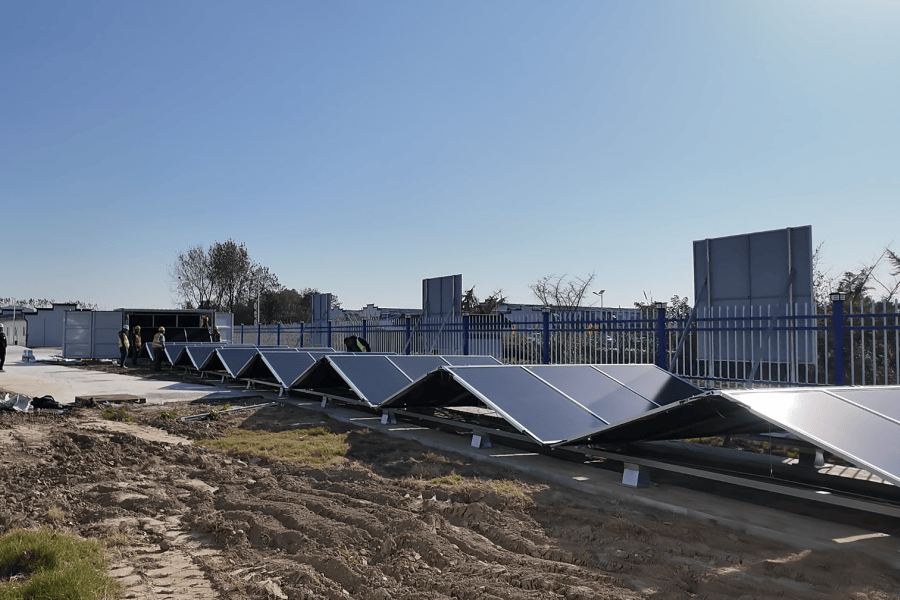
The solution was a 2 MWh all-in-one container paired with a 1.5 MW ground-mount solar array. Because the container was pre-integrated and pre-certified to UL 9540A, the on-site work was focused on foundation, electrical interconnection, and array mounting - not on wiring up subsystems. The thermal management system was specifically calibrated for the 45C+ ambient temperatures, a spec we validated in our environmental chamber before shipping.
The result? The system was commissioned in under 5 months from contract signing, not the projected 14. The base now has a "black start" capability, meaning if the grid goes down, the container can restart the critical loads and seamlessly integrate solar power, all managed by the built-in EMS. The Levelized Cost of Energy (LCOE) for this microgrid - a key metric we optimize for - came in 30% below the business-as-usual scenario of generator-heavy backup, thanks to the avoided fuel and maintenance.
Under the Hood: What Makes This Solution Tick
For the non-engineers making decisions, here's what you should care about inside that container:
- Thermal Management is Everything: Batteries hate being too hot or too cold. We don't just slap on an AC unit. We use a liquid cooling system that precisely controls cell temperature. This extends battery life by years and maintains performance on the hottest days - critical for desert or tropical bases.
- Smart C-Rate Management: "C-rate" is basically how fast you charge or discharge the battery. A higher C-rate gives you more power quickly (like for starting large loads) but can stress the battery. Our EMS intelligently manages this, providing high power when needed for resilience but optimizing for a gentler C-rate daily to maximize system longevity.
- Compliance by Design: This is huge. The entire system is tested and certified as a single unit (UL 9540). You're not buying a "UL-listed battery" and hoping it works with your "UL-listed inverter." We hand you a single system with a unified warranty and a stack of compliance certificates, simplifying your audit and approval process immensely.
- Local Support, Global Standards: Our service model is built around local partners in key regions (US, Europe). They have the training and the spare parts to provide rapid support, but they're backed by a global engineering team that designed the system. This hybrid model ensures you're never left waiting for an expert.

Your Next Move: Questions to Ask Your Team
So, if energy resilience is on your agenda, don't just ask "What's the price per kWh?" Start with these more revealing questions:
| For your procurement & engineering team: | "Is the proposed solution pre-certified as a unified system to UL 9540 / IEC 62933, or are we responsible for field integration and final certification?" |
| For your operations team: | "What is the expected commissioning timeline from delivery to full operation, and what on-site integration work is required?" |
| For your finance team: | "Beyond capex, what is the projected LCOE and total cost of ownership over 15 years, including maintenance and potential performance degradation?" |
| For your security team: | "How does this solution reduce our logistical footprint (like fuel convoys) and provide black-start capability without external support?" |
The future of base energy isn't about assembling more parts. It's about deploying more capability, faster and with less risk. That's the real-world shift the all-in-one container delivers. What's the single biggest energy vulnerability you're looking to solve in the next 18 months?
Tags: UL Standard BESS Grid Resilience PV Plus Storage Pre-integrated Container Military Energy Security
Author
James Zhang
20+ years agricultural energy storage engineer / Highjoule CTO