
Real-world Case Study: Liquid-cooled ESS Container for Agricultural Irrigation
Contents
- The Pump Starts Here: A Familiar Problem
- More Than Just a Power Bill: The Real Cost of Unreliable Power
- The Game Changer: A Liquid-Cooled Container on Site
- Why Liquid, Why Now? The Simple Tech Behind the Reliability
- Beyond the Case: Making It Work for Your Operation
The Pump Starts Here: A Familiar Problem
Let's be honest. When we talk about energy storage for agriculture, especially large-scale irrigation, the conversation often gets stuck on one thing: upfront cost. I've sat across the table from farm managers and operations directors countless times. The initial sticker shock of a Battery Energy Storage System (BESS) is real. But here's what I've seen firsthand on site C the bigger, more insidious problem isn't just the capital expenditure; it's the unpredictable operational expense and the sheer risk of downtime.
Think about a center-pivot irrigation system covering hundreds of acres. When the grid is stable and power is cheap, everything's fine. But during peak demand hours, when electricity rates spike, or worse, during a grid outage in the middle of a critical growth period, the entire season's investment is on the line. You're not just paying more for power; you might be losing the crop. According to the National Renewable Energy Laboratory (NREL), resilience against power outages is becoming a primary driver for behind-the-meter storage in the agricultural sector, not just bill savings.
More Than Just a Power Bill: The Real Cost of Unreliable Power
This is where the aggravation truly sets in. Many early industrial BESS solutions deployed in remote or demanding environments like farms struggled with one critical aspect: thermal management. Air-cooled containers, while simpler initially, often face massive challenges with dust, pollen, and extreme ambient temperatures. I've opened up units after just one season where filters were clogged, fans were straining, and internal temperature differentials between battery modules were worryingly high.
Why does this matter so much? Two words: degradation and safety. When battery cells operate at inconsistent or elevated temperatures, their lifespan plummets. That "10-year warranty" can quickly become a 6-7 year reality, destroying your projected financial returns or Levelized Cost of Energy (LCOE). Even more critical is the safety risk. Thermal runaway is a real concern, and effective heat dissipation is the first line of defense. Standards like UL 9540 for ESS safety and IEC 62933 for performance aren't just paperwork; they are blueprints for managing these exact risks.
The Game Changer: A Liquid-Cooled Container on Site
So, what does a working solution look like? Let me tell you about a project we were involved with in California's Central Valley. A large almond grower was facing steep demand charges and needed backup power for irrigation pumps during Public Safety Power Shutoff (PSPS) events. Their site was dusty, and summer temperatures regularly hit 40C (104F). An air-cooled system was deemed too high-risk for maintenance and performance degradation.
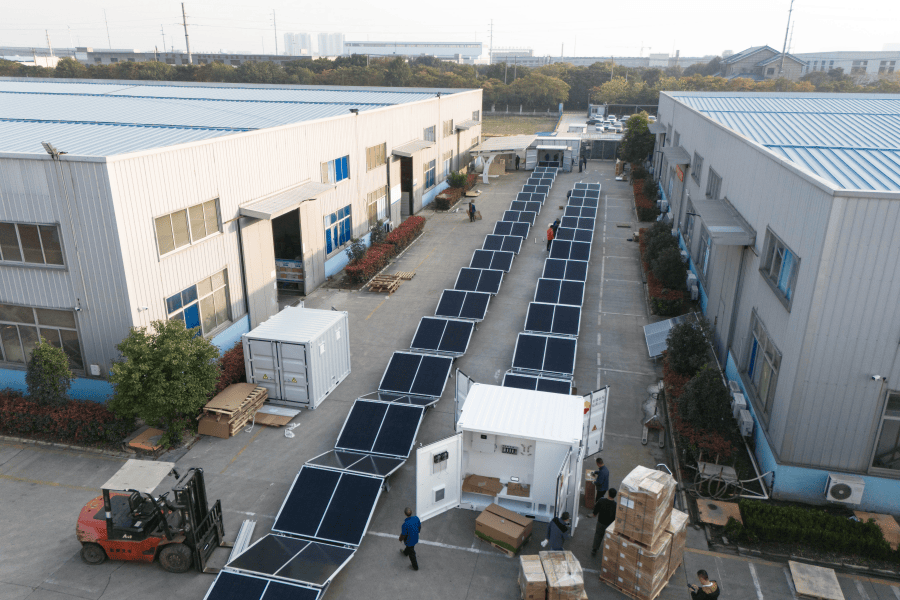
The solution was a 1.5 MWh / 1.5 MW liquid-cooled industrial ESS container. The core advantage? A closed-loop, direct-cooling system that bathes each battery cell in a temperature-controlled fluid. Honestly, the difference on site was night and day.
- Performance: The system could maintain a continuous, high C-rate discharge (we're talking close to 1C) to start and run large pumps without derating, even at peak afternoon heat. This high C-rate capability is crucial for the sudden, large power demands of agricultural motors.
- Reliability: With no massive air intakes or filters, the enclosure was virtually sealed against dust. Internal temperature variation across the battery rack was kept within 2-3C, promoting uniform aging and longevity.
- Footprint & Simplicity: The liquid-cooling hardware is more compact than a massive ducted air system, allowing for higher energy density in the same container footprint. On-site installation was cleaner and faster.

For this grower, the math finally worked. The BESS shaved peak demand, provided critical backup, and did so with a predictable, low-maintenance profile. The project's financial model was built on a reliable 15-year lifespan, thanks to the superior thermal control.
Why Liquid, Why Now? The Simple Tech Behind the Reliability
I know "liquid-cooled" sounds complex, but let's break it down simply. Think of it like a car's engine cooling system versus a simple fan. An air-cooled BESS blows air past the batteries - it's uneven and struggles in hot, dirty environments. A liquid-cooled system uses a fluid (often a non-conductive coolant) that is pumped through cold plates directly attached to each battery cell. It's like each cell has its own personal climate control.
This precision delivers three key benefits any business decision-maker can appreciate:
- Longer Life & Better LCOE: Stable, cool temperatures slow chemical degradation. If your battery degrades 20% slower, your long-term cost of stored energy (LCOE) drops significantly. That's the real return on investment.
- Inherent Safety: Liquid is simply far more efficient at capturing and moving heat away from a potential hotspot than air. This dramatically reduces the risk of a thermal event propagating. It's a core reason why at Highjoule, our liquid-cooled container design was engineered from the ground up to meet and exceed UL 9540 and IEC 62619 standards - it's baked into the architecture.
- Operational Stability: You get full power, on demand, regardless of the outdoor weather. No summer derating. This predictability is worth its weight in gold for operational planning.
Beyond the Case: Making It Work for Your Operation
The California case isn't a one-off. The principles apply to any energy-intensive, remote, or climate-challenged operation - whether it's irrigation in Texas, a processing plant in Germany's North Rhine-Westphalia, or a remote mine site. The shift towards liquid cooling for industrial-scale BESS isn't just a tech trend; it's a practical response to real-world field conditions.
When we at Highjoule Technologies work with partners on these projects, the conversation changes. It's less about "if" the system will survive the environment, and more about optimizing the energy arbitrage and resilience strategy. Our focus is on delivering a containerized solution that arrives site-ready, with local support for commissioning and maintenance, so your team can focus on your core business, not on managing complex battery HVAC systems.
The question for any operation considering storage is this: are you evaluating your system based on the perfect lab conditions on a datasheet, or for the dusty, scorching-hot reality of your own site? Because honestly, in the field, that's the only test that matters.
Tags: UL Standard BESS LCOE Thermal Management Liquid Cooling Agricultural Irrigation Microgrid Industrial ESS IEC Standard Energy Storage System
Author
James Zhang
20+ years agricultural energy storage engineer / Highjoule CTO