
ROI Analysis: Grid-forming Mobile BESS for Mining in Mauritania & Global Applications
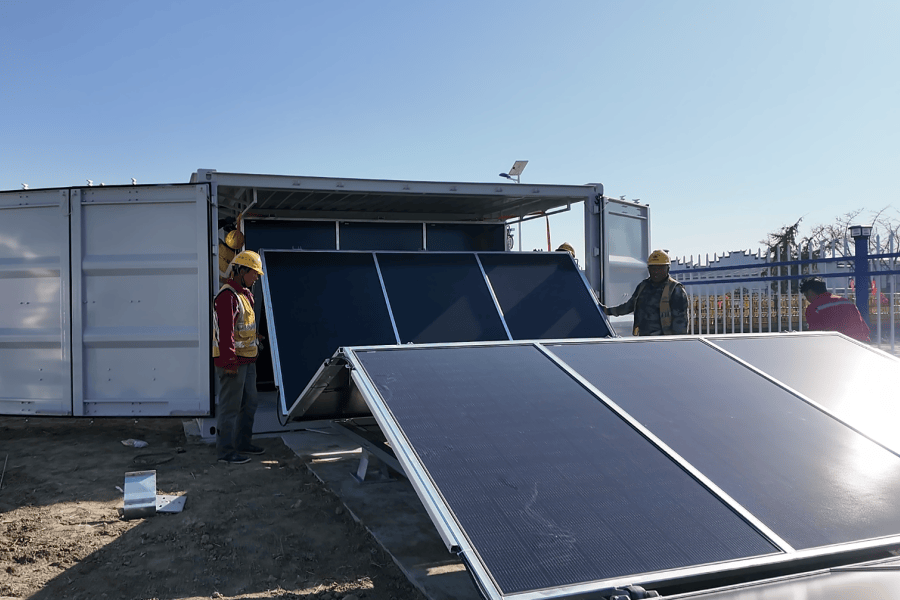
Table of Contents
- The Real Problem Isn't Just Power, It's Predictable ROI
- The Diesel Cost Trap and the "Spinning Reserve" Dilemma
- A Mobile, Grid-Forming Solution: More Than Just Backup
- Learning from the Field: The Mauritania Mining ROI Case
- Beyond Backup: The Technical Levers That Pull ROI
- Bringing It Home: Application in US & European Contexts
The Real Problem Isn't Just Power, It's Predictable ROI
Honestly, after two decades on sites from the Australian outback to Texas industrial parks, I've learned one universal truth: executives don't buy batteries. They buy financial outcomes - predictable ROI, cost certainty, and risk mitigation. The core challenge I see, especially for off-grid or weak-grid industrial operations like mining, is the brutal volatility of energy costs and the staggering capital tied up in underutilized, diesel-guzzling redundancy.
The Diesel Cost Trap and the "Spinning Reserve" Dilemma
Let's agitate that pain point a bit. A remote site runs on a primary diesel genset. For N-1 redundancy (a basic reliability standard), you need a second genset of similar size, just idling as "spinning reserve." You're burning fuel, accruing engine hours, and sinking capital into an asset that produces zero revenue 95% of the time. The International Energy Agency (IEA) highlights that fuel and maintenance can constitute over 70% of the Levelized Cost of Electricity (LCOE) for diesel-based microgrids. Every fuel price spike goes straight to your bottom line. It's a financial model built on quicksand.
I've seen this firsthand. The real cost isn't just the diesel bill; it's the operational paralysis when the grid flickers or a genset fails. A process shutdown in a mineral processing plant can mean tens of thousands per hour in lost production and, frankly, a very long night for everyone involved.
A Mobile, Grid-Forming Solution: More Than Just Backup
This is where the concept of a grid-forming mobile power container shifts the paradigm. We're not talking about a simple battery box that waits for a failure. A grid-forming BESS can create a stable grid voltage and frequency from scratch, just like a traditional generator. But it does it in milliseconds, with zero fuel, and can seamlessly bridge between a failing genset and a backup, or manage a hybrid system with solar. The "mobile" aspect is crucial - it's a high-value asset that can be deployed, redeployed, or scaled as operational needs change, protecting your capital investment.
Learning from the Field: The Mauritania Mining ROI Case
Let's talk about a concrete application: that ROI Analysis of Grid-forming Mobile Power Container for Mining Operations in Mauritania. The scenario is classic: an iron ore site with unreliable grid infeed, heavy reliance on diesel, and plans for a future solar PV expansion. The challenge was to ensure power quality for heavy machinery and reduce the runtime of all diesel gensets.
Our analysis for the client went beyond simple payback. We modeled a containerized, UL 9540/ IEC 62477-compliant system that provided two core functions: 1) Spinning Reserve Replacement: The BESS took over the "idling generator" role, instantly responding to load steps or a genset trip, allowing the second diesel unit to be shut down completely. 2) PV Ramp Rate Control & Time-Shift: It smoothed the aggressive output swings from the planned solar farm, preventing genset destabilization, and stored excess solar for use at night.
The ROI drivers were clear:
- Diesel Savings: Direct fuel reduction from optimized genset loading and eliminated spinning reserve.
- Capital Deferral: The mobile BESS could be relocated for future phase expansions, delaying the purchase of additional gensets.
- O&M Savings: Drastically reduced genset running hours slashed maintenance intervals and engine overhauls.
- Production Assurance: Quantifying the value of avoiding even a single process shutdown often alone justifies a significant portion of the BESS capex.

For Highjoule, the key was designing a system for that environment. We spec'd an aggressive cooling system (Thermal Management is everything when your ambient hits 45C) to preserve battery life and used a moderately high C-rate chemistry to handle the sudden large loads of excavators. The LCOE of the hybrid system (Diesel+PV+BESS) came in 34% lower than diesel-alone over the project's life.
Beyond Backup: The Technical Levers That Pull ROI
For a non-technical decision-maker, think of these as the dials we turn to maximize your return:
- Grid-Forming Inverter: This is the brain. It doesn't follow the grid; it makes the grid. This allows you to black-start a site and integrate more renewables. It's a must for true energy independence.
- C-rate (Charge/Discharge Rate): Simply put, how fast the battery can absorb or release energy. A higher C-rate is like having a bigger pump - it can handle massive, sudden loads (like a large motor starting) without needing a massive, expensive battery. Right-sizing this is an art.
- Thermal Management: Batteries hate heat. A poorly cooled system in Arizona or Mauritania will degrade years faster. Our designs use liquid cooling for precise, quiet temperature control, which directly extends asset life and protects your ROI.
- LCOE (Levelized Cost of Electricity): This is the ultimate metric. It's the total lifetime cost of owning and operating the energy asset, divided by the total energy it produces. Adding a BESS to a diesel or solar-diesel mix almost always lowers the LCOE, creating a more predictable, lower cost per kWh for the next 15 years.
Bringing It Home: Application in US & European Contexts
The principles from Mauritania apply directly to challenges in our core markets. In the US, think of a manufacturing plant in Texas facing demand charges and occasional grid curtailment notices. A mobile, grid-forming container can provide demand-charge management, shaving peak loads from the utility meter, and serve as critical backup to keep essential processes online during grid instability. Because it's mobile, it can be leased or redeployed if facility needs change.
In Germany or the UK, an industrial facility with a large rooftop solar array might face grid export limits. A BESS can store excess generation for self-use later, maximizing the solar investment. Furthermore, with the right grid services software (a key part of Highjoule's offering), that same battery can participate in frequency response markets, creating a new revenue stream. The asset pays for itself while providing internal resilience.
The through-line is flexibility. Whether it's a mine, a data center, or a municipal microgrid, the ability to deploy a standardized, safety-certified (UL/IEC/IEEE 1547), plug-and-play power asset that solves multiple problems - fuel cost, reliability, renewables integration - is where the modern energy ROI is found. It's not a cost; it's a strategic, revenue-protecting investment.
So, what's the energy volatility cost hiding in your operational budget? Maybe it's time we looked at your site's specific load profile and ran the numbers.
Tags: UL Standard BESS LCOE Microgrid ROI Analysis Grid-forming Industrial Energy Mobile Power Container
Author
James Zhang
20+ years agricultural energy storage engineer / Highjoule CTO