
Step-by-step Installation of Rapid Deployment 5MWh Utility-scale BESS for Data Center Backup Power
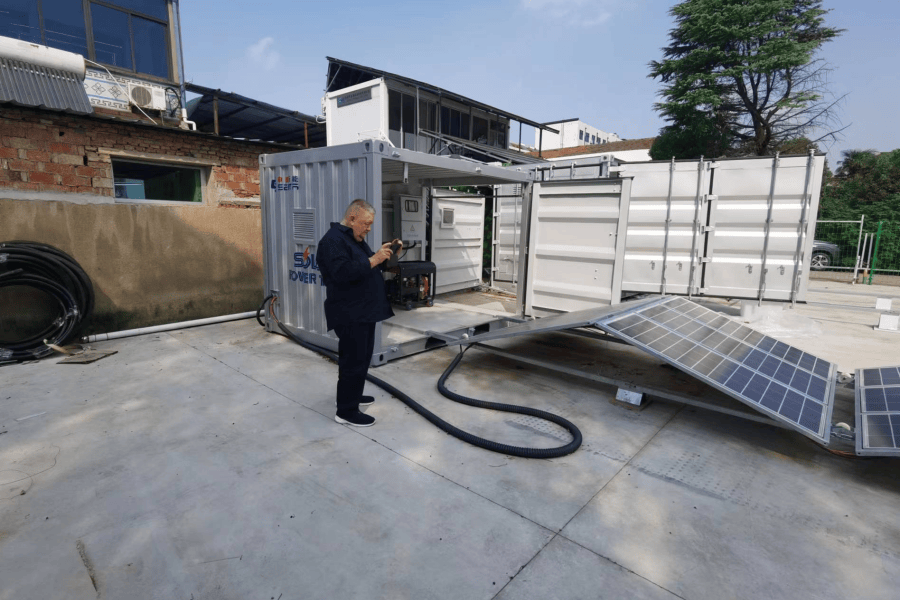
Table of Contents
- The Real Problem: It's Not Just About the Batteries
- Why It Hurts: The Hidden Costs of a Slow or Wrong Deployment
- The Rapid Deployment Path: A 5MWh BESS from Paper to Power
- Case in Point: A 48-Hour Race in Frankfurt
- Expert Insight: What's Beyond the Box? The Nuances That Matter
- Your Next Step: Making It Real for Your Site
The Real Problem: It's Not Just About the Batteries
Honestly, when most folks think about deploying a 5-megawatt-hour utility-scale Battery Energy Storage System (BESS) for data center backup, they picture unpacking some sleek containers, hooking up a few cables, and flipping a switch. I wish it were that simple. The real bottleneck, the thing that keeps facility managers and CFOs up at night, isn't the technology itself - it's the deployment process.
In the US and Europe, we're facing a perfect storm. Demand for ultra-reliable backup power is skyrocketing, driven by data center expansion and grid instability. Yet, the path to getting a BESS online is often bogged down by lengthy site studies, complex permitting tied to local fire codes (like NFPA 855 in the US) and IEC standards in Europe, and a maze of utility interconnection requirements. The fear? A project that drags on for 18 months, bleeding capital and missing its critical reliability window.
Why It Hurts: The Hidden Costs of a Slow or Wrong Deployment
Let's agitate that pain point a bit. I've seen this firsthand on site. A slow deployment isn't just an inconvenience; it directly attacks your bottom line and operational integrity. Every month of delay means:
- Lost Revenue & Risk: For a data center, downtime is measured in millions per minute. Without that BESS buffer, you're exposed to grid fluctuations and potential outages.
- Spiraling Soft Costs: Engineering, legal, and permitting fees don't pause while you wait. The National Renewable Energy Laboratory (NREL) has highlighted how soft costs can dominate storage project economics if not managed aggressively.
- Safety Compromises: Rushing the later stages to catch up can lead to shortcuts. Proper thermal management systems, fire suppression integration, and UL 9540/ IEC 62933 certification aren't checkboxes - they're your insurance policy.
The old way of custom-engineered, one-off solutions for every site simply doesn't scale for the urgency we face today.
The Rapid Deployment Path: A 5MWh BESS from Paper to Power
So, what's the solution? It's a shift from a "construction project" mindset to a "precision deployment" methodology. At Highjoule, we've refined this into a step-by-step playbook for rapid deployment. Here's how it breaks down:
Phase 1: Pre-Flight Check (Weeks 1-4)
This is where 80% of the delays are avoided. We don't just look at a plot of land; we conduct a hyper-focused site assessment:
- Geotechnical & Grid Tie-In Analysis: Will the ground support the containers? Where is the exact point of interconnection, and what's the utility's specific protection scheme requirement? We get these answers upfront.
- Permitting Navigator: We use pre-approved, modular designs that are already compliant with key standards like UL 9540A and IEEE 1547. This gives local authorities confidence and dramatically speeds up plan review.
Phase 2: The Foundation & The Flip (Weeks 5-10)
With permits in hand, site prep begins. For a rapid deployment, we use pre-cast concrete slabs or helical piles - fast, stable, and minimally invasive. Then comes the "flip." Our 5MWH BESS units arrive as fully integrated, factory-tested power blocks. Honestly, it's impressive to see. Each container has its battery racks, HVAC, fire suppression, and power conversion systems already talking to each other. It's not a kit; it's a functional unit on arrival.

Phase 3: Connect, Commission, Go (Weeks 11-14)
The final connections - medium-voltage cabling, communications, and integration with your existing SCADA - are made with military precision. Commissioning isn't just a functionality test. We simulate real-world stress: rapid discharge cycles (testing that C-rate), failure mode simulations, and a full thermal runaway management system check. Only when every alarm and response works as designed do we hand over the keys.
Case in Point: A 48-Hour Race in Frankfurt
Let me give you a real example. We worked with a hyperscaler in Frankfurt, Germany. Their challenge was brutal: a critical expansion needed backup power, but the local grid connection had a hard deadline. A traditional build would have missed it by months.
Our rapid deployment model was the only fit. Using our pre-certified container design (meeting all IEC 62933 and local VdS guidelines), we bypassed months of design debates. The site prep was done in parallel with the final manufacturing. The units shipped from our EU facility. The result? The entire 5MWh system was physically installed, connected to the medium-voltage switchgear, and ready for commissioning in under 48 hours from the arrival of the first container. The client met their grid-agreed connection window with room to spare. That's the power of process.
Expert Insight: What's Beyond the Box? The Nuances That Matter
As an engineer who's stood on a hundred sites, the specs on paper only tell half the story. Here's what I look for:
- Thermal Management is Everything: It's not just about cooling; it's about uniform temperature distribution. A 5C gradient across a rack can significantly degrade cell life and performance. We design for a <2C delta, which optimizes for both longevity and instantaneous power (C-rate) when you need it most.
- LCOE is a Deployment Metric Too: Levelized Cost of Energy isn't just about cell chemistry. A rapid, right-first-time deployment slashes the "E" (energy) denominator by getting the system producing revenue or savings sooner, and boosts the system's usable lifetime by ensuring it operates optimally from day one.
- The Safety "Stack": True safety is layered. It starts with cell chemistry (we prefer LFP for data centers for its intrinsic stability), then goes to module-level fusing, then cabinet-level gas detection and suppression, and finally, the container-level isolation and ventilation. Each layer must be independently robust and intelligently interconnected.
This is where Highjoule's two decades in the field inform our product design. Our systems are built not just to spec, but for the reality of a rainy Tuesday afternoon during commissioning.
Your Next Step: Making It Real for Your Site
Look, the theory is solid. But your site is unique. The real question isn't just "can it be done fast?" but "can it be done fast here, for my specific load profile and risk tolerance?"
That's the conversation I enjoy having. Instead of a generic brochure, let's start with a 90-minute technical deep dive. Bring your site plans, your utility interconnection agreement draft, and your worst-case scenario. Let's map out a realistic timeline, not a sales promise. What's the one constraint keeping you from pulling the trigger on your backup power upgrade today?
Tags: UL Standard BESS Europe US Market Data Center Backup Power Renewable Energy Energy Security Utility-Scale Energy Storage
Author
James Zhang
20+ years agricultural energy storage engineer / Highjoule CTO