
Step-by-Step Installation of Smart BMS Monitored Energy Storage for Utilities
Table of Contents
- The Planning Gap: Why Good Projects Stumble at the Finish Line
- The Real Cost of Haste: Safety, Compliance, and Your Bottom Line
- A Better Way: The Methodical, BMS-Centric Installation Playbook
- Step 1: The Pre-Site Arrival Checklist C More Than Just a Pad
- Step 2: Commissioning the Brain First (The Smart BMS)
- Step 3: The Thermal Dance: Managing the Heartbeat (C-Rate) and Heat
- Step 4: Grid Handshake and The 1,000-Hour Proving Ground
- Beyond Installation: The Real Work Begins
The Planning Gap: Why Good Projects Stumble at the Finish Line
Honestly, over two decades of deploying BESS containers from California to North Rhine-Westphalia, I've seen a pattern. Utilities and developers nail the big stuff C financing, technology selection, interconnection studies. But then, when the container arrives on site, there's this palpable scramble. The focus shifts to "get it plugged in," and the meticulous, step-by-step process that ensures long-term safety, performance, and return on investment gets compressed, or worse, skipped. I've seen this firsthand on site: a brilliant 50 MW project delayed six weeks because the SCADA integration protocol wasn't locked down before the container was energized. That's millions in potential revenue, just gone.
The industry is booming. The IEA reports global grid-scale battery storage capacity surged by over 130% in 2023 alone. But this rapid growth is straining local AHJs (Authorities Having Jurisdiction) and exposing a knowledge gap in field deployment. It's not just about having a UL 9540 or IEC 62933 certified container; it's about the step-by-step installation of that smart BMS-monitored energy storage container that turns a certified box into a reliable, grid-supportive asset.
The Real Cost of Haste: Safety, Compliance, and Your Bottom Line
Let's agitate that pain point a bit. Rushing the installation isn't just a scheduling issue. It directly impacts your three non-negotiables:
- Safety: A smart BMS isn't just a fancy monitor; it's the central nervous system that prevents thermal runaway. If it's not properly commissioned and integrated with thermal management systems before full cell charging, you're operating blind.
- Grid Compliance: Utilities like CAISO or a German DSO require specific communication protocols (IEEE 1547, VDE-AR-N 4110). Getting this "grid handshake" wrong during commissioning can lead to costly re-work and failed acceptance tests.
- Levelized Cost of Storage (LCOS): This is your ultimate financial metric. A botched installation that leads to uneven cell degradation, inefficient cooling, or communication dropouts will inflate your LCOS by reducing system lifespan and availability. A 5% performance hit over 15 years is a massive financial bleed.

A Better Way: The Methodical, BMS-Centric Installation Playbook
The solution is a disciplined, sequential approach that treats the Battery Management System as the project foreman, not a passive observer. At Highjoule, our field manuals are built around this philosophy. Here's the distilled, on-the-ground logic we follow for a successful step-by-step installation of a smart BMS monitored energy storage container.
Step 1: The Pre-Site Arrival Checklist C More Than Just a Pad
Long before the truck rolls in, the site must be "BMS-ready." This means:
- Digital Twin Alignment: The as-built site drawings (foundation, conduit runs, utility interface point) must match the BMS and system controller's expected configuration files. A mismatch here causes days of software reconfiguration.
- Commissioning Power & Data: You need a clean, stable low-voltage power source and secure data network (often fiber) to commission the BMS independently of the main MV transformer. I've seen crews waste a week waiting for the utility transformer while the BMS could have been fully brought online.
- AHJ Pre-Walkthrough: Bring the local fire marshal and inspector to the site before the container arrives. Walk them through the safety systems (gas venting, thermal runaway containment, disconnect locations) on paper. This builds trust and smooths the final inspection.
Step 2: Commissioning the Brain First (The Smart BMS)
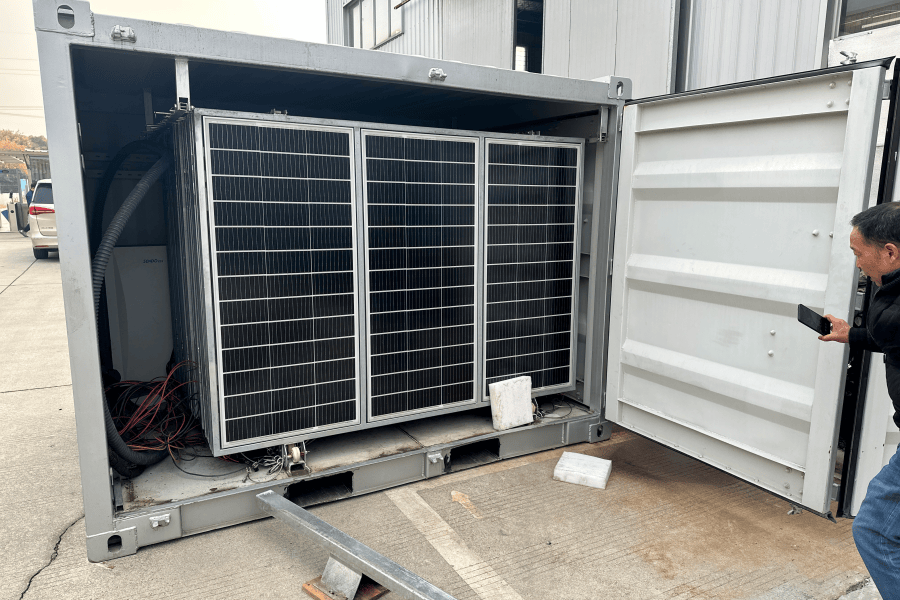
Once the container is placed and grounded, we do not immediately start charging. We power up and commission the BMS and its sensor network in isolation.
Expert Insight: A modern smart BMS monitors voltage, temperature (at multiple cell and module points), and current for every cell string. In this step, we're verifying that every single one of these thousands of data points is communicating accurately. We simulate fault conditions (e.g., a broken temperature sensor) to ensure the system logs it correctly and initiates safe protocols. This is where our Highjoule units, with their triple-redundant communication buses, prove their worth - eliminating single points of failure in the monitoring system itself.
Step 3: The Thermal Dance: Managing the Heartbeat (C-Rate) and Heat
Now we introduce energy, but slowly. The first charge/discharge cycles are low C-rate (e.g., 0.1C) diagnostics. Let me explain C-rate simply: a 1C rate means charging a battery from empty to full in one hour. A 0.1C rate takes ten hours. We start slow to let the BMS and the thermal management system establish a baseline.
Expert Insight: Thermal management isn't just about running fans or chillers. It's about the BMS using real-time cell-level temperature data to predictively control cooling. During a project in Texas, we used this BMS data to modulate cooling pumps, reducing auxiliary power consumption by 18% compared to a fixed-speed system. That directly lowers LCOS. The BMS must learn the "thermal signature" of the container in its specific orientation and ambient environment.
Step 4: Grid Handshake and The 1,000-Hour Proving Ground
Only after the BMS reports a perfectly balanced, thermally stable system do we close the main grid interconnect switch. Then begins the critical grid compliance testing: voltage/frequency ride-through, reactive power support, ramp rate control. The BMS is feeding essential data to the system controller to execute these functions.
But here's the step many miss: the first 1,000 operational hours are a proving ground. We analyze BMS data trends daily - looking for any subtle voltage drift between modules or slight variations in cooling loop efficiency. This is where you catch a underperforming cell string before it impacts the whole system. Our service team often remains on-call during this period, using remote BMS access to collaborate with the owner's team, turning installation into a training opportunity.
Beyond Installation: The Real Work Begins
So the container is live and supporting the grid. Is the step-by-step installation of the smart BMS monitored energy storage container complete? Not really. The installation process simply activates your most powerful tool: continuous, granular data. The real value is in leveraging that BMS data for predictive maintenance, capacity forecasting, and optimizing every dispatch for maximum revenue or grid service effectiveness.
The difference between a grid asset that is a constant headache and one that is a set-and-forget revenue generator lies in these meticulous first steps. It's the discipline to let the BMS lead the dance. What's the one pre-installation question you wish you'd asked on your last project?
Tags: BESS UL Standards IEC Standards Smart BMS Utility-Scale Energy Storage Project Deployment Grid Compliance
Author
James Zhang
20+ years agricultural energy storage engineer / Highjoule CTO