
C5-M Anti-Corrosion BESS: Industrial Park Energy Security & LCOE Optimization
Beyond the Spec Sheet: Why Your Industrial Park's BESS Needs More Than Just a Container
Hey there. Let's be honest, if you're managing energy for an industrial facility in Europe or the U.S., you've probably seen a dozen spec sheets for battery containers. They all promise the world: high density, fast response, great ROI. But after two decades on sites from Texas to North Rhine-Westphalia, I've learned the hard way that what happens between those lines on the spec sheet - and more importantly, outside the container walls - is what truly determines success or a very expensive headache.
Quick Navigation
- The Real Problem Isn't the Battery, It's the Environment
- The Silent Budget Killer: Corrosion and Downtime The C5-M Difference: Engineering for the Real World
- Beyond the Box: Thermal Management & LCOE in Plain English
- Making It Real: What This Means for Your Next Project
The Real Problem Isn't the Battery, It's the Environment
We love talking about battery chemistry - LFP, NMC, you name it. But here's a firsthand observation: the most common point of failure I've seen in industrial BESS deployments isn't the cell itself. It's the hostile environment industrial parks create. We're talking about chemical particulates in the air from nearby processes, salt spray for coastal sites, wide humidity swings, and constant vibration from heavy machinery. A standard container might look tough, but that environment eats away at seals, corrodes electrical connections, and compromises climate control systems. Suddenly, your carefully calculated performance and 15-year lifespan goes out the window.
The Silent Budget Killer: Corrosion and Downtime
Let's agitate that pain point a bit. The National Renewable Energy Lab (NREL) has shown that operations and maintenance (O&M) costs can make up 10-15% of a BESS's levelized cost of storage (LCOS) over its life. Unplanned downtime due to environmental failures is a massive contributor. Imagine a $2 million asset going offline because a cooling fan seized from corrosion, leading to thermal runaway protection kicking in. You're not just losing stored energy revenue; you're facing emergency service calls, potential warranty disputes, and a hit to your facility's overall energy resilience. That's a conversation no facility manager wants to have with the CFO.
I recall a project at a manufacturing plant in the Midwest U.S. They installed a BESS next to a production line that occasionally emitted fine alkaline dust. Within 18 months, they were seeing erratic performance data. When we opened the container, we found conductive dust buildup on busbars and corrosion on the HVAC unit's evaporator coils. The fix cost nearly 5% of the initial project capEx. That's the hidden cost of an under-specified enclosure.
The C5-M Difference: Engineering for the Real World
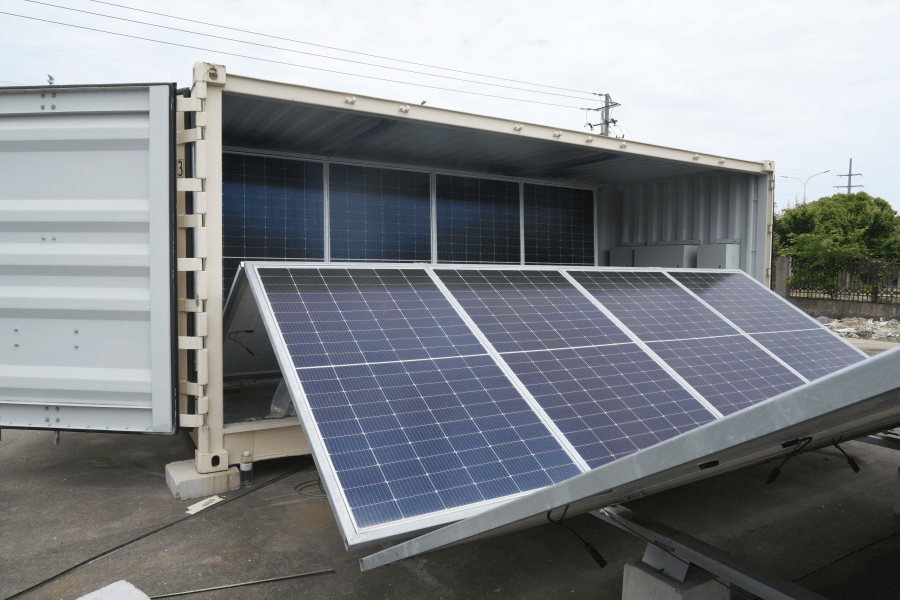
This is where a specification like the Technical Specification of C5-M Anti-corrosion Solar Container for Industrial Parks stops being just a document and becomes your first line of defense. The "C5-M" classification isn't a marketing term - it's a rigorous ISO-aligned standard defining protection against highly corrosive atmospheres. At Highjoule, we don't just meet it; we build our industrial solutions around it as a baseline.
What does that mean in practical terms? It means:
- Materials Matter: We use hot-dip galvanized steel for the primary structure, with a multi-layer powder coating system specifically formulated for chemical resistance. It's about creating a barrier that lasts.
- Sealed for Life: Gaskets and cable glands aren't an afterthought. They're IP66-rated as standard, ensuring no moisture or particulates sneak in, even under pressure washing for cleaning.
- Internal Climate Armor: The HVAC system is a sealed unit with corrosion-protected coils and filters designed for finer particulates. It's not just about keeping the batteries at 25C; it's about keeping the air inside clean and dry.

This approach is baked into our design philosophy. Every BESS we deploy for industrial clients, whether it's in a German chemical park or a Gulf Coast logistics hub, starts with the enclosure as a critical safety and performance component, not just a box to put batteries in. It's fully compliant with UL 9540 and IEC 62933, but those standards are the floor, not the ceiling.
Beyond the Box: Thermal Management & LCOE in Plain English
Now, a robust container enables something even more critical: precision thermal management. You'll hear engineers talk about "C-rate" C basically, how fast you can charge or discharge the battery relative to its size. A higher C-rate is great for grabbing cheap grid power fast or providing rapid frequency response. But it generates more heat. If your thermal system can't handle that heat consistently over years (without corroding!), you have to derate the system - meaning you can't use its full power. That's a direct hit to your project's financial model.
Let me simplify the LCOE (Levelized Cost of Energy) connection: Better thermal management + zero corrosion downtime = more usable cycles over a longer life. You spread the upfront cost over more megawatt-hours delivered. That's how you optimize LCOE. Our system's liquid-cooled thermal design, protected inside that C5-M shell, maintains optimal cell temperature with minimal energy use (the so-called "parasitic load"), ensuring you get every cycle and every kilowatt-hour you paid for.
Making It Real: What This Means for Your Next Project
So, what's the takeaway as you evaluate BESS providers? Look beyond the headline battery specs. Drill into the enclosure specifications. Ask:
- "What specific corrosion protection standard does this meet for my site's ISO classification?"
- "Can you show me the O&M logs and performance data from a similar industrial environment after 3-5 years?"
- "How is the thermal system protected from external contaminants?"
At Highjoule, our local teams in both Europe and North America come with site audit checklists that include environmental sampling. Because deploying a BESS isn't a theoretical exercise. It's about putting a sophisticated piece of electrical equipment into a tough neighborhood and expecting it to work flawlessly for 15+ years. Honestly, that's the only kind of energy storage that makes business sense.
What's the one environmental factor at your site that keeps you up at night when thinking about a 20-year asset?
Tags: UL Standard BESS LCOE Industrial Energy Storage Anti-corrosion Container
Author
James Zhang
20+ years agricultural energy storage engineer / Highjoule CTO