
Smart Military BESS: UL-Certified Containerized Storage for Base Resilience
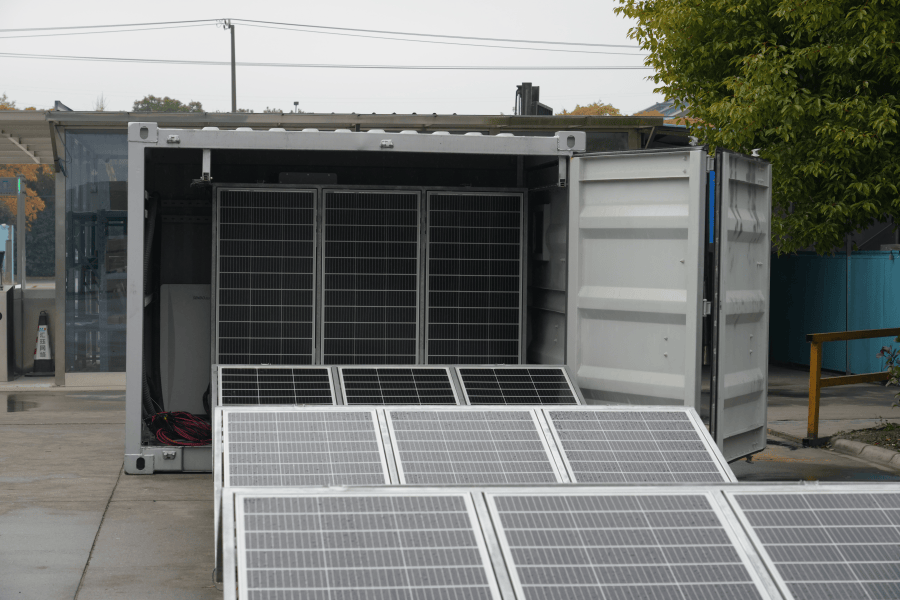
Table of Contents
- The Silent Problem: When "Backup Power" Isn't Enough
- The Real Cost of Downtime and Security Gaps
- The Solution: It's More Than Just a Box of Batteries
- Case in Point: A Northern European Base's Modernization
- The Smart BMS Difference: Your Digital Guardian
- Making the Specs Work for Your Mission
The Silent Problem: When "Backup Power" Isn't Enough
Let's be honest. For years, when we talked about energy resilience for critical facilities like military bases, the conversation often started and ended with diesel generators. They're a known quantity, right? But after two decades on site, from the deserts to the Arctic circle, I've seen the limitations firsthand. The fuel logistics chain is a vulnerability. The maintenance windows are constant. And when a microsecond-level grid disturbance hits, that 10-30 second generator start-up time is an eternity for sensitive command and control systems. It's not just about having backup; it's about having seamless, instant, and intelligent backup.
The industry is shifting. According to the National Renewable Energy Laboratory (NREL), pairing renewables with advanced storage is key to energy security. But slapping a standard commercial battery system onto a base isn't the answer. The technical specifications for a military-grade solution are - and should be - in a different league.
The Real Cost of Downtime and Security Gaps
So we agitate the problem a bit. What's at stake? It's not just a flicker of lights. We're talking about:
- Operational Readiness: A communications blackout during a critical drill or event isn't an "incident report;" it's a mission-impacting failure.
- Total Cost of Ownership (TCO): Diesel is expensive to move, store, and maintain. A poorly integrated battery system with a 5-year lifespan instead of a 15-year one creates a budget sinkhole.
- Safety & Compliance: A thermal event in a standard battery rack? That's a catastrophic risk in a confined or mission-critical area. Compliance isn't about checking a box for UL 9540 or IEC 62619; it's about a fundamental design philosophy that prioritizes safety above all.
The pain point is clear: bases need a resilient energy asset, not another piece of maintenance-heavy, potentially vulnerable infrastructure.
The Solution: It's More Than Just a Box of Batteries
This is where a true Technical Specification of a Smart BMS Monitored Lithium Battery Storage Container comes into play. It's the blueprint for turning lithium-ion technology from a commodity into a mission-critical asset. At Highjoule, we don't see a container as just a weatherproof shell. It's a fully integrated, pre-fabricated power station. The spec sheet is the recipe for resilience.
Think about it like this: the battery cells are the muscles, but the Smart Battery Management System (BMS) is the central nervous system, and the container itself is the armored exoskeleton. All three must be designed together from the ground up.

Case in Point: A Northern European Base's Modernization
I remember working with a base in Northern Europe. Their challenge was classic: reduce diesel dependency, integrate a new solar array, and ensure 99.99% uptime for a radar installation. The catch? Extreme temperature swings and a requirement for remote, unmanned operation.
The solution was a containerized BESS built to a stringent custom spec. We didn't just pick cells off a shelf. We engineered the thermal management system to maintain optimal cell temperature (crucial for longevity and safety) from -30C to 40C ambient. The BMS wasn't just monitoring voltage; it was talking to the base's SCADA system, predicting capacity based on weather, and scheduling grid support functions. Because it was a single, pre-tested container, deployment took weeks, not months. That's the power of a proper, holistic specification.
The Smart BMS Difference: Your Digital Guardian
Let's demystify the "Smart BMS" part. Anyone can monitor voltage. A smart BMS does predictive analytics. It looks at the rate of charge/discharge (what we call C-rate), cell-level temperature differentials, and impedance trends. Honestly, I've seen systems where the BMS caught a failing cell module 48 hours before it would have triggered a shutdown. That's not monitoring; that's prognostics. It allows for planned, safe intervention instead of emergency response. For a base engineer, that's peace of mind you can't put a price on.
Making the Specs Work for Your Mission
So, what should you look for in those technical specifications? Here's my take from the field:
- Safety First, on Paper: The spec must mandate cell-to-container level safety certifications (UL 9540, IEC 62619, IEEE 2030.3). It's non-negotiable.
- Thermal Management Specs: Don't just accept "air-cooled" or "liquid-cooled." Ask for the design ambient range and the guaranteed cell temperature operating window. This directly impacts your system's LCOE.
- Cybersecurity & Interoperability: The BMS must comply with local grid codes (like UL 1741 SB in the US) and have secure, encrypted communication protocols. An islandable microgrid capability is often key.
- Serviceability: Can modules be safely swapped in the field without a full shutdown? The spec should outline this. At Highjoule, we design with this in mind, because downtime for service should be minimal and predictable.
The goal is a system that delivers lower lifetime costs (LCOS), meets the toughest standards, and operates as a reliable, silent partner to the base's mission. It's not the cheapest upfront box, but the most valuable long-term energy asset.
What's the one resilience challenge your current energy setup hasn't been able to solve?
Tags: UL Standard BESS Military Energy Storage Lithium-ion Safety Containerized Battery
Author
James Zhang
20+ years agricultural energy storage engineer / Highjoule CTO