
The Ultimate Guide to All-in-one Integrated Pre-integrated PV Container for Industrial Parks
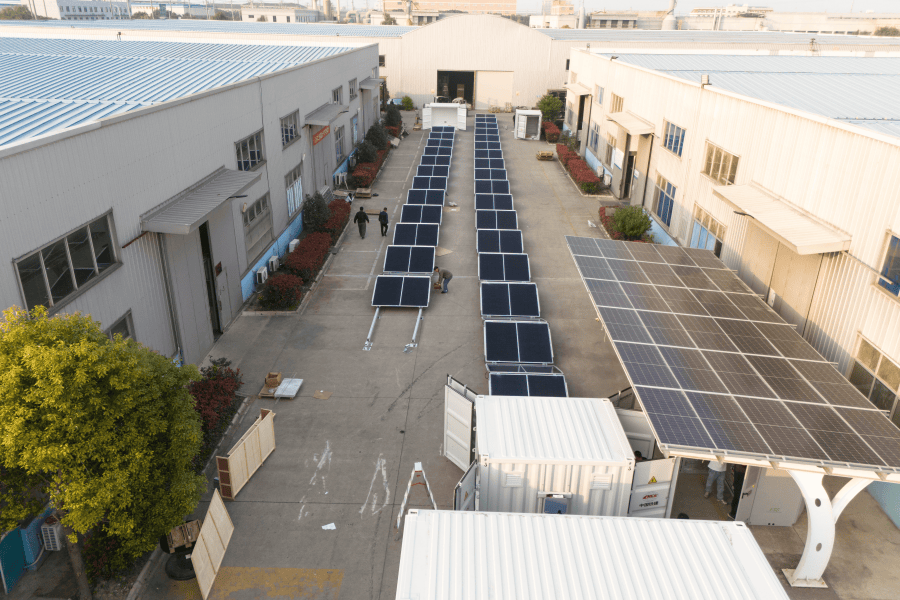
Table of Contents
- The Real Problem Isn't the Tech, It's the Timeline
- The Staggering (and Hidden) Cost of Delay
- The Integrated Answer: More Than Just a Box
- Case in Point: A German Automotive Supplier
- Under the Hood: What Makes a Truly "Pre-Integrated" System
- Making the Choice: What to Look For
The Real Problem Isn't the Tech, It's the Timeline
Let's be honest. If you're managing energy for an industrial park in Europe or the US, you already know you need to add solar and storage. The business case for energy cost hedging, resilience, and sustainability is clearer than ever. The technology? It's proven. I've walked through hundreds of megawatt-hours of operating battery storage on three continents. The real headache, the thing that keeps project managers up at night, isn't whether to deploy, but how to deploy without the nightmare.
I'm talking about the traditional "stick-built" approach. You order the battery racks from one vendor, the power conversion system (PCS) from another, the HVAC and fire suppression as separate packages, and then you try to weave it all together with miles of cabling and a complex control system on your site. You're not just building an energy asset; you're managing a dozen different suppliers, navigating a maze of interconnect studies, and praying that everything arrives on schedule and plays nice together. One delayed component - a transformer, a specialized circuit breaker - can throw your entire project timeline off by months. Honestly, I've seen this firsthand on site: a finished container sitting idle, waiting for one last UL-certified component, while the client watches their potential savings evaporate.
The Staggering (and Hidden) Cost of Delay
This aggravation translates directly to the bottom line. A report by the National Renewable Energy Laboratory (NREL) highlights that balance-of-system (BOS) and soft costs can constitute up to 50% of the total installed cost of a storage system. Every day of on-site labor, every extra engineering hour for system integration, and every month of delayed operational date adds to your Levelized Cost of Energy Storage (LCOE).
Beyond pure cost, there's risk. Having multiple vendors means finger-pointing when something goes wrong. Whose fault is the thermal runaway event? The battery cell maker? The integrator who designed the rack? The HVAC supplier? From a compliance perspective, it's a regulatory minefield. Getting a site-assembled system through the full gamut of UL 9540, IEC 62933, and local fire code approvals is a monumental task. The authority having jurisdiction (AHJ) needs to inspect a complex, one-off system, which inevitably leads to questions, requests for modifications, and more delays.
The Integrated Answer: More Than Just a Box
This is precisely why the concept of the all-in-one, pre-integrated PV container has moved from a niche option to a mainstream necessity for industrial parks. It's not just a container; it's a paradigm shift. Think of it as a "power plant in a box," but one that's been meticulously engineered, assembled, and tested in a controlled factory environment before it ever reaches your site.
At Highjoule, we've built our entire service model around this principle. Our PowerBlockTM Industrial units arrive with the PV inverters, battery racks, PCS, thermal management, fire safety, and the master control system all pre-wired, pre-tested, and pre-certified as a single unit. We handle the "integration headache" at our facility, under rigorous quality controls. Your scope on site shrinks dramatically: site preparation, a simple grid connection, and commissioning. What used to take 9-12 months can often be collapsed into 4-6. That's not just faster; it's capital freed up years earlier.
Case in Point: A German Automotive Supplier
Let me give you a real example from last year. A major automotive parts supplier in Baden-W1rttemberg needed to stabilize energy costs and ensure production line continuity for their precision machining facility. Their challenge? Limited space, a tight deadline to capture a government incentive, and zero tolerance for on-site experimentation.
We delivered two 1.5 MWh PowerBlock units, pre-integrated with their specified PV inverter compatibility. Because the entire system was tested as one at our factory with the full IEC 62933 suite, the T1V certification process was vastly simplified. The containers were placed on pre-prepared concrete pads, connected to the medium-voltage line and the solar farm, and were operational within 11 weeks of on-site work starting. The client's project manager told me his biggest surprise was "how quiet the site was" - no army of different engineers, just coordinated, predictable progress.

Under the Hood: What Makes a Truly "Pre-Integrated" System
Anyone can put equipment in a box. True pre-integration is about deep, thoughtful engineering. Here's what we focus on, based on two decades of seeing what fails and what lasts:
- Thermal Management as a Core System, Not an Add-on: Battery lifespan and safety hinge on temperature. We don't just specify an off-the-shelf air conditioner. We model airflow, cell-to-cell temperature differentials, and design a liquid-cooled or forced-air system that's precisely sized for the specific battery chemistry's C-rate and the local climate (be it Arizona heat or Norwegian winters). This directly optimizes your LCOE by maximizing cycle life.
- Safety by Design, Not by Retrofit: The fire suppression system (typically aero-sol based or clean agent) is integrated with the battery management system (BMS) and thermal sensors at a fundamental control level. It's not a separate loop; it's a primary safety circuit. This holistic design is what gives certifying bodies like UL the confidence to certify the entire unit under UL 9540.
- The "Brain" is Key: The energy management system (EMS) is the maestro. In a pre-integrated unit, it speaks natively to every component - it knows the exact state of each battery module, the efficiency curve of the PCS, the status of the HVAC. This allows for sophisticated, automated strategies like peak shaving, demand charge management, and wholesale market bidding (where applicable) that are both effective and safe, avoiding modes that could stress the hardware.
Making the Choice: What to Look For
So, you're considering a pre-integrated container. Fantastic. But how do you choose? Don't just look at the price per kWh on the spec sheet. Dig deeper. Ask the vendor:
"Can you show me the single UL 9540 or IEC certificate that covers the entire containerized system, not just the components?"
"Walk me through your factory integration and testing protocol. How do you simulate grid disturbances?"
"What is your local service and maintenance footprint? If a module fails in five years, who replaces it, and how quickly?"
This last point is crucial. At Highjoule, our pre-integration philosophy extends to our service. We maintain a spares inventory and train local technicians on the entire system, not just its parts. Because when everything is designed together, servicing it is more straightforward, predictable, and fast.
The goal isn't just to sell you a container. It's to hand you the keys to a predictable, high-performing energy asset that starts saving you money from day one, with none of the traditional deployment drama. That's the real value of a truly integrated solution. Ready to see what a difference the right box can make?
Tags: UL Standard BESS LCOE Europe US Market Solar Plus Storage Renewable Energy Industrial Energy
Author
James Zhang
20+ years agricultural energy storage engineer / Highjoule CTO