
Ultimate Guide to Liquid-Cooled Pre-Integrated PV Containers for Industrial Parks
Contents
- The Hidden Cost of "Space"
- Why Air-Cooling Just Doesn't Cut It Anymore
- The Power of "Pre-Integrated": More Than Just a Box
- Seeing is Believing: A Case from the American Southwest
- Your Checklist for a Future-Proof BESS
The Hidden Cost of "Space"
Let's be honest. When most facility managers in the US or Europe start planning for a Battery Energy Storage System (BESS), the first question is often about the price per kWh. But after two decades on site, from California to North Rhine-Westphalia, I've learned the real bottleneck isn't always the budget. It's the footprint.
Industrial land is expensive. Every square meter dedicated to an energy asset needs to justify its existence. The traditional approach - shipping in separate containers for batteries, power conversion systems (PCS), and transformers, then wiring them up on a concrete pad - consumes a staggering amount of space. I've seen projects where the "balance of plant" area was almost as large as the storage units themselves. According to a National Renewable Energy Laboratory (NREL) analysis, site preparation and auxiliary systems can contribute up to 15-20% of total installed costs for a mid-sized BESS. That's capital tied up in real estate, not in energy capacity.
Why Air-Cooling Just Doesn't Cut It Anymore
Now, let's talk about heat. Batteries, especially when you're pushing for higher C-rates (that's the charge/discharge speed, by the way - think of it as the "sprinting" capability of your battery) to maximize ROI, generate significant heat. Air-cooling, the old workhorse, struggles to keep up. It's inefficient, requires massive ducts and fans (more space!), and creates hot spots that accelerate degradation. Honestly, in a dusty industrial park environment, those fans are just sucking in contaminants, forcing more frequent maintenance.
The result? Reduced lifespan, safety concerns, and a higher Levelized Cost of Energy Storage (LCOES) - the true metric that matters for your bottom line. Thermal management isn't an accessory; it's the defining factor for system longevity and safety.

The Power of "Pre-Integrated": More Than Just a Box
This is where the concept of a liquid-cooled, pre-integrated PV container changes the game. It's not just putting things in one box. It's a fundamental re-engineering of the deployment model.
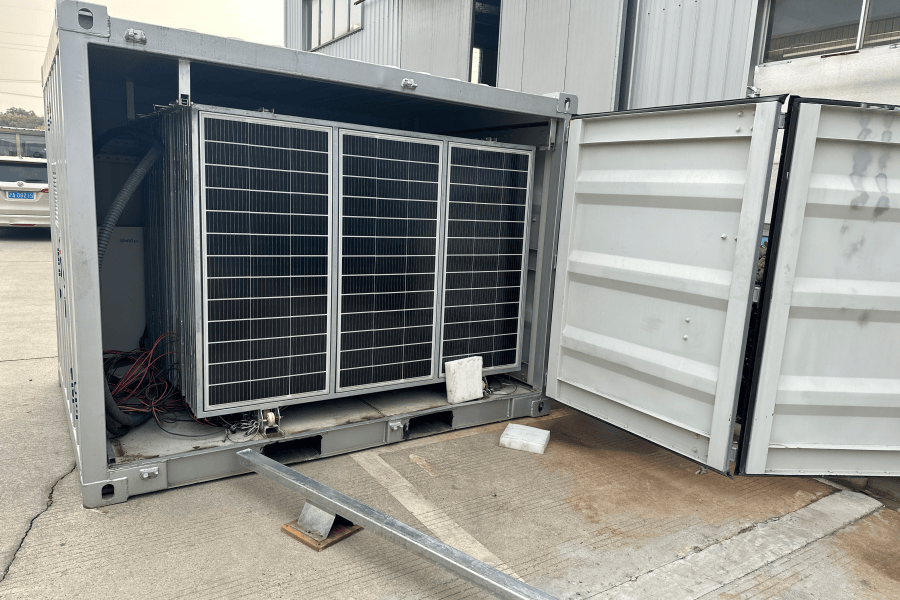
Think of it as a high-performance, plug-and-play energy appliance. The battery racks with built-in liquid cooling plates, the PCS, the transformer, the fire suppression, and the energy management system - all are meticulously engineered and tested to work as one cohesive unit before it leaves the factory. At Highjoule, our design philosophy is to shrink the footprint by over 40% compared to a site-built system. That land you save? It's now available for another revenue-generating activity.
The liquid cooling is the secret sauce. It's like comparing a standard laptop fan to a liquid-cooled gaming PC. It precisely controls each battery cell's temperature, enabling:
- Higher, sustained C-rates: Charge and discharge faster without thermal throttling.
- Longer cycle life: Stable temperatures prevent accelerated aging. We consistently see a 20-30% improvement in projected lifespan.
- Enhanced safety: Eliminates thermal runaway risks far more effectively than air. This isn't just a claim; it's baked into the design certified to UL 9540 and IEC 62933 standards.
The "pre-integrated" part slashes deployment time. I've witnessed a 5 MWh unit go from delivery to commissioning in under two weeks. That's months faster than traditional methods, dramatically reducing soft costs and getting your asset earning revenue sooner.
Seeing is Believing: A Case from the American Southwest
Let me share a scenario from last year. A large manufacturing plant in Arizona wanted to pair their solar PV with storage for peak shaving and backup power. Their challenge? Limited space adjacent to the substation and ambient temperatures regularly exceeding 40C (104F).
A traditional air-cooled BESS would have required a larger concrete pad, expensive HVAC upgrades, and likely derated performance in the summer heat. Instead, we deployed a pre-integrated, liquid-cooled container solution. The compact footprint fit the constrained site perfectly. The liquid cooling system maintained optimal cell temperature even during the desert afternoon peak. The pre-wired, pre-tested nature meant connection was straightforward, and the system met all local interconnection requirements (IEEE 1547 was key here) without hiccups.
The outcome? The client met their critical load backup and demand charge reduction goals, and their finance team was thrilled with the lower total installed cost and faster commissioning timeline. The system's performance data is already validating the lower degradation rate we projected.
Your Checklist for a Future-Proof BESS
So, when you're evaluating solutions for your industrial park, look beyond the basic specs. Ask these questions:
- Thermal Management: Is it passive air, forced air, or liquid cooling? For industrial duty cycles, liquid is becoming the new standard.
- Integration Level: Is it a collection of components or a factory-tested unit? What's the on-site commissioning timeline?
- Standards Compliance: Does it carry the full suite of certifications (UL, IEC) for your market, or will that be a costly site-level hurdle?
- Total Footprint: Include all ancillary space needed. What's the true land cost?
- LCOE Focus: Can the provider model the total cost of ownership over 15+ years, factoring in degradation and maintenance?
The industry is moving fast. The containerized, liquid-cooled BESS is no longer a niche product; it's the logical evolution for efficient, safe, and profitable industrial-scale storage. What's the one site constraint you're facing that a smarter form factor could solve?
Tags: UL Standard BESS LCOE Liquid Cooling Industrial Energy Storage Renewable Energy
Author
James Zhang
20+ years agricultural energy storage engineer / Highjoule CTO