
Wholesale IP54 Outdoor Battery Storage for Remote Island Microgrids
Contents
- The Remote Island Energy Problem: It's More Than Just Price
- The Real Cost of "Cheap" Storage: What I've Seen on Site
- Why an IP54 Outdoor Container Isn't Just a Box, It's Your Foundation
- Looking Beyond the Spec Sheet: The Tech That Actually Matters
- Making It Work: The Nuts and Bolts of a Real Deployment
The Remote Island Energy Problem: It's More Than Just Price
Let's be honest. When you're managing energy for a remote island community or an off-grid industrial site, your challenges aren't the same as a suburban grid-tied system. I've been on those islands C from the Scottish Hebrides to projects in the Caribbean. The air is salty, the humidity is relentless, and the nearest service depot might be a two-day boat ride away. Your primary pain points are brutal: exorbitant diesel fuel costs, grid instability that affects local businesses, and the logistical nightmare of maintaining complex systems in harsh environments.
The promise of solar + storage is a no-brainer. But here's the catch I see too often: projects get fixated on the upfront Wholesale Price of IP54 Outdoor Lithium Battery Storage Container for Remote Island Microgrids as the single deciding factor. That's like buying a boat for a stormy sea based only on its sticker price, without checking if it's seaworthy. The real metric? Levelized Cost of Storage (LCOS) over 15+ years. That includes everything: the initial purchase, the lost revenue from downtime, the cost of emergency repairs, and the eventual replacement.
A report by the International Renewable Energy Agency (IRENA) highlights that for islands, integrating renewables with storage can cut electricity costs by up to 60% versus diesel-only systems. But that potential is only realized if the storage system is built to last in those conditions.
The Real Cost of "Cheap" Storage: What I've Seen on Site
Let me share a story from a microgrid project in the Mediterranean a few years back. The team went with a low-cost BESS enclosure to save capital. It wasn't rated for outdoor coastal use. Within 18 months, salt mist creep had caused significant corrosion on electrical busbars. The thermal management system struggled with the peak summer heat, leading to premature battery degradation. We weren't just looking at a repair bill; we were looking at a full container replacement years ahead of schedule, plus the cost of trucking in temporary diesel gensets during the swap. That "good deal" turned into a financial and operational nightmare.
This is what I mean by agitating the problem. The wrong container isn't a passive box. It's an active risk. It compromises the safety (think thermal runaway in a poorly ventilated, corroding unit), slaughters your efficiency (inadequate cooling forces the system to derate itself), and murders your long-term ROI. For a remote site, downtime isn't an inconvenience; it's a crisis.
Why an IP54 Outdoor Container Isn't Just a Box, It's Your Foundation
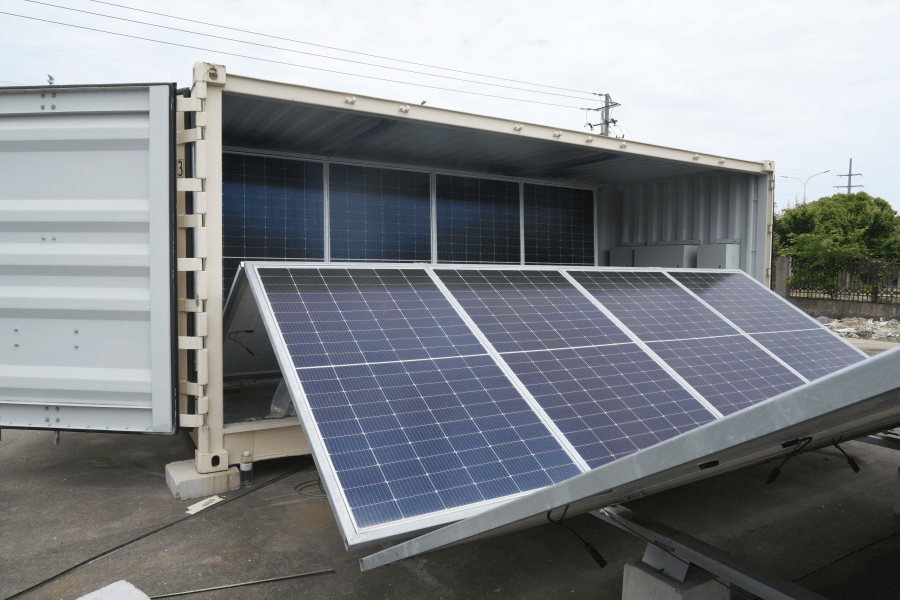
This is where a properly engineered, wholesale-procured IP54 Outdoor Lithium Battery Storage Container shifts from a line-item cost to a strategic asset. The "IP54" code isn't marketing fluff. It's an IEC 60529 standard that means the unit is protected against dust ingress and water splashes from any direction. For coastal, high-humidity, or dusty inland sites, this is your first line of defense.
At Highjoule, when we talk about our containerized solutions for these markets, we're designing for the reality of deployment. It's not just about meeting UL 9540 and IEC 62933 standards for system safety C which is non-negotiable for any credible project in Europe or North America. It's about how those standards are physically embodied. Sealed cable entry points, corrosion-resistant coatings on the steelwork, and positive pressure filtration systems to keep the internal environment clean and dry. Honestly, it's the difference between a system that survives and one that thrives.

Looking Beyond the Spec Sheet: The Tech That Actually Matters
Okay, let's get technical for a minute, but I'll keep it in plain English. When evaluating a container, you need to look under the hood at three things that directly impact your LCOS:
- Thermal Management: This is the heart of longevity. A passive air-cooled system might be cheaper, but for high C-rate applications (that's the speed of charge/discharge) in hot climates, liquid cooling is often a must. It keeps cell temperatures even, preventing hotspots that accelerate degradation. I've seen systems lose 20% of their capacity in 3 years due to poor thermal design.
- Cell Chemistry & System Integration: The container is the house, but the battery cells are the family. Are you using LFP (Lithium Iron Phosphate)? It's the go-to for stationary storage now due to its safety and cycle life. More importantly, how is the Battery Management System (BMS) integrated? It must communicate seamlessly with the power conversion system (PCS) and your energy management software (EMS) for optimal, safe operation.
- Serviceability: Can a technician easily access major components? Are there clear safety disconnects? We design our Highjoule units with service aisles and modular components. On a remote island, you can't have a 4-hour mean time to repair (MTTR) if it takes 2 hours just to disassemble the cabinet to reach a faulty breaker.
A Quick Comparison: The Total Value Perspective
| Consideration | Low-Cost / Generic Container | Engineered IP54 Container (e.g., Highjoule Standard) |
|---|---|---|
| Upfront Cost | Lower | Competitive Wholesale Price |
| Corrosion Protection | Basic paint | Industrial-grade coating, stainless hardware |
| Thermal Management | Often undersized | Climate-matched (air/liquid), prevents derating |
| Safety Certifications | May lack full UL/IEC system cert | UL 9540, IEC 62933 as standard |
| Projected 15-year LCOS | High (downtime, repairs, early replacement) | Optimized (reliability built-in) |
Making It Work: The Nuts and Bolts of a Real Deployment
So, what does a successful deployment look like? Take a project we supported in a microgrid serving a remote research station in Alaska. The challenge: extreme cold, wind, and total logistical self-reliance. The solution wasn't just selling a container. It was: 1. Providing a unit with a pre-integrated, UL-certified system (battery, PCS, EMS) in a single IP54 enclosure rated for Arctic conditions. 2. Offering detailed site preparation guidelines (foundation, cable trenches). 3. Having a local partner trained for basic maintenance, with our remote monitoring and diagnostic support. The system shipped as a "plug-and-play" unit, reducing on-site commissioning from weeks to days C a massive saving when every hour of labor on site is exponentially more expensive.
That's the Highjoule approach. We leverage our wholesale scale to offer robust, standardized container solutions, but we never lose sight of the fact that every site has its unique wrinkles. Our value is in applying 20 years of field experience into the product design upfront, so you don't pay for that learning curve later during operations.

Ultimately, the conversation about the Wholesale Price of IP54 Outdoor Lithium Battery Storage Container for Remote Island Microgrids should end with a question: What is the total cost of ownership for a resilient, safe, and low-maintenance power foundation for the next two decades? If you're evaluating options for a project, what's the one site condition that keeps you up at night C the salt spray, the desert dust, or the extreme temperature swings? Let's talk about engineering for that.
Tags: UL Standard BESS Remote Island Microgrids IP54 Container Lithium Battery Storage
Author
James Zhang
20+ years agricultural energy storage engineer / Highjoule CTO